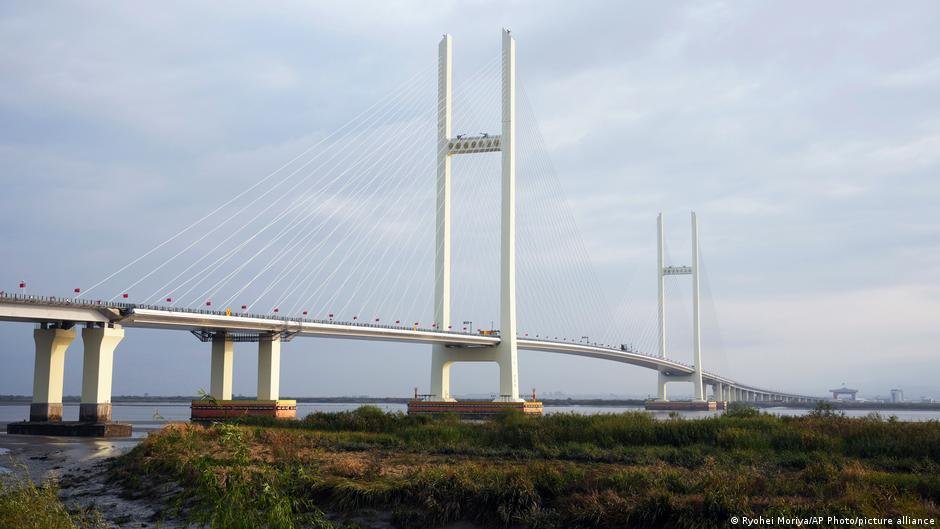
China and North Korea on Thursday officially opened their most significant land border crossing, aimed at rejuvenating trade and commerce after years of strained ties and disruptions.
A ceremony was held to launch the New Yalu River Bridge, Chinese state media Xinhua News reported.
Meanwhile, China News Service showed visuals of trucks adorned with the national flags of China and North Korea on the bridge, which itself was decorated in flags.
Spectators crowded on a road on the Chinese side, in Dandong city, overlooking the ceremony. In Sinuiju city on the North Korean side, work on the approaching road and compound remained unfinished.
‘A new chapter’
The cable-stayed bridge was completed in 2014 but remained unused until now due to lack of connecting roads on the North Korean side, South Korea’s Yonhap News agency reported.
The opening was further delayed by the COVID pandemic which prompted North Korea to close its borders. Train journeys between the East Asian neighbors only restarted in March after six years, but Pyongyang is yet to resume issuing tourism visas to Chinese citizens, which once made up the bulk of its overseas visitors.
The bridge’s opening marks the latest sign of warning ties between Beijing and Pyongyang which have conducted two summits between their leaders in the past year.
“(Bilateral) relations are entering a new phase, embarking on a new chapter,” Chinese Premier Li Qiang said in a video address at the opening, the official Xinhua news agency said.
He added that the border crossing would “strongly promote” economic and trade cooperation and strengthen exchanges between their people.
A conduit for trade
Ahn Chan-il, a researcher originally from North Korea, told the AFP news agency he expected hundreds of vehicles to cross every day.
“The bridge could become a conduit for China’s abundant goods and resources to flow into North Korea and give its economy a significant boost,” he said.
At the same time, experts believe North Korea remains cautious of greater dependence on China.
“The bridge is unlikely to lead immediately to a full-scale return to pre-sanctions trade,” said Lim Eul-chul at Kyungnam University’s Institute for Far Eastern Studies. But it will help move heavy equipment and raw material North Korea needs for development, he said.
China is by far Pyongyang’s largest trading partner despite a series of UN sanctions banning the flow of goods and workers to North Korea over its missile and nuclear weapons program.
Edited by: Natalie Muller
Don’t let the algorithm hide the news. If you rely on our team for trusted reporting, please take a moment to select us as your Preferred Source on Google by clicking here and hitting the “star” or “preferred” button, so you’ll always see our verified news first.