Record dry spells threaten agriculture and the operation of Hungary’s only nuclear power plant. Now volunteers are fighting the drought with artificial beaver dams — a radical new idea in water management.
Image: Marton Monus/REUTERS
Low water levels in Lake Valence, Hungary’s third-largest lake illustrate the extreme summer drought that has led to historic lows in the country’s waters. For the first time, the Paks nuclear power plant, Hungary’s only nuclear reactor, had to be shut down in the summer because there was not enough water in the Danube for cooling. The result was a massive energy crisis.
Image: Marton Monus/REUTERS
Members of the volunteer organization “Water Guardians” have been digging ditches near Budapest so that the land can retain rainwater better. Across the country, hundreds of volunteers are helping build structures like these to restore wetlands, helping Hungary better adapt to climate change.
Image: Marton Monus/REUTERS
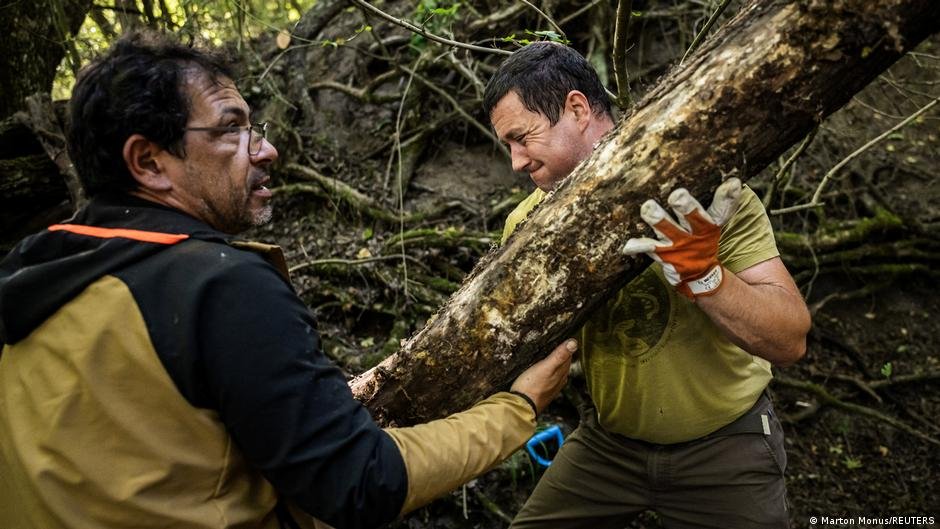
The “Water Guardians” build beaver dams over streams and watercourses in order to dam even small trickles and keep the precious water in the landscape. They’re hoping to prepare Hungary for what is likely to be an even hotter and drier future. The country is experiencing its worst drought crisis in 126 years.
Image: Marton Monus/REUTERS
It’s not just volunteers who are helping with restoration. The government announced in August that it would prioritize “natural water retention methods” — a radical turnaround from the previous government’s water management. Almost a quarter of Hungary lies in flood plains, and for decades, wetlands have been drained and rivers straightened in order to open up more land for agriculture.
Image: Marton Monus/REUTERS
Agriculture, one of the main pillars of the country’s economy, is now being hit hardest by the drought. The Hungarian central bank said the drought damage would reduce economic growth by 0.4 percentage points in 2026. There was already a drought in Hungary last year. Some river and lake beds are now completely dry, like this one.
Image: Marton Monus/REUTERS
Even in the winter there was no rain. Farmer Oszkar Nagyapati, a member of the “Water Guardians,” had to fill water troughs for forest animals in December 2025. “We have straightened our rivers, causing them to flow faster and drain nearby groundwater,” Diana Ürge-Vorsatz, a professor at the Central European University in Vienna, told Reuters.
Image: Marton Monus/REUTERS
Many farmers have now given up water-intensive cultivation of corn. Researchers are testing drought-resistant crops, such as this industrial hemp, in a laboratory at the MATE University in Godollo, Hungary. But according to Ürge-Vorsatz, the most important thing is to “restore the original natural conditions as much as possible in order to maintain groundwater in winter and spring.”
Image: Marton Monus/REUTERS
Forestry engineer Bence Bardos (his back to the camera) inspects a dam built by the “Water Guardians.” The drought is the result of man-made climate change and Hungary’s geographical location in the Carpathian Basin. There is little that can be done about that, but Bardos hopes to be able to at least improve the situation through small steps, he told Reuters.
Image: Marton Monus/REUTERS8 images1 | 88 imageshttps://p.dw.com/p/5OAa2