Skip next section What you need to know
What you need to know
- French Prime Minister Sebastien Lecornu said adequate support for police was essential, both to allow public protests and to keep the peace
- He accused ‘ultra-left and extreme left’ groups of planning to escalate and politicize the unrest as part of an ‘insurrectionary plan’
- France was rocked over the weekend by some of its worst rioting in recent years over amid anti-government protests
- Curfews on Monday night helped restore calm, Lecornu said, with more planned as necessary going forward
- Italy’s Meloni considers curfew, tougher youth detention rules, after Milan riots
- Albania’s PM says ‘red line’ was crossed during anti-government demos and clashes
Follow below for the latest on the protests and unrest in France and other parts of Europe on Tuesday, October 20:
Skip next section France’s Lecornu accuses ‘far-left’ of ‘insurrectionary plan’ to escalate protests10/20/2026October 20, 2026
France’s Lecornu accuses ‘far-left’ of ‘insurrectionary plan’ to escalate protests
Prime Minister Sebastien Lecornu has told French lawmakers that authorities would mobilize a “massive” security presence next weekend, after organizers announced plans for new protests.
“The deployment for next Saturday will be massive,” Lecornu said in the National Assembly.
He said the security operation last weekend had been “too static and not mobile enough.”
Lecornu said adequate support for security forces was “the precondition for everything” when trying to both allow peaceful protests but also keep order, saying that “1,000 injured police and gendarmes over the weekend” nationwide was unacceptable.
Lecornu said the national public message in response should convey to them “clear, frank and massive support.”
The prime minister also accused what he referred to as small ultra-left and extreme-left groups in certain locations of forging an “insurrectionary plan” that fueled the violent rioting over the weekend for which the government could provide evidence.
“What happened at the mayoral office of Limoges was an example. You have a first arrest that was carried out this morning,” Lecornu said. “This individual arrested is, unfortunately, already known to [security] services.”
He said authorities would not tolerate such groups “marching on the Elysee or Matignon,” referring to the offices and residences of President Emmanuel Macron and himself as head of government, and saying that some of these groups had harbored such ambitions.
https://p.dw.com/p/5OTZKSkip next section Paris police set up reporting platform for violence, damage, looting10/20/2026October 20, 2026
Paris police set up reporting platform for violence, damage, looting
The Paris police prefecture has launched an online portal inviting people to upload evidence of criminal unrest over the weekend.
“Withness to violence, damage, or looting in recent days? The [Paris police prefecture] has decided to create a dedicated platform,” it wrote online.
It urged people who thought they might have relevant information not to delay.
“Send all your images to the police services to help them quickly identify and apprehend the perpetrators,” police said.
https://p.dw.com/p/5OTScSkip next section Italy plans to facilitate detention of minors in response to unrest10/20/2026October 20, 2026
Italy plans to facilitate detention of minors in response to unrest
Italy will approve new security measures targeting minors on Tuesday, government politicians said, after days of unrest in several cities, but particularly in Milan.
Under the planned rules, authorities will be authorized to detain people under the age of 18 for up to 12 hours, even if they have not committed a crime, provided there is evidence they pose a threat, Deputy Prime Minister Matteo Salvini said.
“We want to intervene quickly on young people,” Salvini told the RTL radio broadcaster ahead of a meeting of Prime Minister Giorgia Meloni‘s Cabinet called on Tuesday to approve the measures.
Rome is also expected to deploy an additional 500 army troops in Milan as authorities fear more widespread unrest at demonstrations planned for Saturday.
The French student and youth protests first showed signs of spilling into Italy on Friday, with initially peaceful events coinciding with the pre-existing anti-government protest magnet known as “No Meloni Day.”
The unrest persisted and intensified heading into the weekend as several hundred hooded individuals, many of them thought to be minors, set fires and looted shops in the centers of Milan and other cities.
Meloni has passed a steady stream of security and law-and-order crackdowns since taking office in 2022, visible among other places in the prison population increasing by almost one-fifth, or around 10,000 people, over four years.
https://p.dw.com/p/5OTOQSkip next section French police arrest man over Limoges town hall fire10/20/2026October 20, 2026
French police arrest man over Limoges town hall fire
French authorities have arrested a 40-year-old man in connection with the fire that destroyed the historic Limoges town hall during unrest over the weekend.
The building, dating from 1883, was engulfed by fire on Saturday. Its roof and belfry collapsed, making the building’s destruction a symbol of the violence that accompanied nationwide protests.
The suspect was arrested by RAID, France’s elite police unit, near Limoges. Prosecutors say he had previously been flagged as a potential security threat.
France’s Counter-Terrorism Sub-Directorate has joined the investigation, while Justice Minister Gerald Darmanin says anti-terror prosecutors will decide whether to classify the case as a terrorist act.
https://p.dw.com/p/5OSkqSkip next section Dott, Lime count losses after Paris protesters burn shared e-Bikes10/20/2026October 20, 2026
Dott, Lime count losses after Paris protesters burn shared e-Bikes
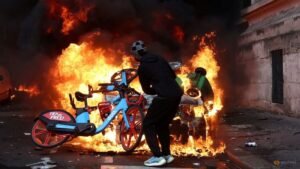
In Paris, sights of e-bikes thrown into burning piles became a common sight over the weekend, prompting bike makers Dott and Lime to asses their losses.
Shared mobility operator Dott, in a statement to Reuters on Monday, said that about 300 of its electric bikes were destroyed and 120 severely damaged in Paris, during the nationwide anti-government protests on Saturday. The company has about 6,000 bikes int he city.
Dott also said 80 vehicles, including bikes and scooters were destroyed in Bordeux and another 30-40 Scooters in Lyon. It estimates the damage at about €400,000 ($450,000).
Lime, another entity for shared electric bikes, said 6% of its Paris fleet was destroyed or damaged.
Ahead of demonstrations, Lime said it worked with the police to remove vehicles from designated protest routes and restricted parking or riding in high-risk areas.
Smovengo, operator of the Vélib’ Métropole bike-sharing service in Paris, told Reuters that some 300 of its 20,000 bike fleet were damaged or stolen over the weekend.
E-bikes often use lithium-ion batteries that can ignite and produce intense fires and toxic smoke.
There was no indication that e-bike operators were specifically targeted during the protests. Rather, their ready availability likely played a role as protesters used them to build barricades or build fires.
https://p.dw.com/p/5OSAiSkip next section France to impose ‘targeted curfews’ wherever necessary, says PM10/20/2026October 20, 2026
France to impose ‘targeted curfews’ wherever necessary, says PM
Francewill impose new curfews in areas where they are required, Prime Minister Sebastien Lecornu said Tuesday after the first night of partial curfews in major cities including Paris.
Lecornu said the targeted curfews had helped keep the peace overnight after a turbulent weekend that saw protesters take aim at state institutions.
“Targeted curfews have contributed to calm overnight,” the premier wrote on X. “Tonight new curfews will be decided where the situation requires it. These decisions will be made on the ground, by the prefects, in coordination with the Mayors,” he said.
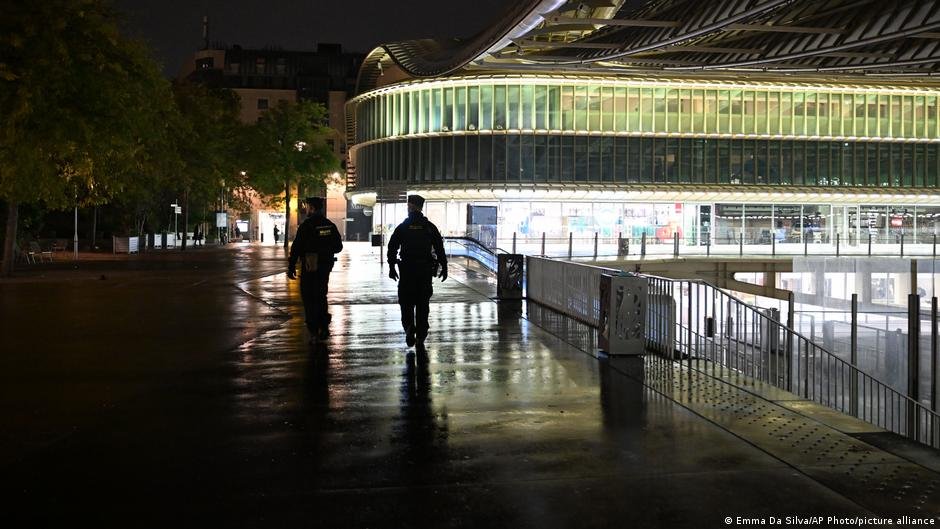
Police confirmed the night had passed without major incidents across France.
https://p.dw.com/p/5ORyVSkip next section Trump blames immigrants, Muslims, for French unrest in attack on Democrats10/20/2026October 20, 2026
Trump blames immigrants, Muslims, for French unrest in attack on Democrats
US President Donald Trump on Monday cited the unrest in France as an example while warning of what he alleged could happen in the United States if opposition Democrats were in power, without providing evidence to support the claim.
At a rally supporting the Republican Senate candidate in Kansas, Trump described France as a formerly great nation that had been “conquered, looted, and burned to the ground by migrants, jihadists and communists.”
“When you see burning steeples and raging fires in France, just remember that is what the radical Dumocrats want to do to America,” he said, using the altered version of his opponents’ name that he often employs as an insult.
Ahead of the rally, Trump told reporters at the White House that he had warned French President Emmanuel Macron he was “making a big mistake.”
“The whole world was coming in, and as you know, Paris is going to be a Muslim city very soon, and that wasn’t the deal,” he said, adding: “We closed our borders. He didn’t.”
The US president’s return to his signature anti-immigration, anti-Muslim rhetoric, which he used to some effect in his election campaigns, comes as his party seeks to avoid a drubbing in the November midterm elections.
His comments echo previous remarks by Republican colleagues. Vice President JD Vance, for example, argued that the French protests occurred because “Western liberals imported the third world into France.”
https://p.dw.com/p/5ORmvSkip next section A turbulent weekend in France: How did it come to be?10/20/2026October 20, 2026
A turbulent weekend in France: How did it come to be?
Jared Reed
Catherine Field, a journalist in Paris, told DW why demonstrations were different this time. Protests markedly sprang up in different parts of the capital city and elsewhere, particularly taking aim at state institutions. Police appeared to have lost some sense of control, she said. Listen to the full conversation here:
https://p.dw.com/p/5ORg9Skip next section READ: What has the French government said about the rioting in France?10/20/2026October 20, 2026
READ: What has the French government said about the rioting in France?
French President Emmanuel Macron has vowed to punish those responsible for the rioting and violence over the weekend.
He also acknowledged “failures in anticipation and intelligence” by police and sought to make clear the distinction between rioters and demonstrators.
https://p.dw.com/p/5ORfzSkip next section Are there more protests planned in France?10/20/2026October 20, 2026
Are there more protests planned in France?
The answer is yes. French unions have called for a new round of rallies on November 5.
Earlier on Monday, French President Emmanuel Macron blamed organized ultraleft groups for the rioting and looting on Saturday.
Prime Minister Sebastien Lecornu said after an emergency cabinet meeting on Monday that he was “fully resolved to restore public order.”
He called for imposing localized curfews, as is in place overnight into Tuesday (see below), but said there was “no question” of imposing a full curfew on entire cities.
But Lecornu refused to rule out declaring a state of emergency, which would give authorities sweeping powers to restrict public gatherings.
https://p.dw.com/p/5ORe7Skip next section Where are curfews in place in France?10/20/2026October 20, 2026
Where are curfews in place in France?
Authorities in France have announced localized curfews in several areas including:
- In northern France, including Lille, Douai, Denain and Wattignies, a curfew for minors is in place for the next two days from 8 p.m. (1800 GMT) to 6 a.m.
- In the south, including Nice, where a specific curfew is in place for minors in the city center.
- Two areas in Paris, where curfew prohibits anyone from entering or remaining on the Place de la République, where rioting took place Saturday, and the shopping neighborhood of Les Halles, which has been subject to looting.
- The partial curfew in Paris went into effect at 11 p.m. Monday and remains in place until 6 a.m. Tuesday.
https://p.dw.com/p/5ORe6Skip next section Foreign governments issue France travel warnings 10/19/2026October 19, 2026
Foreign governments issue France travel warnings
Several countries around the world, including China, Malaysia, Germany and the United States, have advised citizens traveling to France to avoid large crowds and exercise caution in the wake of large-scale protests and looting in major cities.
China’s Foreign Ministry urged Chinese nationals in France to remain alert to potential risks, increase safety precautions, and avoid areas where demonstrations are taking place.
Malaysia’s Ministry of Foreign Affairs said that, while travel to France remains unrestricted, Malaysians are advised to consider postponing non-essential trips until the situation improves.
The Malaysian embassy in Paris has issued an advisory urging citizens already in France to exercise caution and remain vigilant.
The US State Department issued an alert on Monday warning Americans to avoid demonstrations in major French cities, while an alert issued by the American embassy in Paris noted new curfews ordered in cities including Paris and Lille.
“Avoid the areas of the demonstrations,” the warning said.
And in Europe, some of France’s direct neighbors have also issued travel advice to citizens.
The German Foreign Ministry said further riots couldn’t be ruled out and urged German nationals to follow instructions from local police. It warned citizens that they could face fines if they fail to adhere to requests to leave unauthorized demonstrations.
Governments in the Czech Republic, the Netherlands, Poland, Denmark, Sweden, Finland and Norway also issued warnings to avoid protests.
https://p.dw.com/p/5ORYVSkip next section Albania: Prime Minister Rama says protesters crossed ‘red line’10/19/2026October 19, 2026
Albania: Prime Minister Rama says protesters crossed ‘red line’
Albanian Prime Minister Edi Rama said on Monday that protesters had crossed a “red line” after a police station was set ablaze during anti-government demonstrations.
“Protests are a right, whereas violence is a crime,” Rama wrote on social media. “This red line must be drawn clearly at this critical stage of our democratic development.”
Demonstrators in Albania have been clashing with police since last Tuesday after months of protests over university conditions and political corruption came to a head.
Fresh unrest broke out again in the capital Tirana on Monday evening, with protesters throwing Molotov cocktails at the interior ministry and riot police responding with water cannons, tear gas and rubber bullets.
Prime Minister Rama said he was prepared to engage in dialogue, but not with those who commit violence or political parties which fail to distance themselves from it.
“Violence is not a solution, but the government also needs to reflect deeply to understand this revolt,” one 22-year-old student protester told the AFP news agency.
“We are not criminals; we want social peace and better living conditions in our country. We will continue our movement until Rama resigns.”
Around 300 people have reportedly been injured in the clashes, according to local authorities, more than half of them police officers.
Police said they detained 68 people in Sunday’s unrest in Tirana, of whom 22 will face prosecution.
https://p.dw.com/p/5ORU2Skip next section Italy’s Meloni considers curfew after Milan riotPublished 10/19/2026Published October 19, 2026last updated 10/19/2026last updated October 19, 2026
Italy’s Meloni considers curfew after Milan riot
Italian Prime Minister Giorgia Meloni was also considering imposing curfews and other measures on Monday night in response to rioting in several Italian cities over the weekend.
Meloni convened an emergency Cabinet meeting to discuss her government’s response, with local media reporting that emergency decrees could be passed as early as Tuesday.
Italy‘s ANSA news agency reported that the government intends to “respond decisively” after days of peaceful protests against the high cost of living descended into riots and looting in cities including Milan, Turin and Bologna.
On Milan’s central cathedral square, young people dressed in black and wearing masks smashed shop windows and looted supermarkets. At least 14 security personnel were injured, according to official figures, with Milanese prosecutors speaking of “rare violence.”
In total, more than 270 people were detained, most of them minors.
Many luxury stores in central Milan remained closed on Monday as Italian media drew comparisons with events in France.
Hard-right Prime Minister Meloni has governed in Rome for four years at the head of a coalition of right-wing and conservative parties. Parliamentary elections are due to be held next year.
https://p.dw.com/p/5ORU4Skip next section France: Curfews imposed in parts of Paris, Lille, NicePublished 10/19/2026Published October 19, 2026last updated 10/19/2026last updated October 19, 2026
France: Curfews imposed in parts of Paris, Lille, Nice
French authorities imposed curfews in parts of several cities on Monday night in response to criticism over security failings after cost-of-living and anti-government protests descended into rioting and looting over the weekend.
In the capital, Paris, police issued a curfew around the Place de la Republique and Les Halles from 11 p.m. until 6 a.m. local time (9:00 p.m. to 04:00 UTC) on Tuesday morning, while protests were banned in certain other areas from 8 p.m.
“A police deployment is in place to ensure strict compliance with these measures,” read a police statement.
On France’s south coast, the mayor of Nice signed an order installing a curfew for minors in the city center overnight while nearby Marseille also banned gatherings and demonstrations.
Sources in Prime Minister Sebastien Lecornu’s office told the Reuters news agency that curfews had also been set for minors between 8 p.m. and 6 a.m. over the next two days in the northern city of Lille and the nearby towns of Douai, Wattignies and Denain with the agreement of local mayors.
“My determination to restore order is absolute,” Lecornu told reporters, ruling out blanket curfews in Paris but not a potential state of emergency.
To view this video please enable JavaScript, and consider upgrading to a web browser that supports HTML5 video
https://p.dw.com/p/5ORU0Show more posts