Skip NavigationMarketsBusinessInvestingTechPoliticsVideoWatchlistInvesting Club PRO
PRO LivestreamMenu
- Venture firms are taking a new strategy in artificial intelligence, buying legacy companies and rebuilding them around AI.
- The bet puts VCs on offense and leaves traditional private equity on defense.
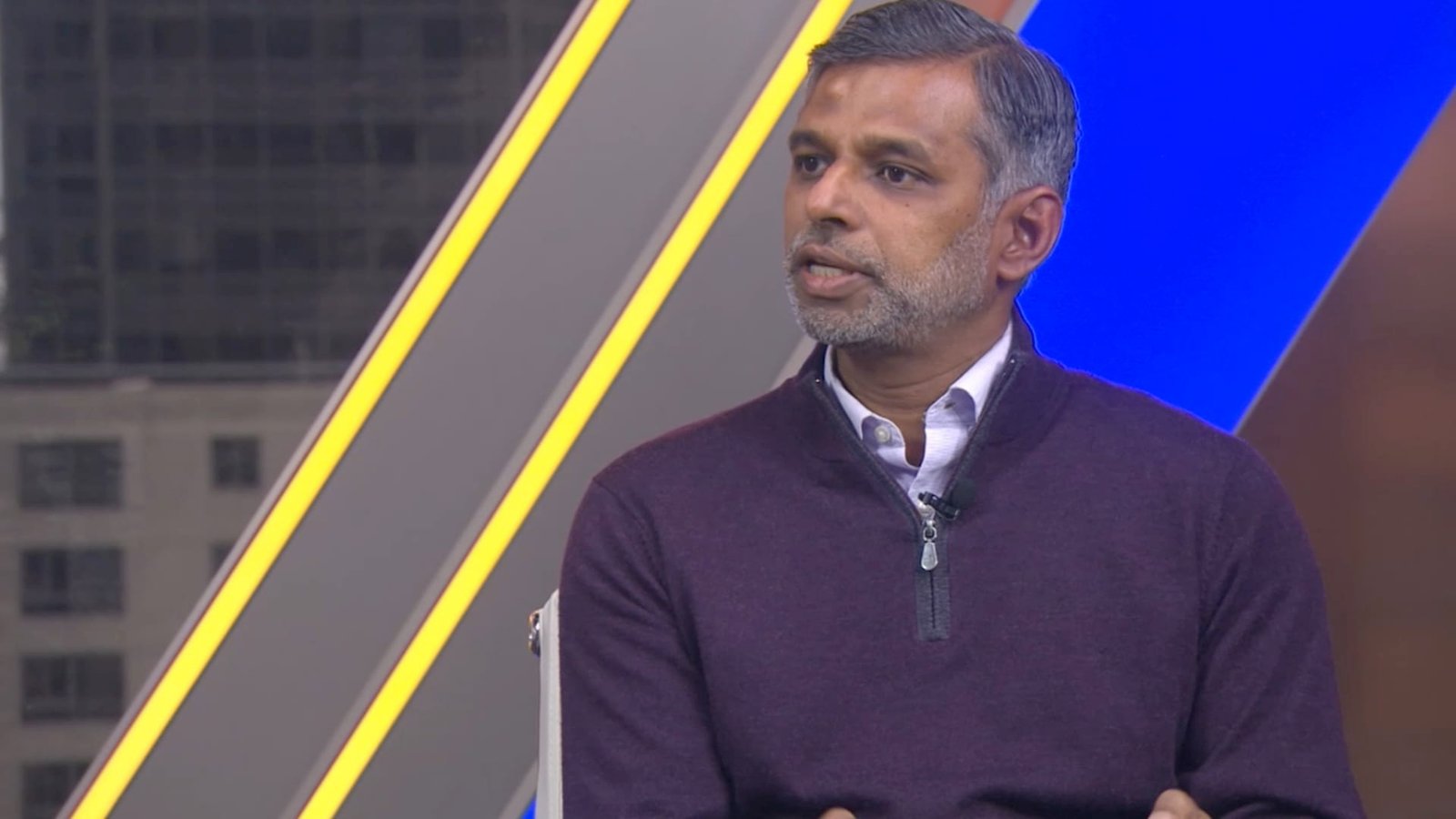
- General Catalyst managing director Madhu Namburi calls it “service as software.”
 watch nowVIDEO07:20The AI rollup: Silicon Valley’s new buyout playbook is hitting Wall StreetTech
Venture capital is buying its way into the artificial intelligence transformation that enterprise software hasn’t delivered. Instead of selling AI tools to companies, venture firms are buying legacy companies outright and rebuilding them around AI from the inside.
The bet puts VCs on offense and leaves traditional private equity, which spent the last cycle buying enterprise software at peak prices, on defense.
In Silicon Valley, the strategy is known as the AI rollup. Over the past six months it’s crossed into public markets twice: General Catalyst and Trian’s $7.6 billion take-private of Janus Henderson (JHG) in December, and Long Lake Management’s $6.3 billion agreement in May to take American Express Global Business Travel (GBTG) private at a 65% premium.
General Catalyst managing director Madhu Namburi calls it “service as software.” It’s a take on software-as-a-service, or SaaS, which made software companies highly profitable because growth didn’t require growing costs. AI rollups apply the same logic to services businesses.
Venture firms have been running the playbook since 2023, mostly inside the private market. General Catalyst — which backs Long Lake alongside Alpha Wave – has co-created roughly a dozen of these rollup vehicles.
Joshua Kushner’s Thrive Capital runs Thrive Holdings with the same model and more than $1 billion in capital. It’s put that money to work, recently backing an AI rollup of regional accounting firms. Lightspeed and Andreessen Horowitz are in the mix too, though it’s early for them. The targets share a common feature. They’re in industries where software adoption has lagged: healthcare, accounting, insurance, customer service, property management, construction.
That also changes who can do these deals. Traditional private equity is built around financial engineering — taking a fixed cash flow, leveraging it, squeezing margins. The AI rollup is built around growth — AI scales customer-facing teams, reinvested cash funds more acquisitions. It’s a twist on the venture model, essentially applying the growth mindset to established companies. Long Lake plans to hold the companies permanently, the strategy employed by Berkshire Hathaway.
Long Lake is the clearest example of what the bridge to effective AI deployment looks like. Three years old, the company has acquired more than 30 businesses across HOA management, construction, and now corporate travel. It runs a proprietary AI platform called Nexus, tuned for the specific workflows of each industry that frontier labs aren’t initially targeting.
Alex Taubman, Long Lake’s CEO, says Nexus performs five times better than general purpose models like Claude or ChatGPT on his firm’s internal evaluations. Beyond the technology, the bet is that owning the company and embedding engineers inside it for years makes the change durable. Most of Long Lake’s engineers came from Ramp and Palantir, where engineers work on site with customers for months at a time.
Traditional private equity made the opposite bet. It spent the early 2020s buying enterprise software at peak multiples on the thesis that recurring SaaS revenue was the most defensible cash flow in business. Deals included Vista’s purchase of Citrix, Thoma Bravo’s acquisition of Anaplan and Coupa, and Silver Lake buying Qualtrics. Three years later, those companies are the ones most exposed to AI disruption.
The recently announced partnerships between Anthropic and Blackstone, Hellman & Friedman, and Goldman Sachs — and a parallel venture with OpenAI backed by Apollo and General Atlantic — are the response. They’re bringing frontier models into the portfolios already on the books. But it looks more like a consultant’s attempt at the deployment problem. Someone else’s AI, deployed into someone else’s company, by people who don’t own either.
Two things could go wrong for the VC model. The first is returns. Operating companies historically produce returns of 100% to 200% over a long hold, not the 10x math venture funds often promise. Pension funds and endowments that wrote checks for venture exposure may end up with something closer to private equity. The second is execution. Vista and Thoma Bravo spent decades building operating teams to run the companies they took private. Venture firms write checks into startups. Taubman’s defense: “Three years in AI is actually like three decades of pre-AI.”
The next take-private cycle is already starting, and it isn’t in software. It’s in the boring non-tech companies underneath it.