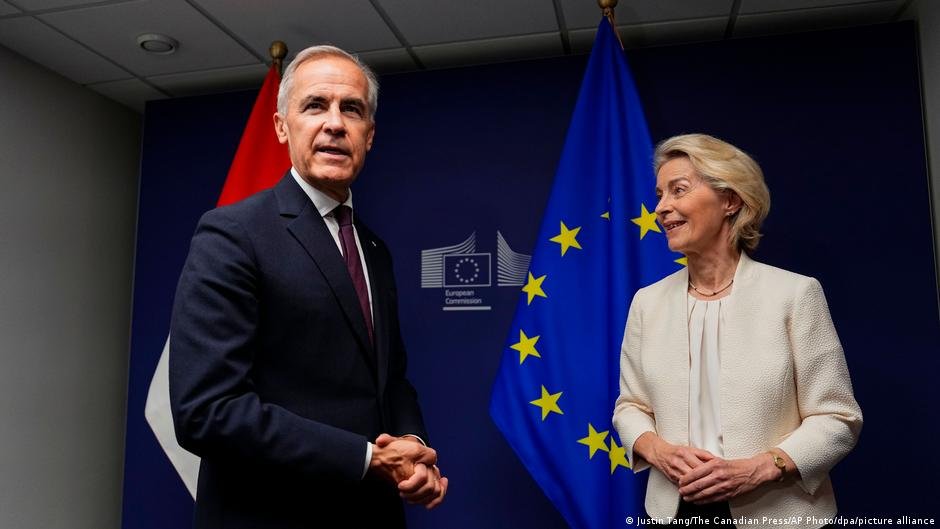
European Union member states have blocked a proposal by European Commission President Ursula von der Leyen to grant Canada a special status as an “associate member” of the bloc.
German Chancellor Friedrich Merz and several other EU leaders pushed to remove the term from a draft declaration ahead of a two-day EU-Canada summit beginning Thursday in Montreal, according to diplomats cited by the dpa and AFP news agencies.
Instead, the revised document calls for a plan to establish “closer ties” between Canada and the EU without membership.
The declaration was approved by EU member states on Wednesday evening and is expected to be published on Friday, at the end of the summit.
Canadian Prime Minister Mark Carney, von der Leyen, European Council President Antonio Costa and several EU commissioners are attending the talks.
Why did EU countries oppose Canada’s associate membership?
Von der Leyen first proposed making Canada the EU’s first “associate member” in September during a speech attended by Carney.
To view this video please enable JavaScript, and consider upgrading to a web browser that supports HTML5 video
However, the proposal raised questions among member states because existing EU treaties do not provide for such a status.
Diplomats said several governments were concerned about the lack of clarity surrounding the proposed arrangement and insufficient consultation between the European Commission and EU member states.
Germany, France and Italy were among the countries that raised objections, although they broadly support closer cooperation with Canada.
Another concern was that the term “associate membership” had already been used in discussions about Ukraine‘s potential accession to the EU.
Merz had previously suggested such a status for Ukraine as an intermediate step toward full membership. Under his proposal, Kyiv could participate in EU summits and ministerial meetings without voting rights.
Von der Leyen, however, used the same term to describe a different arrangement for Canada, a country that does not have a legal path to EU membership.
An earlier draft of the summit declaration would have allowed Canada to participate in consultations on major EU political and regulatory initiatives as an associate member.
It also called for the full scope of the arrangement to be defined by the 2027 EU-Canada summit.
Carney, meanwhile, played down the dispute over the wording of the summit declaration.
He said the precise terminology mattered less than the practical benefits closer cooperation would bring to Canadians.
What will closer EU-Canada cooperation involve?
Despite the disagreement over terminology, both sides intend to significantly deepen their partnership.
The revised declaration focuses on an “Alliance for the Future,” a term Carney has frequently used to describe relations between Canada and the EU.
The initiative aims to remove trade barriers, facilitate investment and secure supplies of critical raw materials, medicines and technologies during crises.
To view this video please enable JavaScript, and consider upgrading to a web browser that supports HTML5 video
Both sides also want to strengthen cooperation on energy, climate protection, artificial intelligence, security and education.
Canada could gain broader access to EU programs covering research, education and defense.
A new economic council is planned to bring together businesses from both sides of the Atlantic.
The declaration also calls for a study into the feasibility of increasing Canadian liquefied natural gas exports to Europe.
However, EU governments watered down several economic commitments in the original draft.
An explicit goal of deeper financial market integration was removed. Instead of promising preferential treatment in economic security measures, both sides now intend to limit potential negative effects on each other.
How has Donald Trump affected EU-Canada relations?
The push for closer ties comes amid growing uncertainty over relations with the United States under President Donald Trump.
Trade disputes, US tariffs and Trump’s territorial claims have raised concerns in both Canada and Europe about Washington’s reliability as a partner.
Both sides hope that closer cooperation will help reduce their dependence on other countries and strengthen their ability to pursue common interests.
To view this video please enable JavaScript, and consider upgrading to a web browser that supports HTML5 video
Trump previously dismissed the idea of Canadian associate membership in the EU as ridiculous.
He also threatened consequences if the arrangement harmed US interests, warning that he could impose high tariffs or halt trade with Europe in several sectors.
Edited by: Sean Sinico
If you rely on our team for trusted reporting, please take a moment to select us as your Preferred Source on Google, so you’ll always see our verified news first.