An emperor’s plea and journalist’s final act: As fascism spread, the League of Nations became the stage for two warnings that foreshadowed the collapse of the international order ahead of World War II.
Image: TT/IMAGO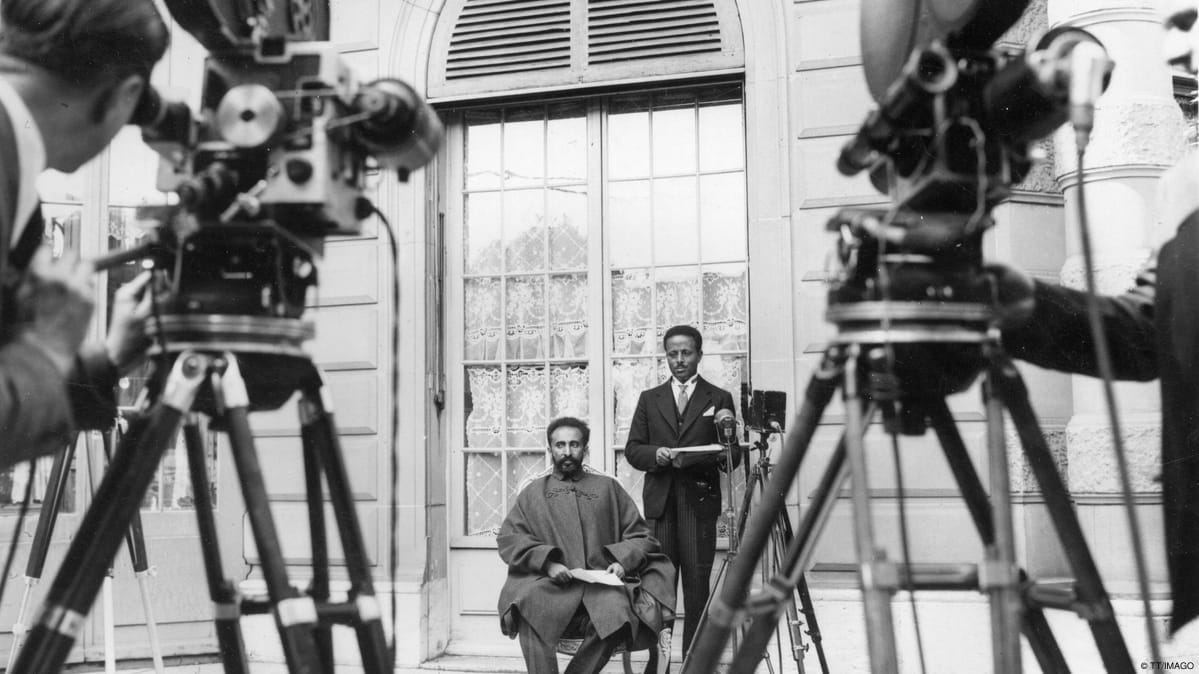
On June 30, 1936, Emperor Haile Selassie stood before the League of Nations in Geneva to denounce Italy’s war of aggression on Ethiopia, then known as Abyssinia. He appealed to the international community to uphold international law. During his speech, he said the famous words: “It is us today. It will be you tomorrow.” Few listened. Just three years later, Germany started World War II.
Image: GRANGER Historical Picture Archive/IMAGO
Back to 1936, just three days after Selassie’s historic speech, a desperate act stunned the League of Nations. Slovak Jewish journalist Štefan Lux shot himself in front of the lectern during a debate to protest the persecution of Jews in Nazi Germany. Against the backdrop of a weakening League of Nations and a Europe sliding toward extremism, he hoped to awaken the world’s conscience.
Image: Arnold Hahn/Public Domain
Italy’s 1935 invasion of the Ethiopian Empire combined colonial conquest with modern warfare. Italian forces deployed chemical weapons, including mustard gas, which was prohibited under international law. The bombing of military installations, as well as villages, military hospitals and civilians, caused hundreds of thousands of deaths.
Image: UIG/IMAGO
The brutality of Italy’s war in Ethiopia sparked anti-colonial protests around the world and helped unite a growing network of activists from Africa, the Caribbean, India, and the United States. In August 1935, Trinidadian intellectual C. L. R. James, chairman of the International African Friends of Abyssinia, warned a crowd of 500 people in London of an impending Italian attack on Abyssinia.
Image: Keystone France/Gamma-Keystone/Getty Images
For many anti-colonial thinkers of the 1930s, Italy’s invasion of Ethiopia revealed a connection: colonialism and fascism were not separate phenomena but different expressions of the same violence. What Europe was witnessing under fascism, they argued, was colonial brutality returning to the continent itself.
Image: CAF/dpa/picture-alliance
Created in 1920 in the aftermath of World War I to prevent future conflicts, the League of Nations lost credibility in the 1930s. Lacking its own military force, it failed to stop aggression by Japan, Italy, and Nazi Germany. As nationalism and militarism spread, its authority weakened. It was formally dissolved in 1946, when its responsibilities were transferred to the United Nations.