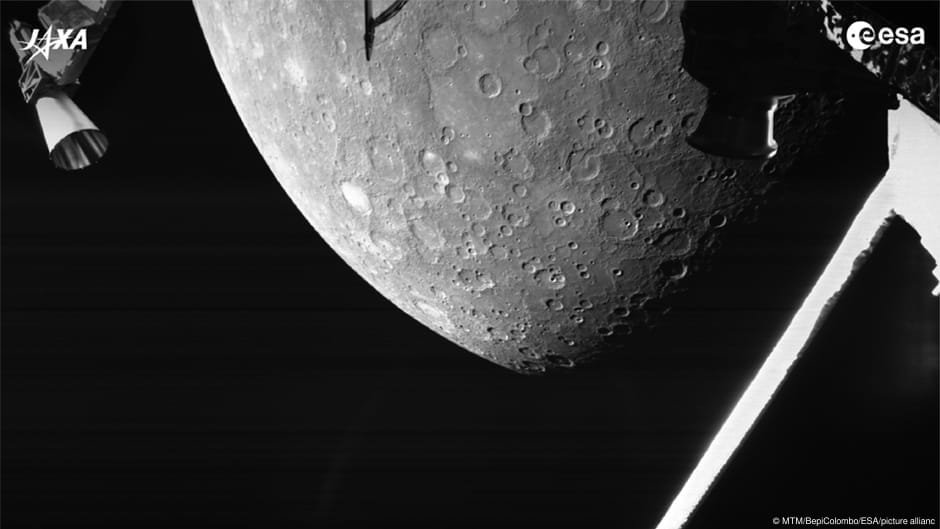
Humans still know very little about Mercury, the planet closest to the sun. It’s hoped BepiColombo, a European and Japanese space probe, will reveal the planet’s secrets, with science operations starting in 2027.
Image: MTM/BepiColombo/ESA/picture allianc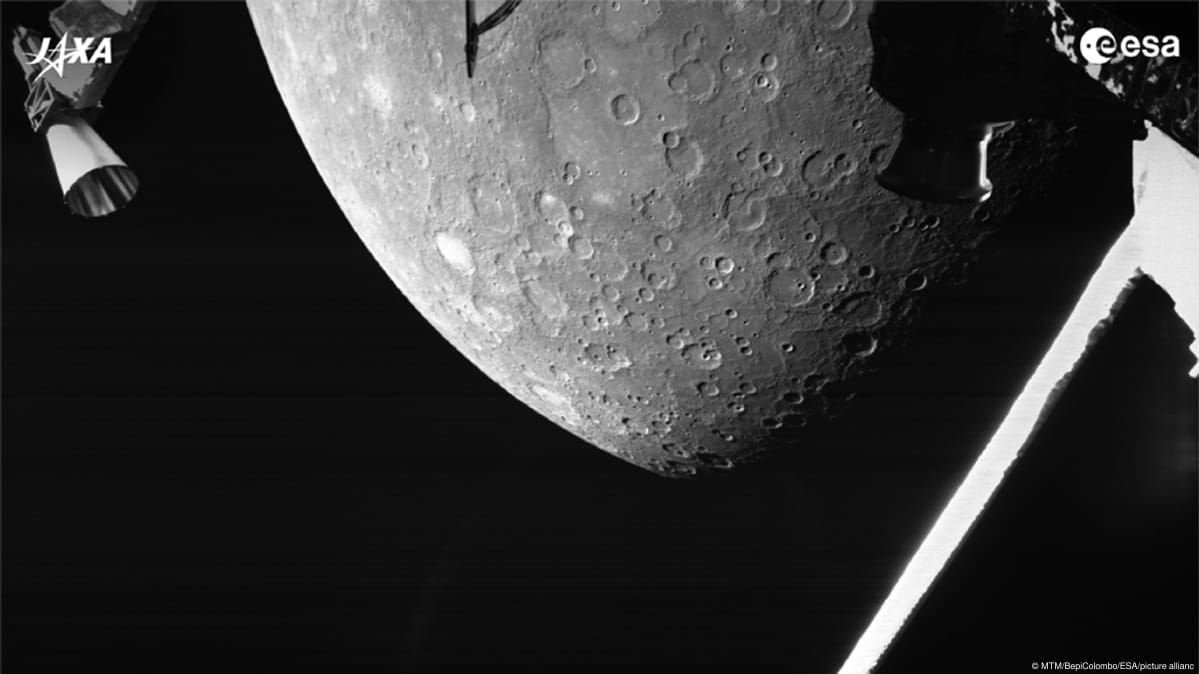
Named after an Italian engineer, Guiseppe “Bepi” Colombo, the spacecraft survived eight long years on its way to Mercury. It has completed six “flybys” of the planet, the closest to our sun. The probe consists of two satellites — the European Mercury Planetary Orbiter (MPO) and the Japanese Mercury Magnetospheric Orbiter (MMO). Scientific operations are due to begin in April 2027.
Image: ATG Medialab/ESA/picture alliance
Spacecraft fly by planets because the planet’s gravitational pull helps them change trajectory and speed. In BepiColombo’s case, the spacecraft flew by Mercury to get closer to and then enter the planet’s orbit. In fact, it performed a total of nine flybys, including Earth and Venus, to avoid the sun’s mighty pull. Flybys are also known as “swing-by manoeuvres” and “gravity-assist flybys.”
Image: ESA
To date, only two space probes have come close to Mercury. The last one was the NASA probe Messenger. It orbited the planet more than 4,000 times and sent more than 250,000 images back to Earth. A planned crash landing in 2015 due to lack of fuel saw the end of the Messenger mission.
Image: picture-alliance/dpa
Although we know very little about Mercury, we do know it has extreme temperature differences. It is uninhabitable — the sun rises there only once every 176 Earth days.
Image: picture-alliance/dpa
Mercury’s neighbor, Venus, is much hotter, even though it is farther from the sun. The reason is that Mercury has no atmosphere, so heat leaves the planet as thermal radiation. Temperatures vary from 430 degrees Celsius (806 degrees Fahrenheit) to minus 180 C.
Image: Reuters/NASA/Johns Hopkins University Applied Physics Laboratory/Carnegie Institution of Washington
BepiColombo captured this image of Venus on its second and final flyby in August 2021. The probe also investigated Venus’ atmosphere and found carbon ions escaping the planet. And because carbon ions usually cling to a planet, the discovery gave scientists new insights into how Venus may be affected by solar wind and other processes.
Image: ESA
Mercury is scarred and filled with craters like those on our moon. This indicates that many meteorites and asteroids must have collided with the planet. Some craters are several hundred kilometers in diameter.
Image: NASA, JHU APL, CIW7 images1 | 77 imageshttps://p.dw.com/p/36onS