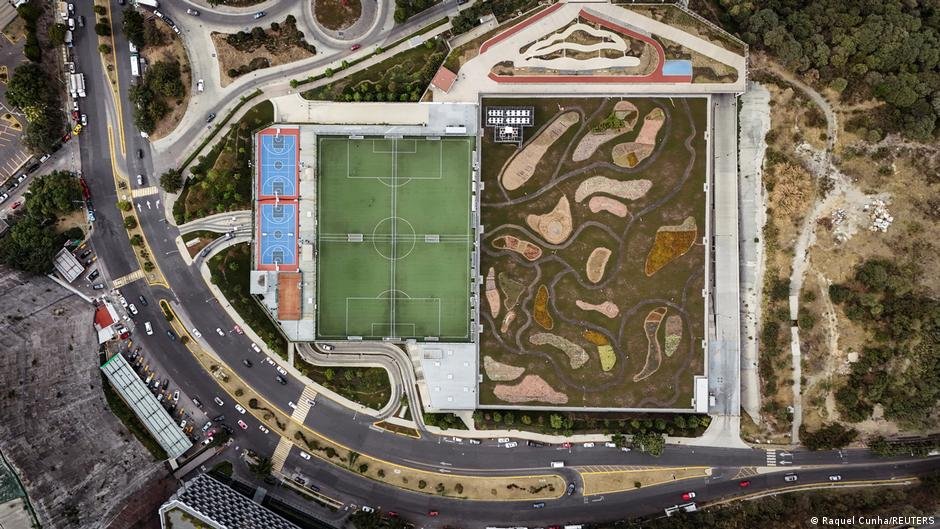
Soccer is a powerful way to bring people and communities together. In Mexico, where space is very often limited, soccer fans have gotten creative and organized their playing fields in all sorts of unconventional areas.
Image: Raquel Cunha/REUTERS
On the southern outskirts of Mexico City, amateur teams meet on a very unique football pitch every Sunday. Known as the “Field of the Gods,” it is perched inside the extinct Teoca volcano and situated a breathtaking 2,700 meters above sea level. The pitch was created by the nearby community more than 60 years ago and is a source of local pride.
Image: Raquel Cunha/REUTERS
Cars above, sports below: this pitch in Mexico City’s colorful Las Aguilas neighborhood gives people the space to play soccer beneath a highway overpass. Mexico is a co-host of the 2026 men’s World Cup, and soccer is by far the most popular sport here. This year’s opening match kicks off on June 11, in Mexico City.
Image: Raquel Cunha/REUTERS
Mexico City is one of the world’s largest and most densely populated megacities. Over nine million people here live on just 1,495 square kilometers (577 square miles). Planners left little room left for safe sports facilities. This informal soccer pitch in Mexico City’s Santa Fe business district was established right on top of a Costco store — and next to rooftop garden.
Image: Raquel Cunha/REUTERS
Further northeast, in the hilly Cerro de la Campana neighborhood of Monterrey, 14-year-old Humberto Guadalupe spends his weekends on the community’s only soccer field, nestled in the foothills. Known to friends and family as “Messi,” he dreams of becoming a professional player one day, just like the Argentinian who inspired his nickname.
Image: Raquel Cunha/REUTERS
This university stadium in Toluca features the gigantic mural “Aratmosfera” by renowned Mexican artist Leopoldo Flores Valdes. The artwork covers roughly 20,000 square meters (215,000 square feet) and incorporates some of the nearby Cerro de Coatepec mountain, making it one of Mexico’s largest murals.
Image: Raquel Cunha/REUTERS
This brightly painted pitch in a residential district in Mexico City’s historical Tlatelolco area promotes sports within the local LGBTQ+ community. Soccer is widely considered a unifying “people’s game.” Over 70% of Mexicans are likely inclined to agree — that’s how many soccer fans are estimated among the population.
Image: Raquel Cunha/REUTERS
Even without the World Cup, football is everywhere in Mexico. Here, in Ecatepec, the most populous suburb of the Greater Mexico City urban area, players have squeezed a field between modest homes and the fuselage of an old airplane. The pitch is part of Avioneta Park, where decommissioned military aircraft are on display.
Image: Raquel Cunha/REUTERS
To the south of Mexico City, amateur footballers in Xochimilco travel by traditional wooden boat through canals to reach some of the city’s last natural-grass pitches. The fields are situated amidst what are known as “chinampas” — fertile artificial islands based on ancient Mesoamerican farming techniques. The area is a UNESCO world heritage site.
Image: Raquel Cunha/REUTERS
The past is also present in Teotihuacan, located about 50 kilometers north of the capital. The site is one of Mexico’s most significant ancient cities. The Aztecs played a soccer-like game called “ullamaliztli,” in which players could never touch the ball with their hands or feet.
Image: Raquel Cunha/REUTERS9 images1 | 99 imageshttps://p.dw.com/p/5F8wL
About The Author