Skip next section What you need to know
What you need to know
- Germany’s population shrank by roughly 110,000, or 0.13%, last year
- Fuel prices near levels from before Iran war on news of potential peace deal
- Friedrich Merz presents Donald Trump with a German World Cup jersey as a birthday gift at the G7 summit
- Interior Minister Alexander Dobrindt inaugurates a new hybrid threat defense center in Berlin
Follow us for the latest news and analysis on developments from and about Germany on Tuesday, June 16, 2026.
Tired of missing our real-time updates? Click here to add us as a Preferred Source on Google. Then tap the “Star” or “Preferred” to keep DW News at the top of your feed.
Skip next section Merz presents Trump with #47 Germany World Cup jersey at G7 06/16/2026June 16, 2026
Merz presents Trump with #47 Germany World Cup jersey at G7
Chancellor Friedrich Merz took a special German national team jersey to the G7 summit in France as a gift for US President Donald Trump.
The jersey bore Trump’s name and the number 47 — a reference to his current stint as the 47th president. It was presented following his 80th birthday and amid the US co-hosting the World Cup.
Merz had also sent Trump a handwritten note, delivered in the US on Sunday.
The prospect of a peace deal with Iran — with the war a source of friction between Merz and Trump in recent months — and Russia’s invasion of Ukraine are among the dominant issues at the G7 summit in France on Tuesday.
For all the latest, check out our live G7 updates.
https://p.dw.com/p/5FUnKSkip next section German population shrinks for first time since 202006/16/2026June 16, 2026
German population shrinks for first time since 2020
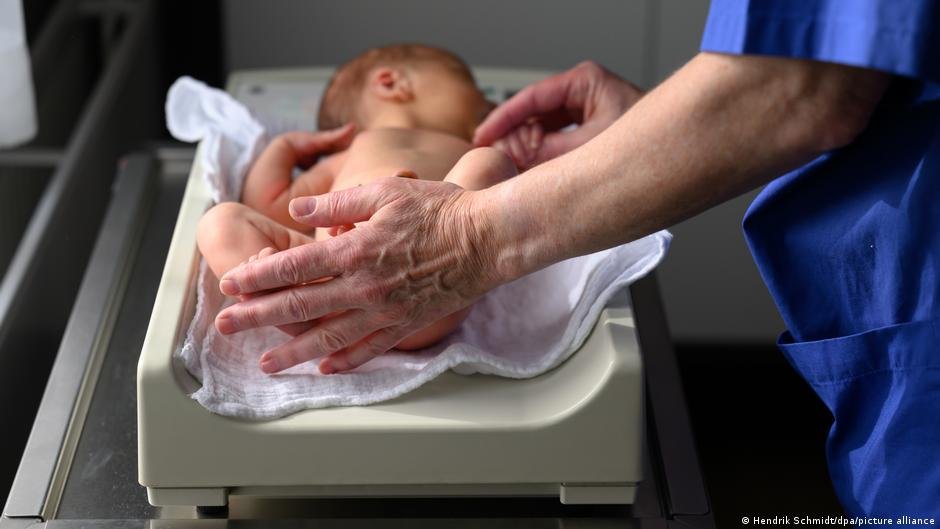
Germany’s population shrank by roughly 110,000 people in 2025, the first calendar-year reduction since 2020, the government’s statistics office Destatis said on Tuesday.
At the end of 2025, 83.5 million people resided in the country. The reduction equates to a little more than 0.13%.
Reduced net migration — with 235,000 more people moving to the country than leaving it — was not enough to cancel out the fact that 352,000 more people died than were born in Germany in 2025.
The last time the German population shrank in a year was in 2020, as the height of the travel restrictions amid the COVID pandemic led to a sharp one-off dip in migration.
Germany’s birth rate hit the lowest level on record last year and Chancellor Friedrich Merz had promised a tougher line on migration in the 2025 election campaign, so the news did not come as a surprise.
The only states where the population grew were the wholly urban city states of Berlin, Bremen and Hamburg.
The rate of population decline was considerably faster in the former East German states, at 0.5% (57,000 people in total), compared to 0.1% (or 68,000 people) across the states that made up former West Germany. Eastern states are home to fewer people with migrant backgrounds, who also tend to have more children.
The population continued aging as a result. The 60-79 age bracket continued to swell, with 358,000 people joining its ranks as more and more so-called “Babyboomers” approached retirement age.
The primary tax-paying age bracket, from 20 to 59, shrank disproportionately to the national average, falling by 1.0% or 409,000 people.
https://p.dw.com/p/5FV6kSkip next section Welcome to our coverage06/16/2026June 16, 2026
Welcome to our coverage
Mark Hallam | Rana Taha Editor
Hallöle, welcome to our updates on all things German on this fine Tuesday.
Chancellor Friedrich Merz is across the border in France for the G7 summit, along with various world leaders including US President Donald Trump, Ukrainian President Volodymyr Zelenskyy, and French President and host Emmanuel Macron.
Closer to home, the statistics agency reports that the national population dipped for the first time since 2020 last year, as a result of reduced net migration and the perennially low birth rates.
Motorists are enjoying some relief at the pumps, as fuel prices near the levels prior to the US-Israeli attacks on Iran on news of a framework for a peace deal. However, that’s also largely thanks to temporary fuel tax cuts introduced when prices were markedly higher.
The last transport of German radioactive waste sent for processing in Sellafield in the UK has docked in the north of the country. Its passage to a storage site is sure to be accompanied by protests, as is customary for such deliveries.
And a new hybrid threat defense center, known in German as GAZ Hybrid, has been inaugurated by Interior Minister Alexander Dobrindt in Berlin.
Do please stick around for updates on all this and more throughout the day, not to mention reading and viewing tips from our analyses and background coverage.
https://p.dw.com/p/5FUdjShow more posts
About The Author