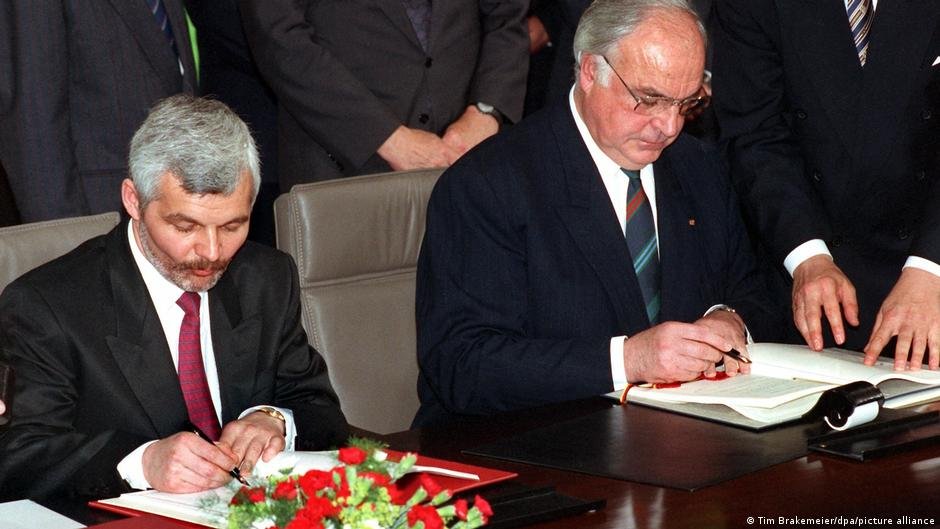
On June 17, 1991, Polish Prime Minister Jan Krzysztof Bielecki and German Chancellor Helmut Kohl met in Bonn — then the seat of the German government — to sign the Treaty between the Federal Republic of Germany and the Republic of Poland on Good Neighborliness, Friendship and Cooperation.
The agreement marked a new beginning in Polish-German relations after decades of enmity and mistrust.
Thirty-five years later, on June 17, 2026, both states — which are now close partners in the European Union and NATO — will mark the anniversary of the signing at a major event in Berlin, the German Polish Forum.
‘Foundation of the new order in Europe’
The Polish Senate, the upper house of the Polish parliament, last Wednesday praised the treaty as a “foundation of the new order in Europe after the collapse of the Iron Curtain” and a “breakthrough” in Polish-German relations.
On the same day, Germany’s parliament, the Bundestag, debated the subject “Strong friendship in peace and freedom — 35 years since the relaunch of German-Polish relations.”
“Today, Germans are grateful for the fact that Poland at the time extended a hand to us in the form of the Good Neighborliness Treaty and took the hand we offered them,” said conservative German lawmaker Knut Abraham, who has held the post of Coordinator of German-Polish Intersocietal and Cross-border Cooperation since May 2025.
Enmity and mistrust
After World War II, Polish-German relations were characterized by hostility and mistrust.
At the heart of the conflict was the dispute about the recognition of the Oder-Neisse Line — the postwar border between Germany and Poland — which was cleverly fueled by the propaganda of the Communist regime in Poland.
In the 1970s, the “Ostpolitik” of West German Chancellor Willy Brandt, which sought a rapprochement between Germany and communist Eastern Europe, did bring about a normalization in relations between the two countries but no more.
Turning point
It was only the collapse of communism and restoration of democracy in Poland in 1989 and the reunification of Germany the following year that made a new start possible.
The confirmation of the Oder-Neisse line as the German-Polish border on November 14, 1990 and the friendship treaty that followed seven months later created the foundation for a partnership.
“With the treaty, we drew a line under the past and laid the foundation for cooperation in the future,” Marek Krzakala, a lawmaker for the ruling Civic Coalition in Poland, told DW.
Krzakala, who is also chair of the cross-party Polish-German parliamentary group in Poland, went on to say that without Germany’s support, Poland’s accession to the EU (2004) and NATO (1999), would have been much more difficult.
Shared interests
When he was appointed Poland’s first non-Communist foreign minister in 1989, Krzysztof Skubiszewski declared that it was his political objective to create a German-Polish Community of Interest.
And so began the painstaking work of creating what Knut Abraham calls a “network of relationships” in politics, business, culture and the border regions.
The list of achievements is long. Today, there are hundreds of Polish-German partnerships between cities, schools, sports clubs and fire departments. Over 3 million German and Polish youths have taken part in exchange programs.
Trade between the two countries last year exceeded €180 billion ($209 billion) for the first time ever, making Poland Germany’s fifth biggest trading partner, just behind France.
New opportunities to develop and flourish have opened up for both Poland’s German minority and Polish expats in Germany.
War reparations highlight burden of the past
Over time, however, early Polish enthusiasm for its neighbor on the opposite bank of the Oder River gave way to growing skepticism, and criticism of Germany began to rise.
Above all, the countries’ troubled past kept rearing its head.
In the late 1990s, the then chair of the German Federation of Expellees, Erika Steinbach, caused consternation in Poland with her plan to set up a documentation center known as the Center Against Expulsion, which focused on the suffering of Germans. This focus was viewed in Poland as a relativization of what Germany did in World War II.
Polish right-wing conservatives, who have always been skeptical toward Germany, realized that they could score political points in Poland with anti-German rhetoric.
Jaroslaw Kaczynski, whose conservative Law and Justice (PiS) party ruled the country from 2005 to 2007 and again from 2015 to 2023, accused Berlin of wanting to set up a “Fourth Reich” and to bring Poland “under the German boot” with the help of the EU.
In 2022, the PiS government put the subject of war reparations on Poland’s official political agenda.
Poland’s losses as a result of German occupation between 1939 and 1945 are estimated to amount to €1.4 trillion ($1.6 trillion).
“Our predecessors tried to convince people that Germany is our enemy,” said lawmaker Krzakala. “But the overwhelming majority of Polish people do not share this opinion.”
“Good relations with Germany are our reason of state, especially during Russia’s war in Ukraine,” he said.
War victims still waiting for ‘humanitarian gesture’
Nevertheless, the desire for reparations is not just restricted to right-wing conservatives and far right populists.
Because Berlin roundly rejected all demands for war reparations, the talk has for years been about finding a “pragmatic solution” for the estimated 50,000 surviving war victims.
The German proposal to provide about €200 million for this group of victims was dismissed as insufficient by the Polish side in 2024. A new offer from Berlin cannot be considered until the 2027 budget, at the earliest.
Poland’s liberal conservative prime minister, Donald Tusk, who faces domestic pressure on this matter, recently said he would give the German side “a little more time.”
Military partnership to the fore
When Russia invaded Ukraine in February 2022, security moved front and center of the bilateral relations between Germany and Poland.
Germany’s Armed Forces, the Bundeswehr, deployed Patriot air defense systems and Eurofighter jets to help protect the airspace on NATO’s eastern frontier in Poland.
To view this video please enable JavaScript, and consider upgrading to a web browser that supports HTML5 video
A German-Polish defense agreement, which is also due to be signed on June 17, is set to shift military cooperation between the two countries up a gear. The choice of Wednesday for the signing of this agreement was no coincidence.
Polish diplomat Janusz Reiter was Poland’s ambassador to Germany when the Treaty on Good Neighborliness, Friendship and Cooperation was signed in 1991. A year ago, he reminded politicians in Berlin that Poland’s eastern border is also Germany’s first line of defense and called on Berlin to actively support Poland in securing this border.
Reiter views the integration of Ukraine into Western structures as the greatest challenge for Poland and Germany. Cooperation between these three countries with their military and economic potential would be a “historic sensation.”
“The window is open,” Reiter said, “but I fear that this historic opportunity might soon pass.”
This article was originally written in German.