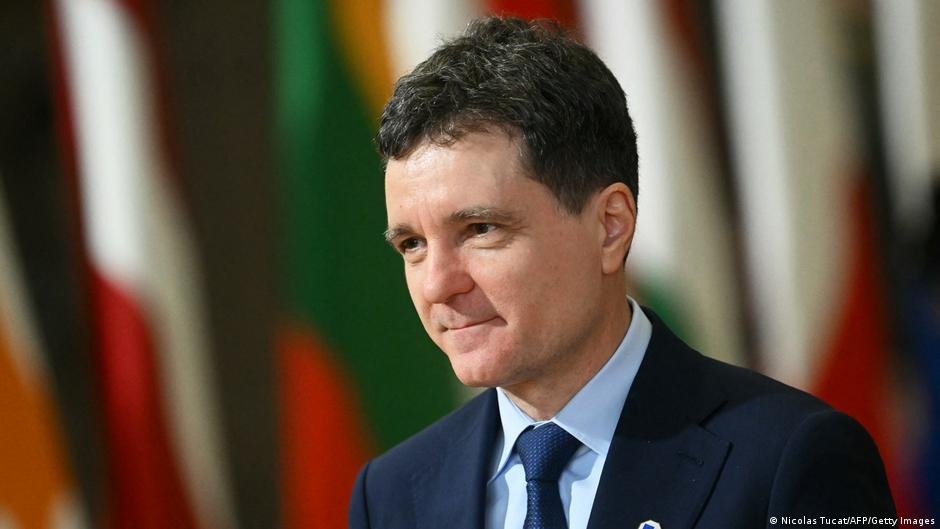
Romanian President Nicusor Dan is a passionate chess player and, by all accounts, a rather good one, too. But now, amid Romania’songoing political crisis, Dan has made a move that is not only risky but arguably breaks the rules of the democratic game.
Many are wondering what could have led Dan, a former civil society activist, to act this way.
Two months ago, Romania’s four-party coalition collapsed, leaving the country without a government as the country finds itself amid severe financial and socioeconomic crisis.
In a surprise move on Sunday, Dan nominated Adrian Vestea of the National Liberal Party (PNL) as the new prime ministerial candidate, after the previous candidate had withdrawn.
Vestea, who currently serves as president of Brasov county council, does not however have the best track record. He graduated from a university of questionable academic standards, and later failed to have the access roads to a major Romanian NATO military base repaired, among other things.
Dan made his nomination without first consulting the parties in parliament, as required by the constitution. Not only that. The president nominated Vestea without the leadership his own PNL party knowing.
PNL Chairman Ilie Bolojan, who heads the current government as interim prime minister, called Vestea’s nomination a “hostile act” and an “attempt to divide the PNL.”
Some commentators have accused the president — once an outspoken champion of the rule of law — of disregarding democratic and constitutional principles.
Political instability in Romania
Romania has been mired in a political crisis for years, with frequent changes of government. For some time now, it has had one of the highest budget deficits in the EU, in 2024 even exceeding its GDP by 9%.
Romania is under pressure to implement fundamental administrative and tax reforms, and overhaul its judicial system, which is regarded as corrupt. Without these measures, Romania faces the threat of a severe financial crisis and of losing out on many billions of euros in EUfunding. Romania’s political elite, however, has been reluctant to make changes.
Romania’s Social Democrats (PSD), which was initially composed of former communistofficials from the Ceausescu dictatorship, today predominantly champions right-wing nationalist positions. Pro-Russian far-right parties have also gained traction in recent years against the backdrop of Romania’s gridlocked reforms and the growing disillusionment with its corrupt political establishment. In the 2024 parliamentary election, three far-right parties secured a total of 35% of the vote, with the Alliance for the Union of Romanians (AUR) standing out as the biggest force among them.
Russian meddling?
That same year, pro-Russian far-right esotericist Calin Georgescu surprisingly won the first round of Romania’s presidential election. Shortly thereafter, the Constitutional Court annulled the election due to alleged Russian interference. While it is true that Russian propaganda is prevalent in Romania, it remains unclear whether its influence on the 2024 election was as decisive and direct as has been claimed.
A new presidential elections, scheduled for spring 2025, was won by then-Bucharest Mayor Nicusor Dan, a moderate conservative. He cast himself as a cosmopolitan, pro-European patriot during his campaign, promising to lead Romania out of the political crisis and keep the country on a pro-European trajectory at all cost. He also pledged to heed Romanians’ wishes and ensure greater transparency, campaigning under the slogan “honest Romania.”
After taking office in May 2025, Dan eventually managed to form a four-party coalition comprising the National Liberal Party (PNL), Social Democrats, the green-liberal Save Romania Union and Democratic Union of Hungarians in Romania (UDMR).
Soon enough, the Social Democrats (PSD) took a more opposition-minded stance given Ilie Bolojan’s position as a determined economic reformer. After only ten months, in April 2026, the Social Democrats left the coalition and then brought it down through a vote of no confidence with help of the far right.
President Dan has since sought to form a new, pro-European government at all costs to avoid early elections, in which far-right parties would likely secure a parliamentary majority.
The math, however, doesn’t add up. The PNL and USR have stated that they will no longer govern with the PSD, although there is a small faction within the PNL that would still be willing to cooperate with the Social Democrats. Adrian Vestea belongs to this wing. At the same time, any government that excludes the far right cannot be formed without the Social Democrats.
Has Romania’s president violated his principles?
Andrei Cornea, a philosopher and one of Romania’s most prominent political commentators, says the president has long been violating his own principles, for example when he refused to sign a law imposing stricter penalties for fascist propaganda. Or when he put figures of questionable integrity in charge of anti-corruption agencies.
“It seemed to us that Nicusor Dan, whatever mistakes he may have made from our perspective, remained a democrat,” writes Andrei Coprnea in the weekly Revista 22. “For a long time, we believed that Nicusor Dan was ‘our president.’ Once again — for the umpteenth time — we were wrong. Now we know: He is ‘their’ president!”
This article was translated from German
About The Author