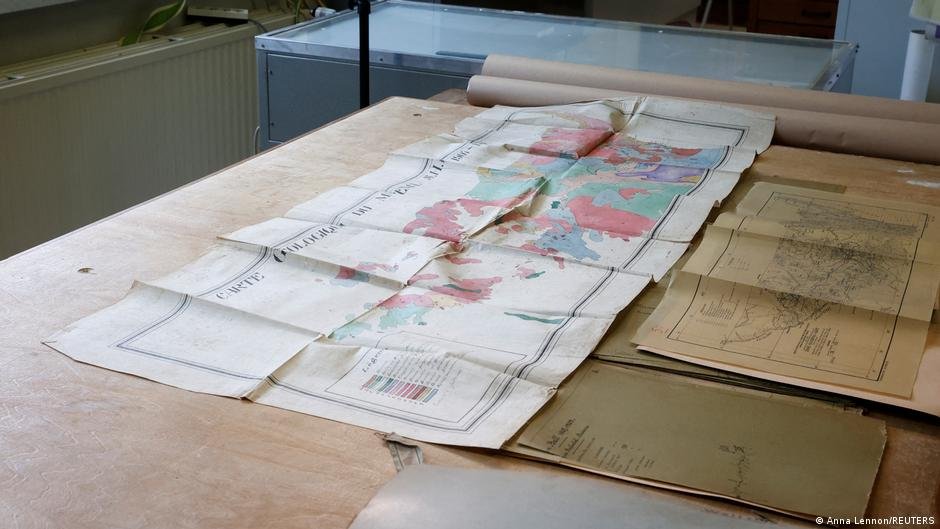
Millions of handwritten, fragile and not yet fully inventoried documents are stored on nearly 500 meters of shelving at the AfricaMuseum in the Belgian town of Tervuren. They document how the mineral wealth of Democratic Republic of Congo (DRC) was mapped and exploited by Belgium during the colonial era.
Congo is pushing for the transfer and digitization of the archive to identify new deposits of vital minerals like cobalt and copper. KoBold Metals, a private mining startup backed by US billionaires Jeff Bezos and Bill Gates, has offered to assist the country. But the AfricaMuseum has repeatedly rejected the proposal.
Global race for rare earths
In 1885, Belgian King Leopold II took possession of Congo, plundered the territory and subjected its population to extreme brutality. Leopold ruled it as his personal domain; in 1908 it became a Belgian colony — a source of rubber, ivory and minerals — and, in 1960 Congo gained independence.
Today, global competition for critical materials is increasing steadily — and Congo remains rich in natural resources. There are deposits of lithium, copper, cobalt and coltan, 90% of which remains untapped, according to the Ministry of Mines.
As a result, the number of interested investors is high. Washington has also recently deepened its strategic partnership with Kinshasa to secure supply chains and reduce dependence on China for materials used in batteries, electronics and defense.
KoBold Metals is one of several US companies expanding in Congo.
‘Unethical to leave this to a company’
“We scan and digitize the documents and make them immediately accessible to the public,” said Benjamin Katabuka, Managing Director of KoBold Metals, DRC.
But the AfricaMuseum is not keen on the proposal. “We would like to work with them on certain files — but what we could not accept was their proposal to take over our entire geological archive,” AfricaMuseum Director Bart Ouvry told DW.
“The privatization of a complete archive is not possible for us. We would consider it unethical to leave this to a company.”
Ouvry’s position is in line with that of the Belgian government, which views the geological archives as public property. “Under no circumstances can Belgium grant exclusive access to a foreign company or private entity with which it has no contractual relationship,” said spokesperson Florinda Baleci.
KoBold Metals could pursue commercial interests and seek to monetize the valuable data contained in the old maps.
AfricaMuseum-Congo digitalization project under way
A museum digitization project is already ongoing — in cooperation with the National Geological Survey of the DRC and supported by the European Union, Ouvry explained.
“We started development two years ago. When they [KoBold Metals] approached us last year, our project was already quite advanced. Production actually began in January. We have hired staff for this work, because part of it is technical, but the majority is scientific in nature and must be carried out by our own scientists,” Ouvry said.
Artificial intelligence is being used in the process. “Today, there is hardly any scientific project in which AI is not used,” he added.
Who has the right to decide about the archives?
Last year, KoBold Metals received authorization to search for lithium and other minerals in Congo. The company also concluded agreements with Kinshasa on the digitization of data — including records preserved in Belgium.
According to a report by the Financial Times, Congolese Mining Minister Louis Watum Kabamba expressed a desire in February to accelerate the transfer of the Belgian data and reportedly issued corresponding instructions to the national geological service. Later, at a conference of the African mining sector in Cape Town, he defended himself against accusations that he had “given away” the DRC’s mining potential to the United States.
According to KoBold Metals, DRC Managing Director Benjamin Katabuka, the request for access to the archives was made by the Congolese government. KoBold referred to a Belgian law from 2022 that establishes a framework for the return of colonial-era collections to African countries. Archives, however, are excluded from this law.
Ouvry: ‘The archives are Belgian archives’
In Ouvry’s view, the Congo’s authority does not extend that far in any case. “The archives are Belgian archives. They deal with the Congo, but also with other countries such as Rwanda, Burundi, neighboring countries where Belgian companies have long been active,” he told DW.
“Therefore, it is not up to the Congolese government or a private company to decide about these archives. Of course, we recognize that it is … important from a moral and political perspective to share these archives with the Congolese government,” the museum director clarified. “But we must accomplish that ourselves.”
The National Geological Survey of the DRC has also given the AfricaMuseum “priority,” according to Ouvry. “We will prioritize three regions that are currently most important to the Congolese government, and the data for those regions will be transferred to them very soon.”
Even now, the AfricaMuseum archive is accessible on a limited basis: Copies can be provided upon request, and private companies must present a letter of support from Kinshasa in order to consult geological maps.
Within four to five years, the entire archive is expected to be digitized and made available to the public in accordance with Belgian and European law, Ouvry said. He rejected rumors that the Trump administration had pressured the museum to open the archive to KoBold Metals.
To view this video please enable JavaScript, and consider upgrading to a web browser that supports HTML5 video
This article was originally written in German.