13 minutes agoShareSaveAdd as preferred on GoogleZoya Mateen

 First.wav
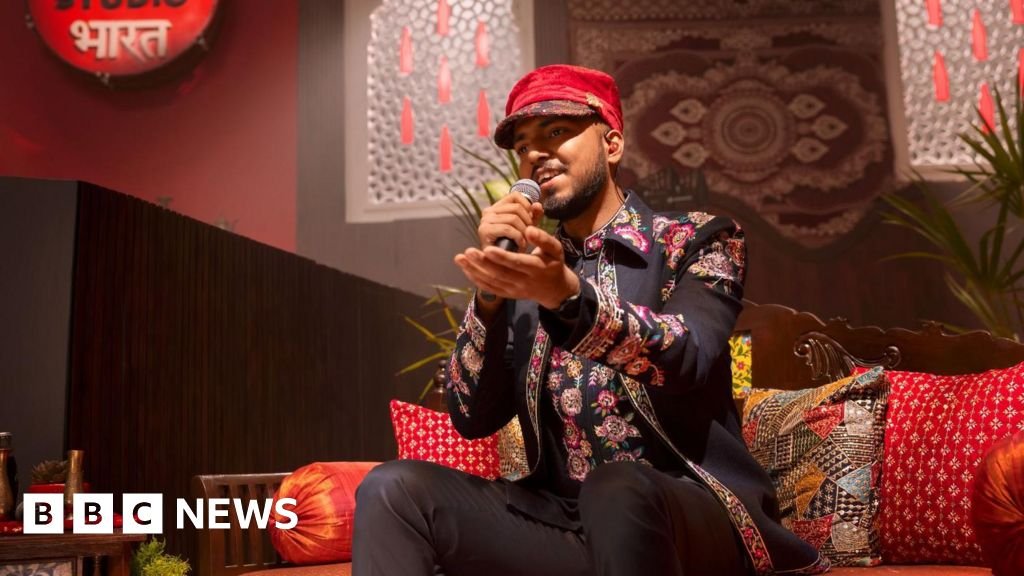
On a recent season of an Indian music show, a young singer from the northern state of Bihar performs a haunting, century-old folk song about separation, colonialism and longing.
It tells the story of a woman watching her husband leave to fight in a distant war under British rule. She mourns his absence, curses the empire that claimed him and, at one point, imagines taking up a dagger herself.
Performed by Bihar folk singer Utpal Udit in collaboration with acclaimed vocalist Rekha Bhardwaj, Kachaudi Gali went on to attract millions of views, becoming one of the breakout successes of the show Coke Studio Bharat, the Indian edition of the popular music franchise that has introduced regional and folk traditions to new audiences across South Asia.
The success thrust Udit into the national spotlight. More unexpectedly, it also brought renewed attention to Bhojpuri, a language often stereotyped as the tongue of migrant labourers and low-brow entertainment despite a rich literary and cultural history that stretches back centuries.
Spoken by tens of millions across northern India and a diaspora stretching from the Caribbean to the Pacific, Bhojpuri is one of South Asia’s most widely spoken languages, with a vast canon of folk songs, poetry, storytelling and theatre.
Yet that is not how many Indians encounter it today.
For many, Bhojpuri is synonymous with a hugely popular music industry known for songs rife with sexual innuendo, misogyny and double entendres. In films and television, Bihari accents and characters are often reduced to comic sidekicks, migrants or rustic outsiders.
Regional artists have spent decades preserving Bhojpuri folk traditions, but these are often eclipsed by the language’s more visible – and more stereotyped – image.
Now musicians like Udit are trying to broaden the picture.
“It hurts when you are deeply connected to the music of your roots, yet others perceive it poorly,” Udit told the BBC. “I really want to change that.”
 Getty Images
Born in Saharsa district, Udit grew up moving across different parts of the state because of his father’s work, absorbing folk traditions along the way.
He says that at first, the melodies stayed with him more than their meanings. Later, curiosity led him deeper into the works of Bhikhari Thakur and Mahendra Misir, the poets and playwrights who helped shape Bihar’s folk imagination.
Many of those stories revolve around migration – a defining theme of Bhojpuri folk music and of Bihar itself.
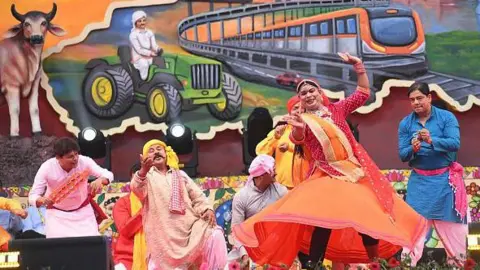
One of India’s poorest states, Bihar has long been shaped by people leaving in search of work: first under colonial labour systems, later for the factories, construction sites and expanding cities of modern India. That journey has echoed through its music for generations.
One song Udit frequently performs, Jani Ja Bideswa Ke Or, from Bhikhari Thakur’s celebrated play Bidesiya, tells the story of a woman pleading with her husband not to leave home in search of work. The house will feel empty without him and her soul will suffer, she sings.
Written more than a century ago, the song emerged from a period of mass migration, but its themes remain strikingly familiar today.
Udit says preserving that connection between past and present has become central to his work.
“I want people to realise that Bhojpuri and Bihari music have much more depth than the stereotypes suggest,” he said. “I want them to hear the stories the music conveys.”
On social media, Udit often accompanies his performances with detailed explanations of their history and cultural significance. A short rendition of a folk song might be paired with a reflection on migration, colonialism or the work of a playwright.
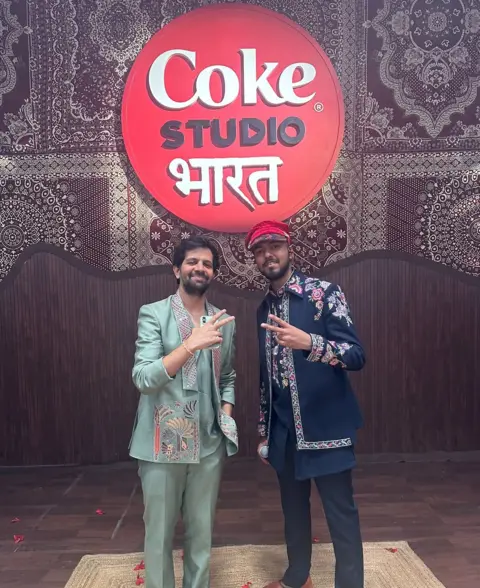
It was what drew Khwab, the producer of Kachaudi Gali, to Udit’s universe.
About a year ago, he came across a video of Udit performing the song in his village on Instagram. The video caught Khwab’s attention. The caption held it.
“Utpal is obviously a brilliant singer,” Khwab said. “But when I read his explanation of the song’s history, I literally sat up in bed. I knew then that something significant had to come from this.”
 First.wav
What also struck him was the sense that an entire cultural archive had been obscured by stereotypes.
So he and Udit decided to reimagine Kachaudi Gali for a new audience.
For the Coke Studio version, Khwab wanted the production to feel modern while remaining faithful to its roots. Traditional instruments – including the shehnai, tabla, dholak, harmonium and dotara – were recorded live, while the arrangement drew on the scale and polish of popular music.
The challenge, he explained, was not simply preserving folk music, but translating it for listeners unfamiliar with the tradition.
“It’s about preserving what might be lost while creating something fresh. I wanted others to realise that folk music can be cool too.”
Not every artist seeking to reshape perceptions of Bhojpuri looks to the past, though.
A few hundred kilometres away, rapper Sanket Shikriwal has arrived at the same question from almost the opposite direction.
Over the past few years, Shikriwal has emerged as one of the most distinctive voices in India’s independent music scene, described as a rapper challenging assumptions about what Bhojpuri music can sound like.
If Udit’s work is rooted in recovery, Shikriwal’s thrives on collision.
In his music, Bhojpuri shares space with jazz, spoken word and hip-hop. Village memories coexist with references to Franz Kafka and John Coltrane. Bihar appears alongside Mumbai; migration alongside internet culture. His songs sound less like a folk revival than an ongoing conversation between past and present, village and city, belonging and escape.
The music can also be abrasive. It contains street language and profanity, complicating any attempt to cast him as a clean alternative to the excesses often associated with commercial Bhojpuri music.
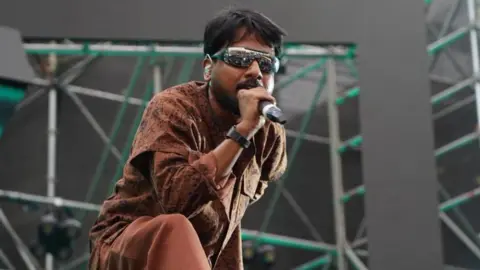 Shikriwal
But Shikriwal rejects the idea that profanity itself is the problem.
“I’m not using profanity for the sake of a tough-guy persona,” he said. “It’s my way of expressing agitation.”
The distinction matters, he argues, because Bhojpuri is often judged by standards that other genres are not.
Hip-hop has long used profanity as a vehicle for anger, social commentary and self-expression. Closer to home, Punjabi music – despite controversies over violence and hypermasculinity – has evolved into one of India’s most successful cultural exports. Artists such as Diljit Dosanjh and the late Sidhu Moosewala transformed regional identity into a source of pride and aspiration.
Bhojpuri, Shikriwal argues, has rarely been afforded the same generosity.
“The question isn’t whether Bhojpuri can be made respectable,” he said. “It’s why Bhojpuri speakers are always expected to prove that they are.”
What he hopes for is not a sanitised version of Bhojpuri culture, but a more confident one – secure enough to define itself on its own terms.
“I want people to look at Bihar and see philosophers again,” he said.
“We call it the Land of Buddha, yet we treat its people with such disrespect.”
Udit believes that shift may already be under way.
The response to Kachaudi Gali, he says, offered a glimpse of what that future might look like.
“It was a reminder,” he said, “that one of India’s most widely spoken languages is still waiting to be heard on its own terms.”