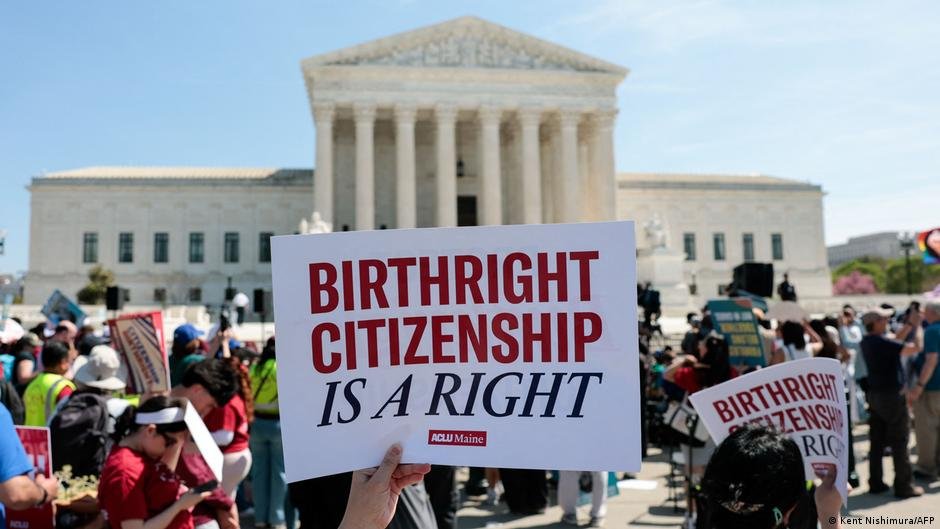
The United States’ Supreme Court ruled on Tuesday that President Donald Trump‘s executive order restricting birthright citizenship is unlawful.
In one of the most consequential decisions for the top court, which had waited until the final day of the term, justices ruled 6-3 to maintain the right to US citizenship for nearly everyone born on US soil.
Trump issued the order on the first day of his second term in office last year as part of a range of policies aimed at cracking down on immigration, both legal and illegal.
Justices had already expressed skepticism during oral arguments in April, which Trump personally attended in a highly unusual move for a sitting US president.
The order had directed governed agencies not to recognize the citizenship of children born in the United States if neither parent is a US citizen or “green card” holder, a legal permanent resident.
Critics had argued that the order violated the 14th Amendment, which is considered to confer automatic citizenship to those born on the territory of the United States.
In its ruling, the court upheld that broader conception of birthright citizenship.
“Citizenship, then and now, was the right to have rights … to freely participate in our political community. The Framers of the Fourteenth Amendment extended that promise to ‘every free-born person in this land,’” Chief Justice John Roberts wrote for the court.
“We keep that promise today,” he added.
US birthright citizenship: the 14th Amendment
The provision in question, known as the Citizenship Clause, states: “All persons born or naturalized the United States, and subject to the jurisdiction thereof, are citizens of the United States and of the state wherein they reside.”
The Trump administration, however, claims that simply being born in the United States is not sufficient to render a person “subject to the jurisdiction thereof,” and therefore a citizen.
Such people would include the babies of immigrants who are in the country illegally or whose presence is lawful but temporary, such as university students or those on work visas, the administration argues.
Solicitor General D. John Sauer, the lawyer for the Trump administration, argued that birthright citizenship “demeans the priceless and profound gift of American citizenship” and “rewards illegal aliens who not only violate the immigration laws but also jump in front of those who follow the rules.”
Opponents have accused President Trump of racial and religious discrimination in his approach to immigration and several lower courts, including one in New Hampshire, have blocked the executive order, which Trump is now challenging.
“It’s one of the clearest statements of who we are as a country,” said the American Civil Liberties Union (ACLU) in a statement. “No matter who your parents are, if you’re born here, you belong here.”
How do most countries determine a child’s citizenship?
Most countries, especially outside the Americas, follow the legal principle of jus sanguinis, or “right of blood,” whereby a child’s citizenship is inherited from its parents, regardless of place of birth.
In the European Union, for example, no member state grants automatic, unconditional citizenship to children born to foreigners.
US legal practice, however, is descended in many ways from English common law, which long assigned citizenship based on the legal concept of jus soli, or “right of soil.”
In the United Kingdom, though, the British Nationality Act of 1981 abolished jus soli and people born in the UK now only receive citizenship if at least one parent is a British citizen or has “settled status” under the law.
Supreme Court rules on campaign spending, transgender sports
Prior to the ruling on birthright citizenship, the Supreme Court had also found in favor of a Republican appeal against campaign spending limits and upheld state laws banning transgender girls and women from school sports teams.
Siding with Vice President JD Vance and other Republican plaintiffs, the court ruled 6-3 that a cap on the amount of money parties can spend on election campaigns violates First Amendment protections of freedom of speech.
The ruling comes ahead of midterm elections in November in which the Republicans will have a significant cash advantage over the Democrats.
According to the Reuters news agency, the three major Republican committees — the Republican National Committee, the National Republican Congressional Committee and the National Republican Senatorial Committee — had $256 million in the bank and no debt as of May.
That was more than double the roughly $126 million held by their Democratic counterparts, who are also weighed down with more than $18 million in debt.
The court’s conservative majority also ruled that state laws in Idaho and West Virginia banning transgender girls and women from school athletic teams don’t violate the Constitution or federal laws prohibiting gender discrimination in education.
The decision, which follows other such rulings against transgender Americans in the past year, represents another setback for the LGBTQ+ community.
“Today’s news has nothing to do with safety or fairness in sports,” Trevor Project CEO Jaymes Black argued in a statement.
“These rulings only serve to send a message to transgender and non-binary young people that says: ‘You don’t belong.’”
Edited by: Wesley Rahn
To view this video please enable JavaScript, and consider upgrading to a web browser that supports HTML5 video