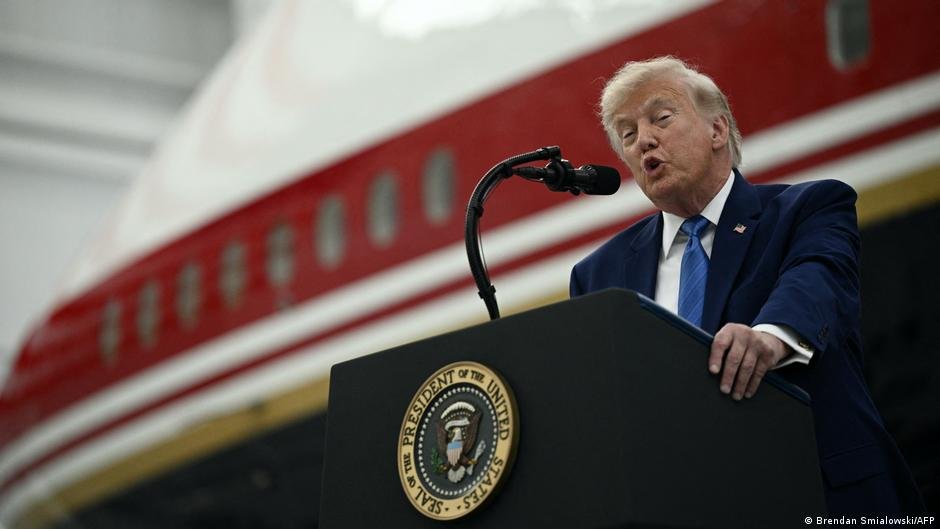
One of the first acts of Donald Trump’s second term was an attempt to redefine the 14th Amendment of the US Constitution. Among a flurry of executive orders, the US president called for an end to the concept of birthright citizenship, which has existed in the US since 1868.
But his wish was denied on Tuesday, after the US Supreme Court ruled against the government. “It’s one of the clearest statements of who we are as a country,” said the American Civil Liberties Union (ACLU) in a statement. “No matter who your parents are, if you’re born here, you belong here.”
Trump had called the existing policy “a disgrace”, with his vice president JD Vance having previously described it as “the dumbest immigration policy in the world”.
The order had already been through a number of number of legal twists and turns in various courts, including the Supreme Court. Though Tuesday’s ruling means the legal status is unchanged, it will still leave a mark, according to Kim Lane Scheppele.
“The fact that the question is now open in a way it never was has made citizenship more precarious, including for those who have lived all of their lives in the US,” the professor of Sociology and International Affairs at Princeton and an expert in the sociology of law, told DW shortly before the decision was announced.
To view this video please enable JavaScript, and consider upgrading to a web browser that supports HTML5 video
“Don’t forget that citizenship is under attack in many ways under Trump. They’ve opened an office of denaturalization inside the Justice Department and are pressing to require proof of citizenship to vote. And few of us have such proof, less than half the US public has passports, for example.”
What is the current law regarding US birthright citizenship?
The 14th Amendment says that: “All persons born or naturalized in the United States and subject to the jurisdiction thereof, are citizens of the United States and of the State wherein they reside”.
This has been consistently interpreted by courts and governments to mean that children born in the US, whatever the status of their parents, become a US citizen by default. There are a few specific exceptions to the blanket law, including children born to foreign diplomats or invading enemy forces.
How many people would changes to US birthright citizenship affect?
The Migration Policy Institute think tank estimates that 255,000 children are born in the US every year to noncitizen parents.
Any changes would not have been retrospective, meaning that anyone who previously qualified for citizenship under birthright would have remained unaffected. According to research by the Pew Research Center, that was as many as 4.4 million Americans between the period of 2006 and 2023 alone, though some will have left the country or died.
A number of prominent Americans were granted US citizenship at birth despite their parents not being citizens at the time, including many members of Trump’s inner circle. This includes Secretary of State, Marco Rubio, FBI Director Kash Patel, and Second Lady, Usha Vance.
What impacts would a change have had?
While the court has now ruled that no changes to birthright citizenship will take effect, the Trump administration’s proposed changes would, if implemented, have significantly altered how citizenship is determined at birth.
It’s difficult to know precisely but the Trump administration says that, upon a child’s birth, its parents’ status would have been assessed to determine whether the child is eligible for citizenship and the other vital documentation that comes with it. From that point on, a birth certificate alone would not be enough to get a passport or social security number.
What would happen to the statehood of the child would have depended largely on where their parents are from. Some countries do not automatically grant citizenship born to their nationals abroad, particularly in southeast Asia. In such a case, it appears the child would be stateless.
“Something important to understand about the US is that we don’t have a readily available way to prove citizenship, precisely because most of us rely on birthright citizenship for that claim,” said Scheppele.
“So women who have just given birth — let alone the fathers of new babies — will not have readily available ways of proving their citizenship in the cases of absolutely routine births. Imagine if the citizenship and immigration status of all new parents had to be recorded for every birth in the country – and you can begin to see the administrative chaos that would result.”
How does birthright citizenship work elsewhere?
Trump has often falsely claimed the US is “the only country that has it”. In fact, data compiled by the Pew Research Center shows that 32 other countries, mostly in North America and Latin America, also offer birthright citizenship.
Elsewhere, the picture is a little more complex. Many countries including, Greece, Iran, France and Morocco offer it to any child whose parents were born in their country. Others, like Australia, Germany and the United Kingdom grant citizenship to any child born to a legal resident of that country. On the more restrictive end, countries like Israel, Haiti and Liberia only offer birthright citizenships to those who fall under defined criteria.
What might this mean for Trump politically?
Trump has previously described birthright citizenship as “magnet for illegal immigration” that he feels is allowing foreign nationals to access US benefits unfairly. His failure to get one of his flagship immigration policies through the courts will no doubt rankle.
The ability to force through tough immigration policies such as this is key to delivering on his promises. Trump has made much of deporting “illegal aliens” en masse, capping refugee arrivals and the success of his Immigration and Customs Enforcement (ICE) agency.
While failure will be frustrating for him and his administration, it is unlikely to deter him from this strand of the ‘America First’ strategy that defines him. But while a win could have opened the door to an even more extreme policy on those who are already citizens, Tuesday’s decision should ease those concerns, at least for now.
Edited by: Andreas Illmer