For a day, anyone could create and spread fake Singapore satellite images. Then Google backtracked
A new Google Earth AI-generation feature has been pulled after backlash and concerns over disinformation risks.
Google Earth’s new AI-generation feature stirred controversy on social media before it was ultimately pulled, with experts fearing it would have caused misinformation to spread more easily.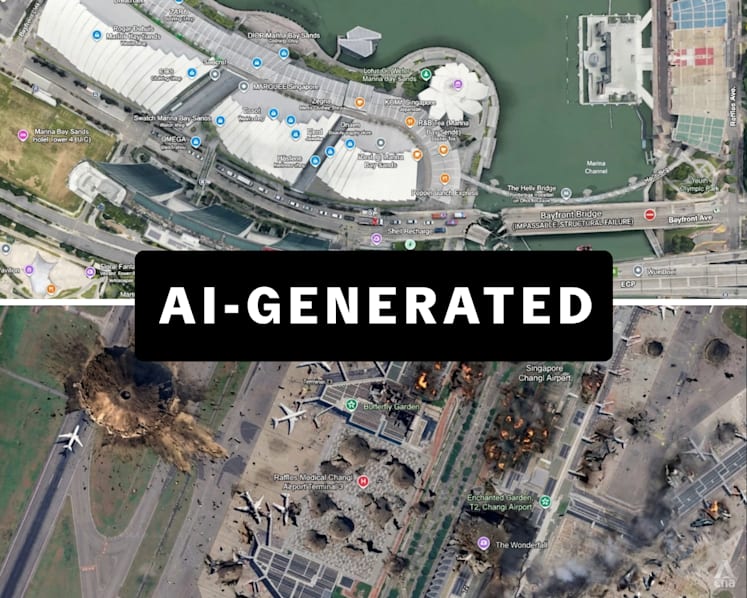
New: You can now listen to articles.

This audio is generated by an AI tool.
Read a summary of this article on FAST.
Get bite-sized news via a new
cards interface. Give it a try.
Click here to return to FAST
Tap here to return to FAST
FAST
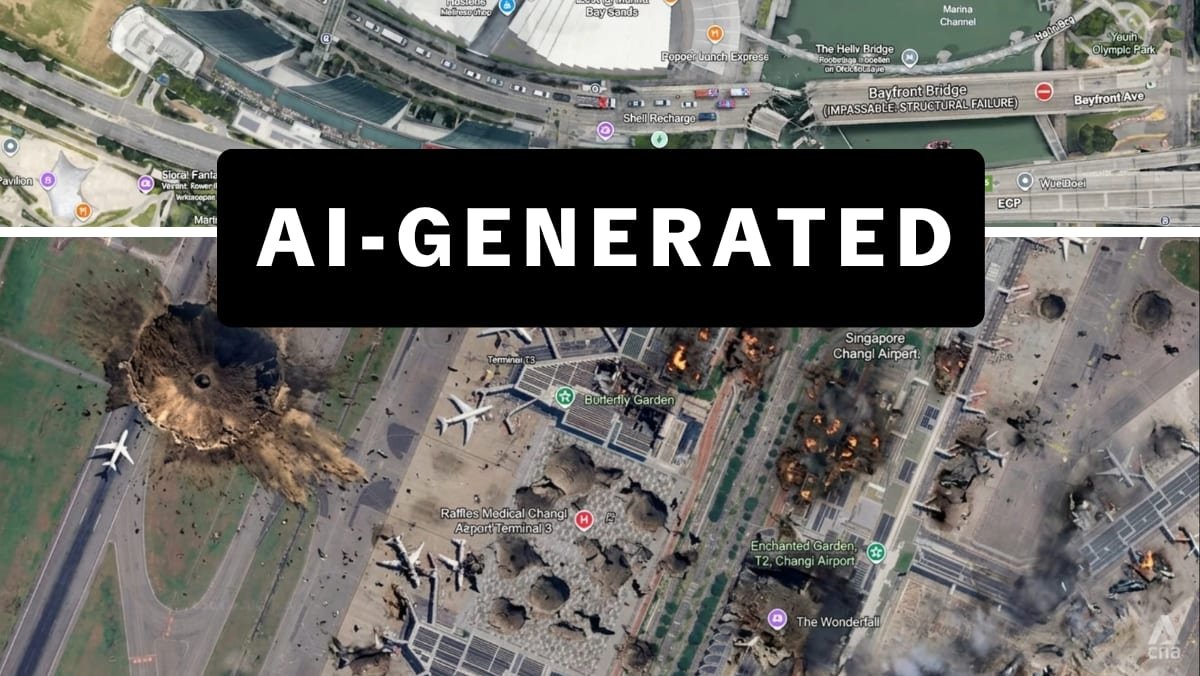
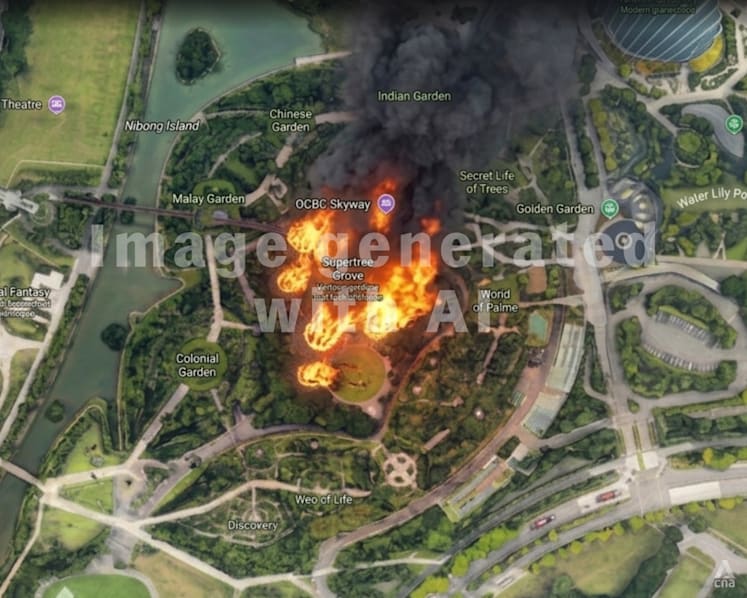
SINGAPORE: Aerial scenes of destruction at Singapore’s Changi Airport, a fire at the Gardens by the Bay park, a collapsed bridge near the Marina Bay Sands resort: None of these happened, but for a day, anyone could generate such hyper-realistic images using just a single-sentence AI prompt.
Google on Friday (Jul 31) pulled back a new feature it unveiled just over 24 hours earlier, which allowed users to create such images by directly using Nano Banana – the tech giant’s own AI image generator – within the Google Earth satellite imagery website.
In its initial Thursday announcement, Google framed the feature around imagination and planning, such as visualising a new neighbourhood or creating a real estate blueprint.
But it drew swift criticism from experts across the fields of journalism, AI and open-source intelligence, who warned that the feature could allow disinformation to be created more easily, and more quickly. Prominent open-source investigator Henk van Ess was among the first to call this out, arguing in an early Friday blogpost that it would cause more harm than good.
While fake, AI-generated images are not new, experts also noted that the Google Earth development would exacerbate an already fraught situation. Satellite imagery, in particular, has long been viewed as more credible and also relied on to debunk falsehoods; the new feature rendered a free, accessible and leading option in this space as a tool for spreading convincing falsehoods instead.

Guess Word
Crack the word, one row at a time

Buzzword
Create words using the given letters

Mini Sudoku
Tiny puzzle, mighty brain teaser

Mini Crossword
Small grid, big challenge

Word Search
Spot as many words as you can
Google does not publish active user numbers for Google Earth, but reporting over the years places its total number of downloads in the range of 500 million to over a billion.
On Friday, Google said it was rolling back the new feature and working on implementing “stronger guardrails”.
“We know that people uniquely trust Google Earth for a reliable view of the world,” it said in a statement. “We’ve seen geospatial professionals using this feature for a range of useful purposes, however we’ve also seen people sharing screenshots of generated imagery that appear to violate our policies.”
Before the feature was removed, CNA tested it by generating the above three fictitious scenes at Singapore-based locations on Google Earth. There were no refusals or restrictions when entering the AI prompts.
The public Google Earth map was not altered and those fake examples could not be seen by others. But CNA was able to easily take screenshots and begin the process of uploading to major social media platforms like Facebook, Instagram and TikTok, without being asked to declare that those were AI-generated images.
CNA also ran the screenshots through four commercial AI-detection tools. Half of them deemed two of the images as authentic, with a low likelihood of manipulation. Another tool flagged one image as likely real.
When the images were run through Google’s Gemini AI app, they were detected as either partly, mostly or entirely created or edited with Google AI.
WHY AI-GENERATED MAP IMAGERY MATTERS
For two decades, Google Earth has been viewed as a standard reference for verifying what a location looks like. It has also been a reliable tool used by investigators worldwide, such as in conflict reporting in Ukraine and in the Middle East.
In recent times, Google Earth imagery has also been the subject of AI manipulation, with significant consequences. In February, an Iranian state-run news outlet posted a “before-and-after” Google Earth satellite image claiming an Iranian drone strike had destroyed US radar equipment at a Qatar base. But this was eventually proven to be an AI-manipulated version of a Google Earth image of a US base in Bahrain. By then, the image had drawn millions of views and spread across social media globally.
It was the use of genuine Google Earth imagery which gave the fake image more credibility – and experts noted that if an AI-generation tool were to be baked into the Google Earth interface natively, such attempts at disinformation would no longer require as much effort.
Apart from van Ess, whose views have been widely echoed online, others called the move “irresponsible” and potentially causing “catastrophic damage to the credibility of satellite imagery”.
On LinkedIn, before the feature was pulled, open-source investigator and AI specialist Tom Jarvis from the non-profit Centre for Information Resilience wrote: “Google has made a feature that turns the tables for the worse. Those who could be held accountable by a satellite image can now more easily disrupt information spaces with the same tool.”
Mr Benjamin Ang, who heads the centre of excellence for national security at Singapore’s S Rajaratnam School of International Studies (RSIS) think-tank, told CNA: “Research shows that for decades, human beings have been used to viewing satellite images as more believable than photos taken from ground level, because they appear to come from an objective angle, and because they were harder to tamper with.”
“In the past, making fake satellite images in a convincing way needed a relatively high level of resources, technology, and skill, but now practically anyone can create fakes that cause panic or outrage or deceive the recipient,” he added.
An earlier Google statement had attempted to defend the feature by noting that every image created with Nano Banana in Google Earth included the SynthID digital watermark – a Google-made tool that helps people identify AI-generated content.
“So if someone is unsure about an image, they can ask the Gemini app or use Lens in Search to see if the image was AI-generated. In addition, we prevent image creation on harmful topics and are continually updating our protections,” the post said then.
Mr Ang noted however that once an image “enters your average family chat or friends chat group on WhatsApp, Telegram or WeChat, practically no one is going to go through the inconvenience of uploading the image to a verification portal … before they forward it to others”.

Source: CNA/rl(jo)
Sign up for our newsletters

Get the CNA app
Stay updated with notifications for breaking news and our best stories
Get WhatsApp alerts
Join our channel for the top reads for the day on your preferred chat app

Get bite-sized news via a new
cards interface. Give it a try.
Click here to return to FAST
Tap here to return to FAST
FAST
About The Author