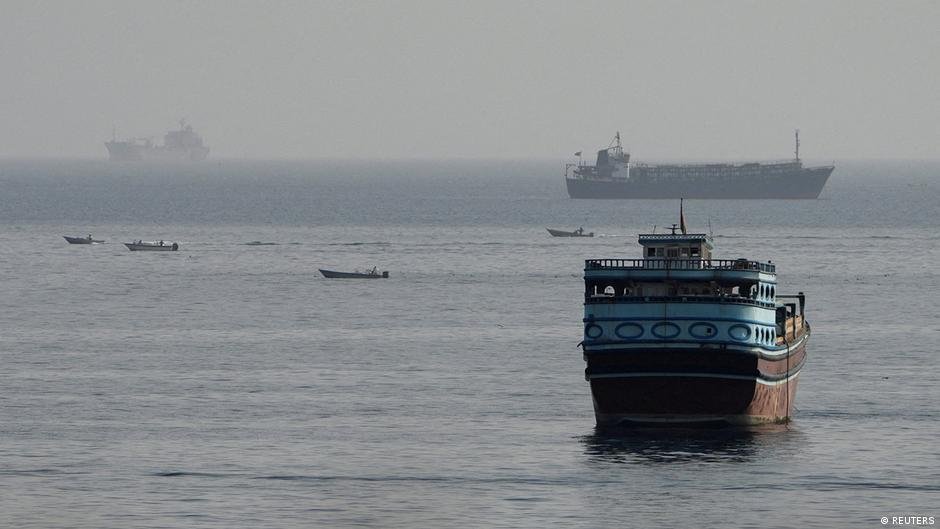
Iran’s Foreign Ministry spokesperson, Esmail Baghaei, said this week that an agreement with Oman, which lies on the other side of the Strait of Hormuz, is in the “final stage” of review and drafting — provided that no external party interfered in the process.
The two Persian Gulf states have agreed on the geographical coordinates of a navigation route through the strait, Baghaei was quoted as saying by state news agency IRNA on Wednesday evening.
Baghaei told journalists that even if an understanding was reached, it would not mean that the strait had become safe for all passing vessels.
“The factors making the Strait of Hormuz insecure still exist on the part of the United States, particularly the naval blockade and other aggressive and threatening actions against Iran and its interests,” he said.
What the agreement could look like
Iranian Deputy Foreign Minister Kazem Gharibabadi also said an agreement on new shipping arrangements was nearing completion, IRNA reported.
Gharibabadi stressed that the proposed arrangement would not amount to a full reopening of the strait, but would instead establish a new model for maritime traffic.
According to IRNA, Gharibabadi said the route would be temporary and could remain open for between two and four months.
To view this video please enable JavaScript, and consider upgrading to a web browser that supports HTML5 video
Tehran said that any reopening of the strait must be accompanied by an end to the US blockade of Iranian ports.
Reports cited by Agence France-Presse (AFP) said Iran was planning to block US and Israeli ships from the waterway as part of a deal with Oman.
Iran also argued that vessels passing through the strait should pay fees for safe passage. Oman did not support unilateral Iranian control of the waterway.
Obstacles and skepticism
A proposed deal between Iran and Oman to give Tehran control over ships entering the Persian Gulf through the Strait of Hormuz is not easily workable because of US sanctions and restrictive insurance clauses on payments, according to industry sources cited by Reuters on Friday.
However, analysts cautioned that any deal on the reopening of the strait should be viewed as a tactical pause rather than a durable settlement.
Security analyst Shukriya Bradost told DW such a pause could benefit Washington more than Tehran.
“The United States could use the period to improve coordination with its regional partners, review its military strategy and prepare stronger options,” she said.
“Iran, meanwhile, would continue facing economic pressure, internal divisions and growing political and security costs.”
“If this period becomes merely a pause in tensions and Tehran fails to secure a tangible strategic gain, the passage of time may benefit the United States more than any other party,” Bradost added.
To view this video please enable JavaScript, and consider upgrading to a web browser that supports HTML5 video
Other analysts pointed to fundamental disagreements over the future governance of the waterway.
Babak Dorbeiki, a London-based political analyst and former official at Iran’s Strategic Research Center, said Tehran and Washington are pursuing different objectives.
“Iran wants control over vessels entering the strait, while the United States wants completely free passage,” Dorbeiki told DW. “These positions cannot easily be reconciled.”
Competing views of Iran’s role in Hormuz
Alireza Salavati, a London-based political economy commentator, said both Tehran and Washington could potentially present a deal as a tactical success.
From Iran’s perspective, he said any understanding could be presented as an achievement.
“The regime has not collapsed, its missile capabilities remain intact, enriched uranium has not left the country, and for the first time since the war, Iran has reinforced its leverage over the inbound shipping lane of the strait,” he told DW.
Salavati added that Tehran could claim domestically that it has preserved the strategic leverage of the Strait of Hormuz.
He said the United States could also portray the situation as a success in the form of “relief from the pressure of soaring energy prices, an opportunity to replenish weapons stockpiles while easing pressure on defence production, and the ability to declare an end to the active phase of the war.”
Salavati suggested that Tehran is unlikely to regard any arrangement as the end of the broader confrontation.
Trump has faced pressure from members of his own party in Congress to bring the conflict to a close before November’s midterm elections.
Oman has not publicly commented on the reported agreement, which Iran says was negotiated without US involvement.
To view this video please enable JavaScript, and consider upgrading to a web browser that supports HTML5 video
Edited by: Keith Walker