Balogun furore risks eroding faith in officiating, say Webb and Masters
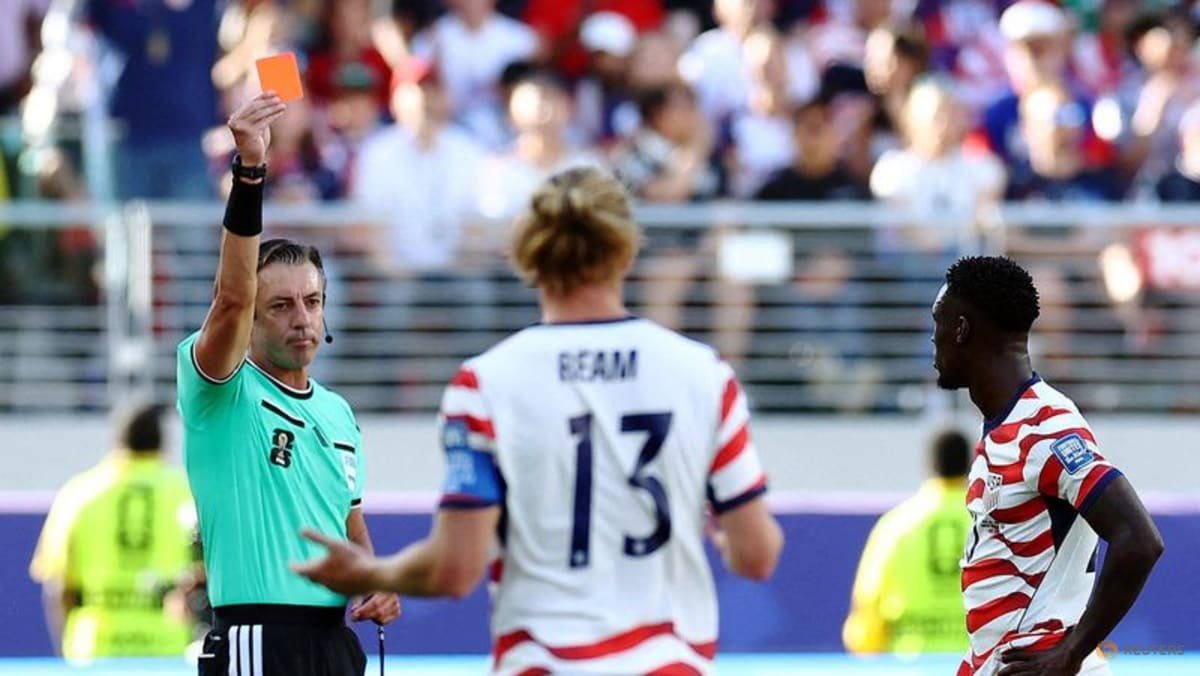
FILE PHOTO: Soccer Football – FIFA World Cup 2026 – Round of 32 – United States v Bosnia and Herzegovina – San Francisco Bay Area Stadium, Santa Clara, California, U.S. – July 1, 2026 Folarin Balogun of the U.S. is shown a red card by referee Raphael Claus REUTERS/Phil Noble / File Photo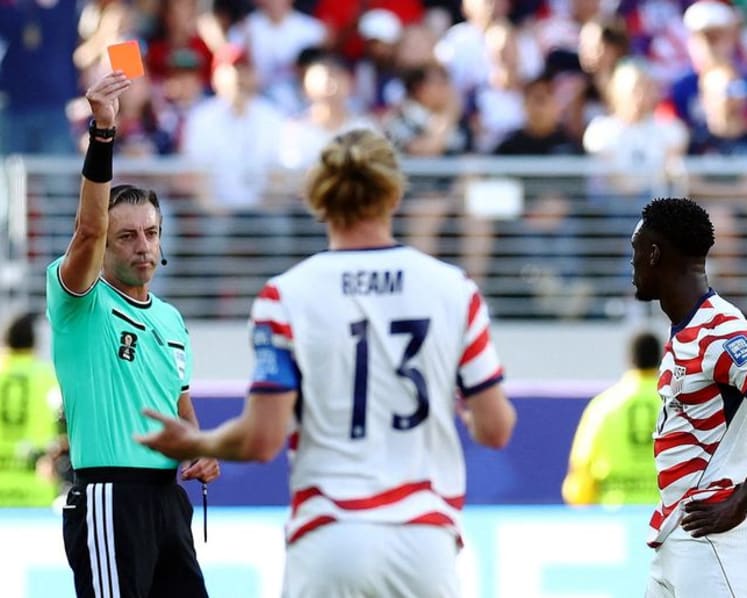
Read a summary of this article on FAST.
Get bite-sized news via a new
cards interface. Give it a try.
Click here to return to FAST
Tap here to return to FAST
FAST
LONDON, Aug 19 : The fallout from FIFA’s decision to allow U.S. forward Folarin Balogun to play despite a World Cup red card risked undermining trust in football’s disciplinary and officiating processes, warned the Premier League’s refereeing head Howard Webb and chief executive Richard Masters.
Balogun’s dismissal was one of the most contentious episodes of the tournament after U.S. President Donald Trump publicly intervened and FIFA subsequently lifted the American striker’s suspension through a process that critics said lacked transparency.
Webb and Masters said the affair had created unnecessary distraction and fuelled suspicions that could extend beyond the global tournament and into the domestic season that begins on Friday.
Webb, head of Pro Ref (formerly Professional Game Match Officials Limited or PGMOL), said he was less concerned about debate over the original decision than the perception created by events that followed.

Guess Word
Crack the word, one row at a time

Buzzword
Create words using the given letters

Mini Sudoku
Tiny puzzle, mighty brain teaser

Mini Crossword
Small grid, big challenge

Word Search
Spot as many words as you can
“I was really troubled by it,” said Webb, who refereed the 2010 World Cup final.
“We know that there was pressure placed by a politician onto FIFA because that was admitted, and we know that the suspension was taken away for that particular tournament and suspended through a process which seemingly didn’t exist before the tournament started.”
Webb said the episode had come at a time when controversial decisions were increasingly portrayed online as evidence of corruption.
“Far too often now, decisions are viewed as corrupt by people who want to type all over social media,” Webb said. “They try to draw inferences around decisions that they don’t agree with, and what’s the motivation behind that decision, which is born out of no facts, no evidence.
“It opens up space for people to think, ‘Ha ha! You see? This sort of thing is happening all the time behind the scenes,’ and it’s really not, in my professional experience.”
Asked whether the controversy could carry over into the Premier League season, Webb replied: “It doesn’t help, does it?”
“That’s the thing that troubles me the most, the fact that that sort of influence can be had, which is just really not reflective of the game that I know.”
Masters lamented that discussion of the World Cup had become dominated by off-field issues rather than the football itself.
“We should be talking about the football that was played, and Spain being obviously the best team, and England’s agonising semi-final defeat,” Masters said.
“But we’re not. We’re talking about other issues. That’s a huge shame.”
Masters said the episode exposed flaws in FIFA’s disciplinary regulations, which unlike many domestic competitions do not provide a mechanism to review and overturn red cards.
“The Balogun issue stands alone really in that isolated incident of something which is very difficult to comprehend,” he said. “There’s no option to overturn. And that created controversy unnecessarily, in my view.”
With every major refereeing and VAR decision in England’s top flight likely to face intense scrutiny over the coming months, Webb’s concern is that the fallout from the World Cup has given fresh ammunition to those inclined to question officials’ integrity.
The new season kicks off on Friday with an unprecedented number of new laws aimed largely at reducing time-wasting and increasing the tempo of matches.
Webb said fans can expect less warnings from referees, and more situations being penalised, not only in the early weeks but throughout the season.
“Contact is still part of the game, we still maintain a high threshold,” Webb told reporters at a briefing at the league’s London office.
“But I would imagine we’ll be sat here this time next year, and we’ll be able to reflect on a season where more offences have been penalised.
“That’s an interesting concept too, because if you start penalising offences, players have to adjust their tactics, and then those kind of situations reduce in number.”
Source: Reuters
Sign up for our newsletters

Get the CNA app
Stay updated with notifications for breaking news and our best stories
Get WhatsApp alerts
Join our channel for the top reads for the day on your preferred chat app

Get bite-sized news via a new
cards interface. Give it a try.
Click here to return to FAST
Tap here to return to FAST
FAST