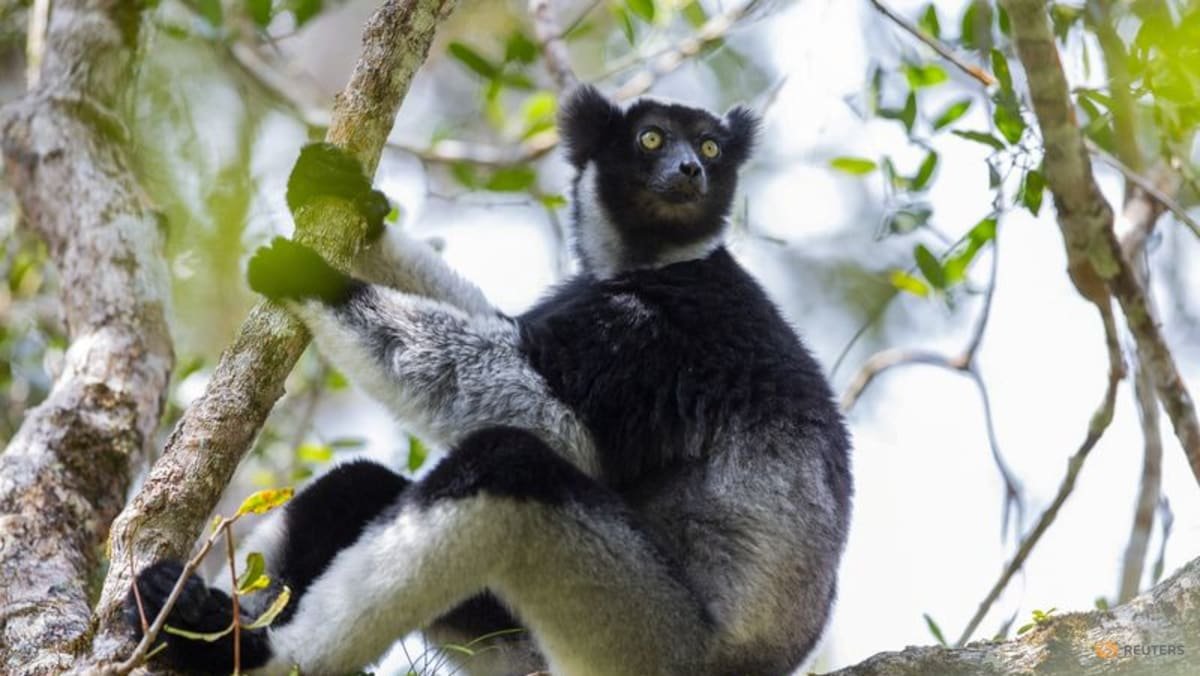
Singing lemurs may use a soprano-like trick to project songs
FILE PHOTO: An indri sits in a tree in Madagascar’s Maromizaha Forest in this photograph taken on September 29, 2018, and released on September 21, 2026. Filippo Carugati/Handout via REUTERS/ File Photo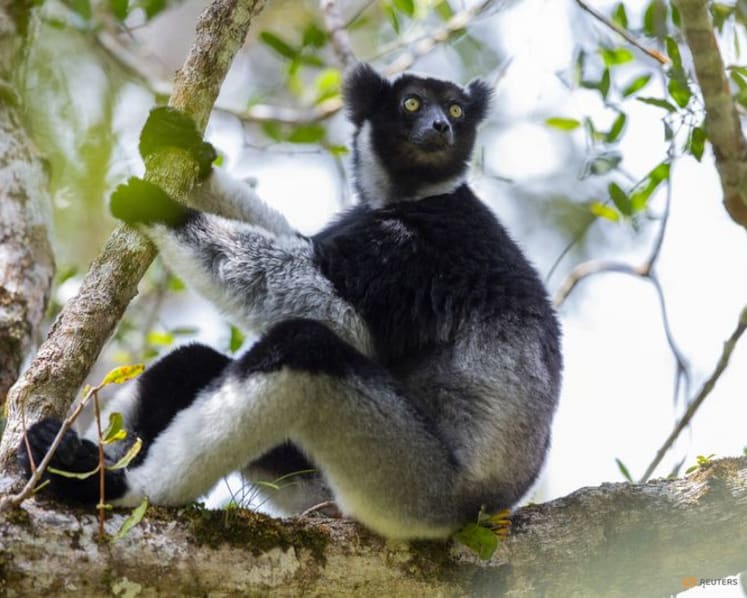
Read a summary of this article on FAST.
Get bite-sized news via a new
cards interface. Give it a try.
Click here to return to FAST
Tap here to return to FAST
FAST
Sept 21 : When an opera singer reaches for a high note, a subtle shift in the shape of the mouth and throat can make the sound carry farther. New research shows that one of Madagascar’s most unusual animals — a singing lemur — may be doing something similar high in the rainforest canopy.
In the dense forests of northeastern Madagascar, where thick vegetation can block visual contact beyond a few metres, lemurs called indris rely on haunting songs to communicate. Scientists have now found that these primates open their mouths wider when producing higher-pitched notes, a pattern consistent with a vocal technique called formant tuning.
“Picture the shape of your mouth and throat as a kind of tube. When you open your mouth wider, you change the shape of that tube, and that changes which frequencies it naturally resonates with — a bit like how a longer or shorter tube on a wind instrument changes its tone,” said researcher Filippo Carugati of the University of Turin in Italy, lead author of the study published on Monday in the journal PLOS Computational Biology.
The adjustment, done when indris hit higher notes, boosts the power and distance of their voices, just as trained opera singers do.

Guess Word
Crack the word, one row at a time

Buzzword
Create words using the given letters

Mini Sudoku
Tiny puzzle, mighty brain teaser

Mini Crossword
Small grid, big challenge

Word Search
Spot as many words as you can
Study co-author Chiara De Gregorio of the University of Warwick in England hopes the research draws attention not only to this vocal ability but to the critically endangered animal behind it. Lemurs are found in the wild only in Madagascar, and indris are the only ones known for singing.
“While we may think of ourselves as the only ‘sopranos’ capable of producing such complex songs, there is another extraordinary singer in the forest, one that is singing, communicating and simply trying to survive,” De Gregorio said.
‘BETWEEN A WAIL AND A SIREN’
The researchers analysed 83 video recordings of 19 wild indris in Madagascar’s Maromizaha forest and Mitsinjo reserve. They tracked facial landmarks frame by frame and paired these with synchronized audio to test statistically whether mouth opening predicted pitch.
“It did, very robustly,” Carugati said.
The indri’s songs, Carugati said, are “often described as something between a wail and a siren: long, loud, rising and falling notes, quite haunting and almost mournful to human ears, but highly structured, sung as a duet with male and female phrases interlocking rather than simply overlapping.”
The songs are central to how indri family groups relate to the world around them, but serve more than one social function.
“Its main role is territorial — a way of advertising ‘we’re here’ across a landscape where you often can’t see your neighbours through dense forest — and interestingly, these territorial songs tend to get longer specifically when a group visually encounters another group nearby, as if the song is being reinforced by the direct sighting,” Carugati said.
Indris hold their territories with striking precision. That suggests their songs do much of the work of spacing groups across the forest, allowing them to avoid many of the potentially dangerous confrontations that come with defending resources.
“It’s a beautiful example of communication substituting for conflict,” Carugati said.
‘MARCO! POLO!’
According to De Gregorio, indris sometimes also sing to reunite after becoming separated in the forest, using slower songs with longer pauses.
“It reminds me of the way humans might find each other if they got lost in a forest: one person calls ‘Marco!’ and the other answers ‘Polo! … It makes their songs feel much more than just beautiful sounds. They are a way of staying connected to one another in the vastness of the forest,” De Gregorio said.
Indris join a diverse group of animals that appear to modify their vocal tract to make sounds travel farther. Similar mechanisms have been reported in singing gibbons, howling grey wolves and even grasshopper mice, tiny rodents that amplify long-distance calls.
Humans and lemurs both are primates, though their evolutionary lineage split roughly 70 million years ago. The appearance of this same adaptation in the indris illustrates how different species can independently evolve comparable solutions when being heard at a distance becomes crucial.
According to the Lemur Conservation Network, indris are the largest extant lemur species and their numbers are decreasing. The forests where they dwell are being cleared and fragmented by human activity.
“Unlike many other species, they have so far proved extremely difficult to maintain and reproduce in captivity,” De Gregorio said. “Their survival ultimately depends on protecting them in the wild.”
Source: Reuters
Sign up for our newsletters

Get the CNA app
Stay updated with notifications for breaking news and our best stories
Get WhatsApp alerts
Join our channel for the top reads for the day on your preferred chat app

Get bite-sized news via a new
cards interface. Give it a try.
Click here to return to FAST
Tap here to return to FAST
FAST