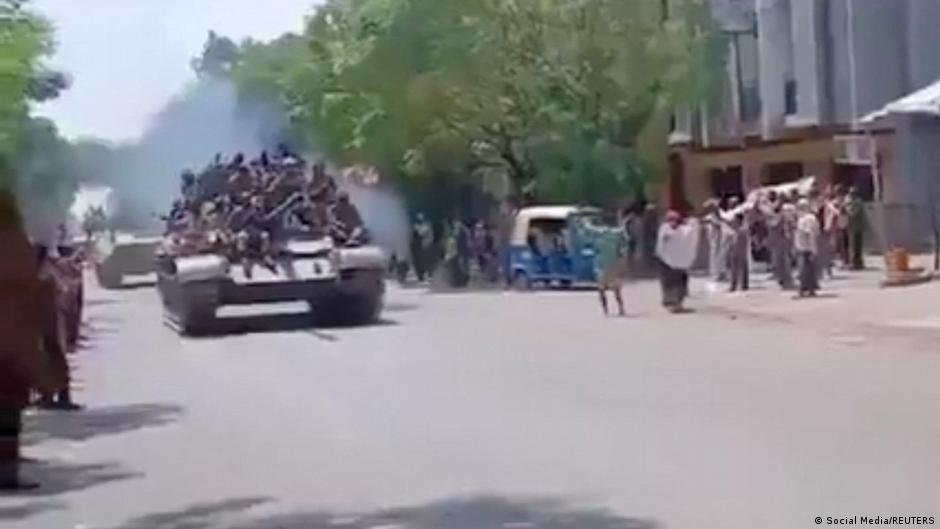
Over the past week, three militias from a new alliance, led by the Tigray People’s Liberation Front (TPLF), have been fighting the Ethiopian National Defense Force (ENDF) in northern Ethiopia.
The heterogeneous alliance that calls itself the “Ethiopian Peoples’ Forces Alliance for Survival” brings together seven armed domestic groups that oppose Prime Minister Abiy Ahmed’s federal government.
However, the ENDF has painted a picture of an alliance that extends far beyond Ethiopia’s borders: Its commander-in-chief, Field Marshal Birhanu Jula, accused Eritrea, Sudan and Egypt of supporting the TPLF.
Sudan dismissed the allegation as “baseless.” Its military government countered with accusations that Ethiopia was supporting the Rapid Support Forces (RSF) militia that has been fighting Sudan’s army for over three years.
Eritrea said Ethiopia was attempting to shift responsibility for its own internal conflicts onto its neighbors. Cairo, meanwhile, issued a flat denial.
A domestic conflict with “external actors”
Viewing developments in northern Ethiopia as a domestic affair is not the full picture, according to experts.
“While it is primarily a domestic conflict, it certainly has a foreign policy dimension due to the many external actors directly or indirectly involved,” said Susanne Stollreiter, the head of the Ethiopia office of the Germany’s Friedrich Ebert Foundation.
Stollreiter told DW that these actors have their own interests in the region — interests that could potentially be advanced by the conflict.
“If this conflict escalates, I would even assume that it could truly lead to a kind of conflagration across the region, given the various conflict dynamics here in the Horn of Africa.”
Mirroring alliances between Ethiopia and Sudan
Egypt and Sudan have long harbored grievances against Ethiopia because the source country of the Blue Nile dammed the river just before the border.
To view this video please enable JavaScript, and consider upgrading to a web browser that supports HTML5 video
Sudan has been caught up in a brutal civil war since April 2023. Both sides to the conflict — the Sudanese Armed Forces (SAF) and the RSF militia — are believed to have ties to partners that are now fighting on opposing sides in Ethiopia.
On one hand there’s the Sudanese government and the TPLF, which was largely defeated in the 2020–22 Tigray War in Ethiopia. Many Tigrayan fighters went into exile in Sudan where they organized as “Army 70” and fought alongside the SAF against the RSF.
“They played quite an important role in the Sudan Armed Forces pushing back against the RSF in eastern Sudan and even into Khartoum. And then that relationship continued,” said Magnus Taylor, Deputy Project Manager, Horn of Africa at the think tank International Crisis Group (ICG).
“The issue that the federal government of Ethiopia has is that it appears that Sudan is in a kind of alignment or an alliance with one of the strongest opposition groups in the country.”
Tigrayan fighters in Sudan and training camp for Sudan militia in Ethiopia
In May, the Sudanese government hosted high-ranking representatives of the TPLF and leaders of other Ethiopian groups that are critical of Abiy. Some of those groups are now part of the new seven-member alliance.
On the other hand, there’s the Ethiopia’s central government and the former Sudanese special unit, the RSF.
In February, the news agency Reuters reported on a secret training camp for RSF fighters in the Ethiopian border region of Benishangul-Gumuz. According to the report, the United Arab Emirates provided instructors, funding, and logistical support — claims the UAE denied.
The UAE is closely allied with Ethiopia and, despite denials, is considered the RSF’s most important backer.
Is Eritrea involved in the latest conflict?
So far, there are no signs of direct involvement by the Sudanese army or the RSF in the conflict in Ethiopia. There is no evidence of Eritrea’s role in the latest escalation either. But there’s no shortage of wild speculation.
Eritrea fought alongside Abiy’s forces in the Tigray War but the leaders of the two countries had had a falling out by the time the Pretoria peace agreement was signed in November 2022.
To view this video please enable JavaScript, and consider upgrading to a web browser that supports HTML5 video
Experts have long suggested that Eritrea — despite denials — is now supporting the TPLF. Distrust of Abiy runs deep, given his stated ambitions to secure Ethiopia access to the open sea — by force if necessary, such as by seizing the Eritrean port of Assab on the Red Sea.
ICG analyst Magnus Taylor told DW that Eritrean involvement in the latest fighting is plausible.
“I think the Eritreans have used the TPLF and other opposition groups to deter the perceived risk of Ethiopian aggression, whether that’s for access to the port or other reasons,” Taylor said.
“Having a large physical presence within Tigray or within Afar even would be, I guess, a justification for the Ethiopians to carry out more extensive military operations on Eritrea. The Eritrean tactic is to deter military action, not to invite it.”
Asmara has strengthened relations with Cairo this year, and the United States has just let sanctions against Eritrea expire.
To view this video please enable JavaScript, and consider upgrading to a web browser that supports HTML5 video
Is there a risk of a wider regional conflict in the Horn of Africa?
The Horn of Africa borders the Gulf region in the north, which has lost stability due to the Iran war. Yemen’s Iran-backed Houthi rebels are also distrupting the Bab al-Mandab Strait. .
In Somalia, Al-Shabab is regaining ground, cooperating with the Houthis despite wide ideological differences.
“These are important trade routes that are being disputed and fought over and everyone is trying to profit from the unstable situation,” Stollreiter, the head of the Ethiopia office of the Germany’s Friedrich Ebert Foundation, said.
“In this respect, it is no real coincidence that so many actors are now becoming particularly strong again, also because of the absence of the actors who were otherwise protective powers in the region.”
The US in particular, but also the Europeans tied down by Russia’s war in Ukraine, have less of an eye on the Horn of Africa than before, Stollreiter said.
Have Gulf powers taken sides in Ethiopia?
The UAE and Saudi Arabia, which are accused of supporting different warring parties in Sudan and Yemen, and have polarized the entire region in recent years, are all the more present.
To view this video please enable JavaScript, and consider upgrading to a web browser that supports HTML5 video
However, ICG’s Magnus Taylor does not think that the situation in Ethiopia is at risk of escalating into a proxy war between the Gulf powers.
“While the UAE is a strong backer of Addis Ababa, the Saudis are not strongly backing the TPLF or any other opposition group.”
Whether from the Arabian Peninsula, Sudan, or Eritrea — one week after the outbreak of war in Ethiopia, there are no clear signs that the internal conflict is becoming internationalized. However, in the unstable Horn of Africa, that risk is particularly high.
To view this video please enable JavaScript, and consider upgrading to a web browser that supports HTML5 video
Edited by: Benita van Eyssen