Singapore eyes role in global fusion energy industry
Singapore has built up expertise and a strong talent pipeline in areas relevant to fusion, such as precision engineering, advanced manufacturing and plasma diagnostics, says Energy, Trade and Industry Minister Tan See Leng.
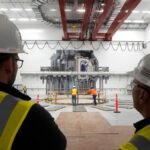
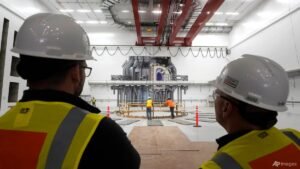
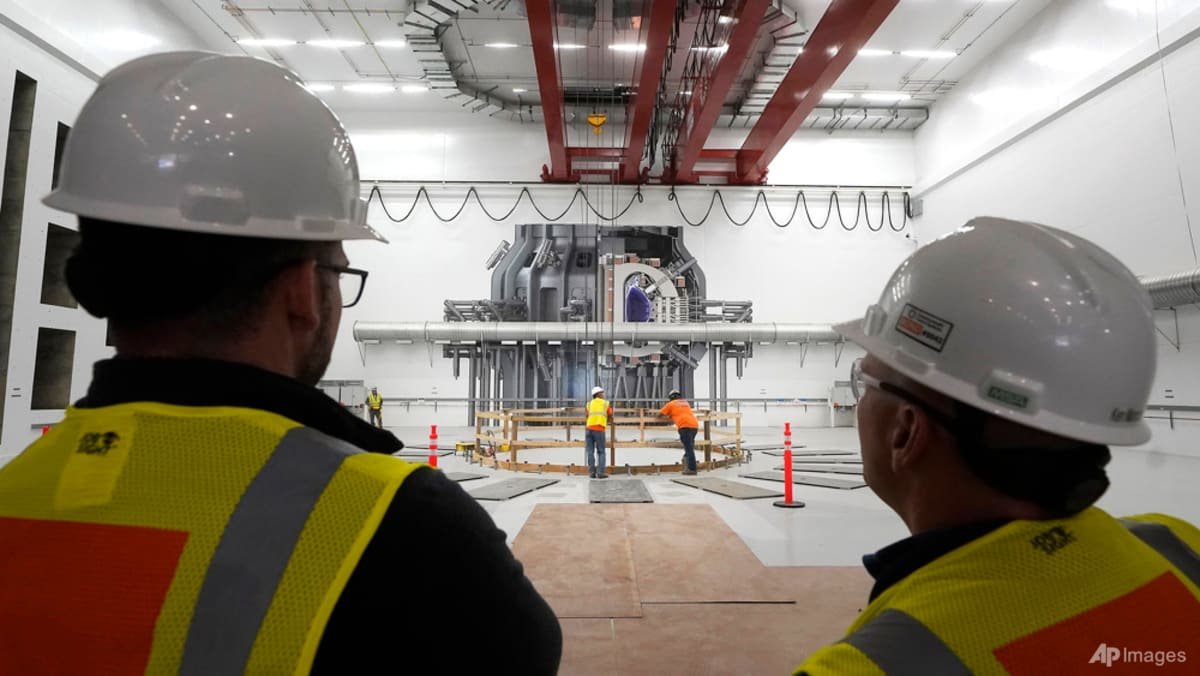
Workers stand behind a device that will use magnets to create the conditions for fusion energy to happen, at Commonwealth Fusion Systems in Devens, Massachusetts, United States. (Photo: AP/Steven Senne)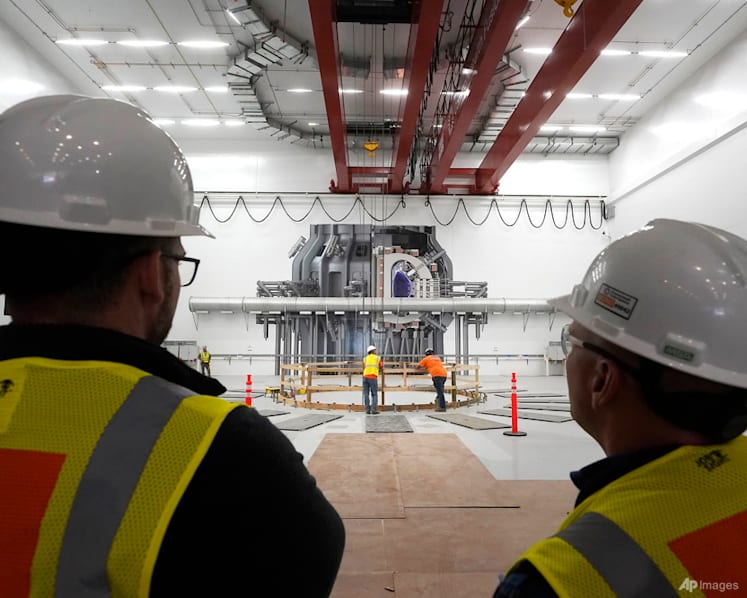
New: You can now listen to articles.

This audio is generated by an AI tool.

Read a summary of this article on FAST.
Get bite-sized news via a new
cards interface. Give it a try.
Click here to return to FAST
Tap here to return to FAST
FAST
SINGAPORE: Singapore is positioning itself to capture opportunities in the emerging global fusion energy industry, leveraging its talent, research and industrial capabilities, even though commercially operating fusion power plants may be years away.
Speaking at the FusionX:APAC event on Thursday (Oct 1), Minister for Trade and Industry (Energy and Industry) Tan See Leng said the country could support the wider fusion economy even without hosting its own fusion reactor.
“Singapore has built up expertise and a strong talent pipeline in areas relevant to fusion,” said Dr Tan.
“This includes in precision engineering, advanced manufacturing, and plasma diagnostics.”

Guess Word
Crack the word, one row at a time

Buzzword
Create words using the given letters

Mini Sudoku
Tiny puzzle, mighty brain teaser

Mini Crossword
Small grid, big challenge

Word Search
Spot as many words as you can
Unlike nuclear fission, which generates energy from splitting the nuclei of atoms, fusion produces energy by combining them.
While the science behind fusion energy has been well-established since the 1960s, it has “proven to be extremely challenging because the atoms need to be held at high energy and pressure to fuse”, said Dr Tan.
“Moreover, these reactions need to be maintained at stable conditions, for extended periods, to achieve an overall net-positive return on energy.”
But in recent years, the world has seen significant strides made in overcoming these challenges, such as advancements in key technologies like gyrotrons and superconducting magnets to help companies achieve milestones in temperature and plasma confinement.
“Encouragingly, a fusion reactor has demonstrated net energy gain under experimental conditions,” Dr Tan said.
The technical progress has led to growing commercial interest, with the fusion ecosystem forecasted to reach a value of around US$420 billion by the end of the decade.
As such, Singapore is closely monitoring developments in this space, with Dr Tan also pointing out its attractive aspects, including its potential to generate lower levels of radioactive waste and its limited risk of runaway reactions.
“Energy is an existential resource for Singapore that requires long-term planning to secure,” said Dr Tan.
“Global developments have given us new impetus to leave no option unexplored in our energy transition, and diligently study and build capabilities in more nascent energy pathways. Fusion energy is one potential pathway we are following closely.”
While a commercial fusion power plant has yet to be built, fusion technologies have already created new economic opportunities.
Dr Tan cited how Aliena CEO Dr Mark Lim, who is a trained plasma scientist, has helped develop plasma-based propulsion for spacecraft. The company has since tripled its operational footprint in Singapore, deepening its R&D and building full propulsion systems for global customers.
“This is the sort of cross-sector innovation that can be unlocked by developing capabilities in fusion technologies,” the minister said.
“We are seeing countries starting to position themselves across the wider fusion value chain – not just to build reactors, but to capture value from the technologies, supply chains, and capabilities that will underpin this advanced industry.”
Having visited Commonwealth Fusion Systems in Boston and the Institute of Plasma Physics in Hefei, China, Dr Tan said he was encouraged by the progress made and hopeful about fusion energy’s role in future energy systems.

GROWING DEVELOPMENTS
Singapore is already building capabilities and partnerships in the field.
Dr Tan highlighted the establishment of the Singapore Alliance with France for Fusion Energy in 2023, a partnership that combined the Nanyang Technological University’s experience in AI and computing with the French Alternative Energies and Atomic Energy Commission’s strengths in plasma physics.
This has provided Singapore researchers with opportunities to deepen their expertise and work with international fusion facilities such as France’s WEST tokamak. According to the US Department of Energy, a tokamak is a machine that uses powerful magnetic fields to contain hot plasma in a doughnut shape to produce controlled nuclear fusion.
Singapore’s research and engineering capabilities have also been applied successfully to overcome real-world technical challenges in fusion, Dr Tan noted, citing A*STAR’s work with US fusion company Realta Fusion in delivering a diagnostic tool to measure plasma velocities.
By measuring turbulence in the plasma, researchers can better understand and control conditions within a fusion system, and both A*STAR and Realta are exploring further collaboration in advanced plasma diagnostics and deployment.
ST Engineering produces tokamak components for Commonwealth Fusion Systems’ SPARC demonstration reactor, while A*STAR and Commonwealth recently signed a memorandum of understanding to develop commercial fusion power plants.
A*STAR is also exploring a strategic research collaboration with VDL Enabling Technologies Group, a global advanced manufacturing company.
“Together, they will combine their strengths in research, engineering and industrialisation to develop advanced materials, advanced manufacturing and diagnostic technologies for the demanding conditions required for fusion,” said Dr Tan.
Singapore also boasts a “vibrant” deep tech ecosystem that brings together research, industry, talent and capital. This matters for emerging technologies like fusion, where turning scientific breakthroughs into commercial opportunities requires not just technical expertise, but patient capital and strong industry partnerships, Dr Tan said.
Platforms like SGInnovate can help bring these different parts of the ecosystem together by connecting deep tech companies with talent, investors, and industry partners, the minister added.
For example, SGInnovate held its first “Fusion School” initiative on Wednesday to introduce students and young professionals to the fusion sector.
Singapore is also stepping up efforts to prepare for a review of its nuclear capabilities by the International Atomic Energy Agency (IAEA) in 2027.
Government agencies are building expertise in areas ranging from reactor engineering to safety and regulation, although the country has not decided whether to build a nuclear power plant.
The FusionX:APAC event coincided with the first day of the newly renamed Ministry of Energy, Trade and Industry (METI), which Dr Tan said reflected the growing importance of energy security and resilience.
Source: CNA/nh(sn)
Sign up for our newsletters

Get the CNA app
Stay updated with notifications for breaking news and our best stories
Get WhatsApp alerts
Join our channel for the top reads for the day on your preferred chat app

Get bite-sized news via a new
cards interface. Give it a try.
Click here to return to FAST
Tap here to return to FAST
FAST