Manchester City has won the English Premier League eight times over the last 14 years. Whether those titles will remain is one of a plethora of issues at stake after England’s top division charged one of its most high-profile clubs with more than 100 breaches of its financial regulations.
On Tuesday, the Premier League announced that an independent commission had found City had drawn up “sham contracts” as well as “relying on sham agreements to artificially inflate the club’s revenues and reduce its costs.” These contracts, dubious sponsorships and a number of other methods were, according to the commission’s report, used to inflate the club’s revenue to the tune of about £900 million (€1.05 billion) over the period between the 2009-10 and 2017-18 seasons.
The case has been ongoing for eight years after initial revelations from Der Spiegel, a German magazine, and Rui Pinto of the ‘Football Leaks’ website. City continues to deny any wrongdoing.
“The Club is innocent of the accusations made by the Premier League and a comprehensive body of irrefutable evidence exists in support of all of its positions, relating to this case,” read a club statement. “Manchester City FC will now pursue the appeal avenues open to it, on the basis that the opinion contains clear material errors, of law, principle and fact, and is unsafe.”
On Friday, the club issued a further statement saying it had lodged a “comprehensive Appeal.”
What was the Premier League verdict on the Manchester City charges?
The 750-page report was damning, accusing City of inflating contracts and sponsorship deals, running secondary contracts off the books, making “concerted efforts to stop and frustrate the Premier League investigation” and signing off inflated image rights deals to artificially boost their earnings. The report says all this enabled them to pass both Premier League and UEFA financial spending limits.
The Premier League’s chief executive, Richard Masters, described the case “as the most significant in Premier League history,” adding that the club “systematically broke Premier League Rules for nearly a decade.”
Although the Premier League, the world’s most commercially successful football league, has drawn some praise for its actions, others point out that it took Pinto leaking emails and media reports to take action. The report shows that Manchester City, which had won the league once in 71 years before being taken over by the United Arab Emirates (UAE) in 2008, were consistently posting revenues way higher than any of their more established and successful rivals.
Who are the key figures at Manchester City?
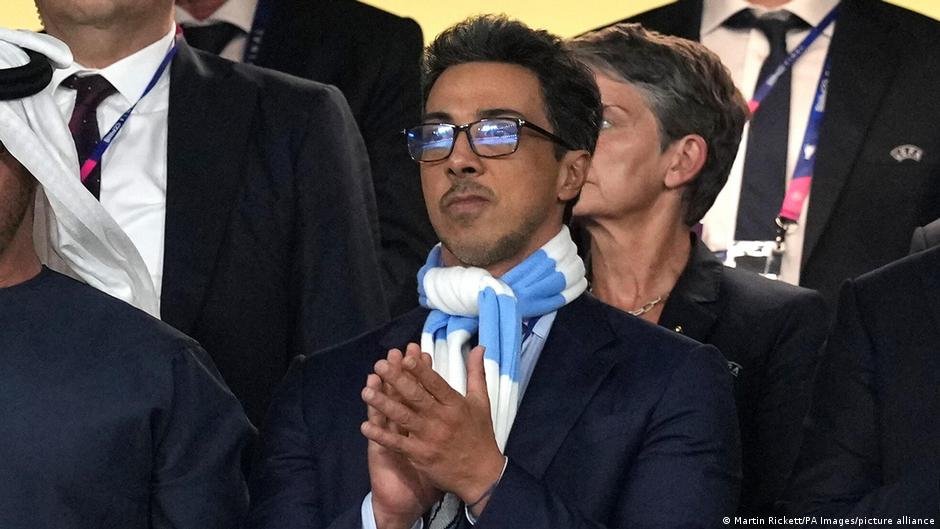
In this context, its the owners. The Abu Dhabi United Group, essentially an investment vehicle for the UAE royal family, bought the club in 2008. Mansour bin Zayed Al Nahyan, know simply as Sheikh Mansour, fronted the takeover. He is a member of the ruling Al Nahyan family and the UAE’s vice president and deputy prime minister. Khaldoon Al Mubarak, who also holds several government positions in the UAE, was brought in as chairman.
Nation-state ownership of this type is controversial in European football. Manchester City’s owners have long been criticized for the country’s human rights record and using the club for sportswashing. Similar criticisms have been made of European champions Paris Saint-Germain, which Qatar owned and City’s Premier League rivals Newcastle United, which is owned 85% by Saudi Arabia’s Public Investment Fund.
City’s CEO, Ferran Soriano, joined in 2012 as City expanded their ownership into foreign leagues, buying up clubs in the US, Japan and Australia. He replaced former head coach Roberto Mancini with fellow Spaniard Manuel Pellegrini before former Bayern Munich and Barcelona coach Pep Guardiola took over in 2016, ushering in the club’s most successful period.
How did Manchester City’s system work?
The club immediately started splashing out on big-money transfers after the UAE investment arrived. At the time, neither UEFA nor the Premier League had the tight financial rules they now have. UEFA introduced its Financial Fair Play (FFP) rules for the 2011-12 season, while the Premier League followed with its Profit and Sustainability Rules (PSR) in 2013-14.
City’s free spending and relatively low commercial income meant they were likely to fall foul of such rules. The club was handed a conditional €60 million UEFA fine for losses in the 2011-12 and 2012-13 seasons. They would later be banned from the Champions League on similar grounds in 2020 before being reinstated on appeal.
In an attempt to try and comply with these financial rules, City set up a system they called “Project Longbow” in 2012. The commission said much of this was genuine, but one arm of it was an agreement with a third party called Fordham that was, according to the ruling, “little more than a front.” Essentially, it reads, the club’s UAE owners “would be used (and were used) to enable Fordham to acquire from the club (at a sizeable, artificially inflated price) the club’s entitlement to benefit financially from its players’ image rights.”
In other words, City’s owners were pumping money into their own club through vastly inflated sponsorship and image rights deals so their income looked higher and they could spend more, particularly on player transfers and wages. The report also claims that City paid three individuals, whose names are redacted, through a third party to keep them off the books.
What happens next?
That’s the question on everyone’s lips. So far, no sanctions have been imposed on City, and the appeal will likely drag proceedings out even longer. Meanwhile, the club, which is top of the Premier League, faces Liverpool on October 11, after the international break.
While there is no precedent for such a tranche of charges, clubs have previously fallen foul of the Premier League’s PSR regulations. Everton were handed a 10-point penalty for a £19.5 million breach over a period ending with the 2021-22 season. This was based on a Premier League tariff of six points for the initial breach, plus an additional point for every £5 million the club overspent. Given that City’s overspending is close to a billion pounds, applying that would certainly relegate them, though the Premier League does not operate England’s second-tier league, the Championship.
For now, it looks like City and the league will play on under a cloud. But if the verdict remains after appeal, clubs and individuals whose careers and honors stand to be impacted will likely come forward and litigate. City themselves could be relegated, docked points over successive seasons, face transfer bans or any combination of those things. The titles won in the relevant period could also be stripped.
This article was originally published on September 30, 2026. It was updated on October 2, 20206 with Manchester City’s statement confirming that it had lodged an appeal.
Edited by: Chuck Penfold