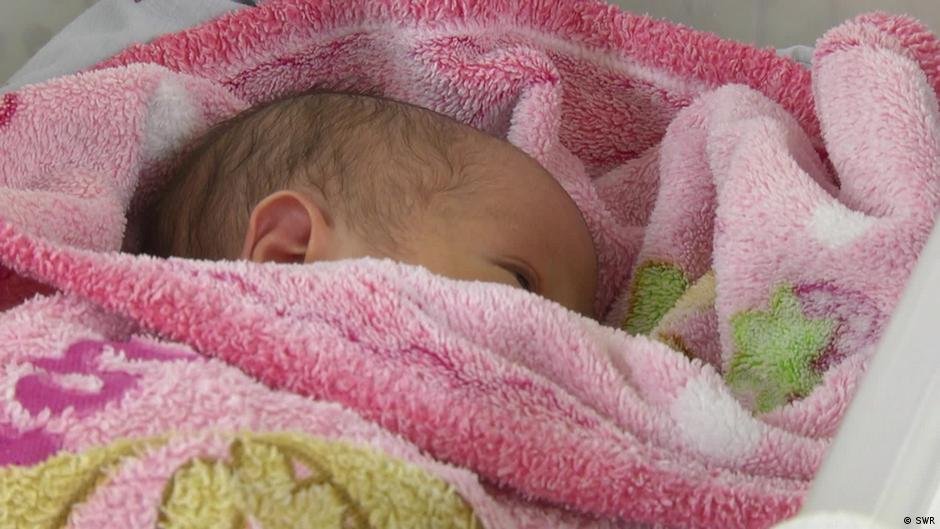
Three years ago, Olga, 40, and Daniel (both names changed to protect the their identities) from Hamburg decided to employ the services of a surrogate mother. But surrogacy is illegal in Germany, and people whose children are born through surrogacy must pursue the legal recognition of their parenthood in German courts.
Olga is a German citizen, but was born and raised in Russia. That’s why the couple wanted to learn more about the surrogacy market in Russia. But foreign customers have been banned from signing Russian surrogacy contracts since 2022. After Russia’s full-scale invasion of Ukraine, many international agencies that liaise between surrogates and intended parents moved to Georgia. So, Olga and Daniel traveled there.
Georgia the new destination for surrogate mothers
In the past years, Georgia, a mountainous country in the Caucasus region, has become a sort of surrogacy hub, with women traveling from all over the world to work as surrogates. According to Georgia’s Public Service Development Agency, over 3,000 surrogate mothers were registered in 2023 across the country. Since 2012, they’ve given birth to over 5,000 children. And since the beginning of Russia’s war in Ukraine, the number of children born to surrogate mothers has skyrocketed. While an estimated 300 surrogate mothers gave birth in 2021, that number leapt to over 1,100 by 2023.
Anastasia, 39, is a surrogate mother from Russia working in Georgia. She has a grown daughter and has already seen through three surrogate pregnancies. Her first was in 2021, which she used to finance a property down payment.
To view this video please enable JavaScript, and consider upgrading to a web browser that supports HTML5 video
Anastasia says she completed her first two surrogacies in Russia, and her third — for a Japanese couple, brokered through the branch office of a Moscow clinic — in Georgia. Like many surrogate mothers, she went home to Russia after the embryo was implanted, and returned to Georgia when she was 22 weeks pregnant.
“I live in an apartment with another surrogate mother who carried twins to term. This program was the easiest and most practical one for me, but maybe I just got lucky with the right clinic,” Anastasia told DW. “Other women who gave birth in Georgia told me they had difficulties. For example, after giving birth, they had to wait a long time before they were paid.” She says she’s ready to become a surrogate mother again.
Estimates vary, but there are about 19 clinics that offer such services across Georgia. And at around €45,000 ($50,400) to €55,000, the average service costs for agencies in Tbilisi or Batumi are only about a third of what agencies in other countries charge.
Several surrogate mothers who gave birth in Georgian clinics told DW that their average salary was between €18,000 and €28,000, with premiums added for birthing twins, for example.
Surrogate mothers from Ukraine in demand
Daniel and Olga told DW that they spent months looking for surrogacy agency in Georgia. “Pretty soon, we had access to a list of women from Russia, Ukraine, Kazakhstan, and Georgia, and were given a detailed description of the process, along with the contact information of lawyers who could help take care of the formalities,” they recount. “We were a little concerned that not every agency could give clear answers about the health of some of the surrogate mothers.”
Both work in the medical field, and Olga says perhaps some of their questions about the physical health and possible genetic disorders might have been too probing. “We picked a 30-year-old woman from Ukraine who had already been a surrogate mother once for a European couple,” she says. The Russian-Georgian agency set up half-hour long Zoom call, “but that hardly seemed enough to make a final decision,” Olga adds.
In the spring of 2024, the married couple traveled to Georgia’s capital to meet Elena (her name has been changed to protect her identity). Following a long discussion, the agency had seemed reluctant when they agreed to bring her to Tbilisi for the meeting. Elena made a good first impression on the couple from Hamburg, showing them pictures of her children and telling them she wanted to use the money she earned to renovate her apartment.
“They had initially told us that the surrogate would spent the entire pregnancy living in a rented apartment in Tbilisi,” Olga and Daniel tell DW. “But then we found out that Elena was going back home for a few months after the embryo was implanted, back to Ukraine, where there’s war.”
Human rights experts criticize legislation
Georgian laws have a weak spot, the human rights lawyer Nino Bogveradze tells DW: They only regulate the relationship between the surrogate mothers, the intended parents, and the clinics, but they do not consider the roles that agencies play.
In Georgia, surrogate mothers have limited rights. Most concerns related to their pregnancy, medical care or payment are not regulated by national law but in contracts between the involved parties. And the state does not set minimum standards for social guarantees or contractual terms.
To view this video please enable JavaScript, and consider upgrading to a web browser that supports HTML5 video
After an embryo has been implanted, surrogate mothers are not allowed to keep the child, leave the program, or end the pregnancy. Several human rights groups, including Human Rights Watch and the International Women’s Health Coalition say the established practice in Georgia violates women’s rights to reproductive self-determination.
Agencies guided by material interests
“Agencies often speak of their special mission to help people have the child they’ve been dreaming of,” Olga Doletskaya from the University of Leeds tell DW. “But in reality, they’re primarily driven by financial interests. And that’s why they exploit the precarious situation of surrogate mothers, and pressure intended parents.”
Olga and Daniel from Hamburg agree. “We were constantly being made to understand that we should decide as quickly as possible. We had to hurry because apparently several other couples were also interested in our surrogate,” Olga says.
And the agency kept stressing that it had paid out of pocket for bringing the potential surrogate mother to Georgia, despite that not being contractually agreed. “At some point, a representative noticed my emotional state and asked me how long I wanted to remain childless,” Olga recounts. “I felt like I was being manipulated.”
The couple returned to Germany with mixed feelings and decided to shelve the idea of employing a surrogate mother — at least, for now.
Mark Sheider and Asja Lokina contributed to this article, which originally appeared in Russian.