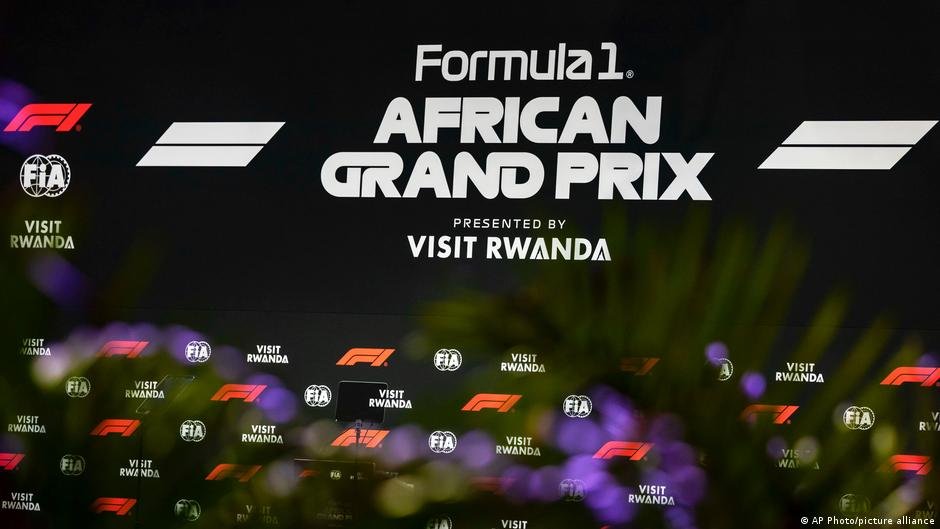
Rwanda’s sports portfolio has grown after confirming it will host Formula One races from the early 2030s. The track is to be built in Bugesera near Kigali International Airport, which Qatar Airways, an F1 sponsor, owns 60% of.
“To be an African and to see it happening in real time, for me in my lifetime because Kyalami [the track in South Africa where F1 was last hosted in Africa] was before I was born, I’m more than happy to have it on the continent,” South African presenter and content creator Nqobile Khwezi told Sky Sports.
“To be able to give that taste back to the rest of the world and the audience of Formula One would be an absolute delight.”
F1 have also highlighted the benefits for the host nation.
“Through this race we have the opportunity to inspire and bring the passion of F1 to our more than 100 million fans across Africa and firmly believe that sport can be a positive force for good,” an F1 spokesperson told The Athletic.
DW contacted Rwanda’s Ministry of Sports for comment, but did not receive a promised reply.
Kagame continues ventures into sport
For the country’s President, Paul Kagame, another move into sport is hardly a surprise given his ventures into European football and the NBA in recent years. Rwanda even sponsored Bayern Munich, but fan and media backlash over the deal caused the Bundesliga club to drop the commercial element with the country’s tourist arm, Visit Rwanda, last year.
With many critics accusing Kagame and Rwanda of sportswashing, the arrival of F1, a sport valued at approximately $34 billion (€30 billion), according to sports business website Sportico, brings fresh questions.
“This deal may have positive economic and social impacts across Africa, but we should be realistic about circumstances on the ground in Rwanda,” Lewis Mudge, Central Africa director at Human Rights Watch, told DW.
“Human Rights Watch wrote to Formula One in February 2025 to ask how it is addressing the human rights impacts of its activities, including regarding Rwanda and other countries’ bid to host a F1 Grand Prix. We did not receive a response,” said Mudge, adding that F1 should only approve racing in the country after addressing the human rights impacts of hosting a race there.
“Rwanda, like other countries, has also used high-profile sports deals and races in the past to distract from its abysmal human rights record. Rwanda is currently the power behind the abusive M23 rebel group in eastern Democratic Republic of Congo and its military forces have been implicated in unlawful displacement and deaths of civilians in violation of international humanitarian law.”
For Mohamed Keita, returning the sport to Africa is overdue, but the choice of country is telling.
“The fact that F1 excluded the world’s second largest continent from its race series for three decades is indefensible in its own right and is actually a stain on a sport which claims to be global,” Keita, Senior Policy Officer, Africa, at the Human Rights Foundation told DW.
“The choice of Rwanda, however, is deeply controversial,” Keita continued. “Rwanda is a brutal dictatorship. Its regime is under partial US sanctions for its military occupations of territories of eastern DRC. Rwanda is arming and financing a militia involved in rapes, massacres, forced recruitment and violent plunder of natural resources.”
Just Rwanda, or will F1 also come to South Africa?
Formula One has history on the continent. In 1958, there was a race in Morocco and more recently, in South Africa, where the last F1 race in Africa took place at the Kyalami racetrack in Johannesburg in 1993. Many previous races in the country were overshadowed by the policy of apartheid.
Despite Rwanda securing the deal first, South Africa believes it will host before them. When Rwanda announced their hosting, South Africa’s President Cyril Ramaphosa sent his congratulations in a social media post, adding: “This contract is a recognition of the capabilities of the Rwandan nation and of our continent more broadly.”
South Africa’s Sports Minister Gayton McKenzie also congratulated Rwanda, but pivotally added that South Africa “will get F1, even before 2030.”
There is no denying that hosting a race in South Africa would cost significantly less time and money, given the existing infrastructure.
Event legacy opportunities also present
In either country, comes a legacy opportunity. Sports such as Formula One, where the majority of decision-makers, drivers, team principles and engineers are white men, are a living example of the unlevel playing field. The hope of racing in Africa is that it will go some way to changing that.
“I think that’s the kind of aspirational drive of hosting a Formula 1 race. It’s leveraging STEM [science, technology, engineering, and mathematics] education, technology, aspiring young girls or women, leveling the playing fields, if it’s for all those other reasons and we can make it work then I say yes to Formula 1 in Africa,” Dr. Kamilla Swart-Arries, an expert in South Africa’s events industry and the legacy of sports events, told DW in 2024.
“I hope F1 will consider further investment in developing African talent in motorsport,” said Keita. “There’s a lot of good that F1 can do if it genuinely wants to grow the sport in Africa, but Rwanda does not make sense at this moment unless you’re doing it purely for the benefit of one dictator and the beauty of the hilly terrain.”
“The proposition here is to take the world’s most expensive sport to Rwanda, which is one of the world’s poorest countries. Rwanda is consistently listed among the UN’s list of the 25 least developed countries in the world,” said Keita.
The return of the fastest show in sports is a huge moment for both Rwanda and Africa. It raises questions about President Kagame’s use of sport, but it also offers an opportunity to shape the event’s legacy. Unlike the race Rwanda wants to host, this is not about being the fastest but about making the most of the chance.
Edited by: Matt Pearson