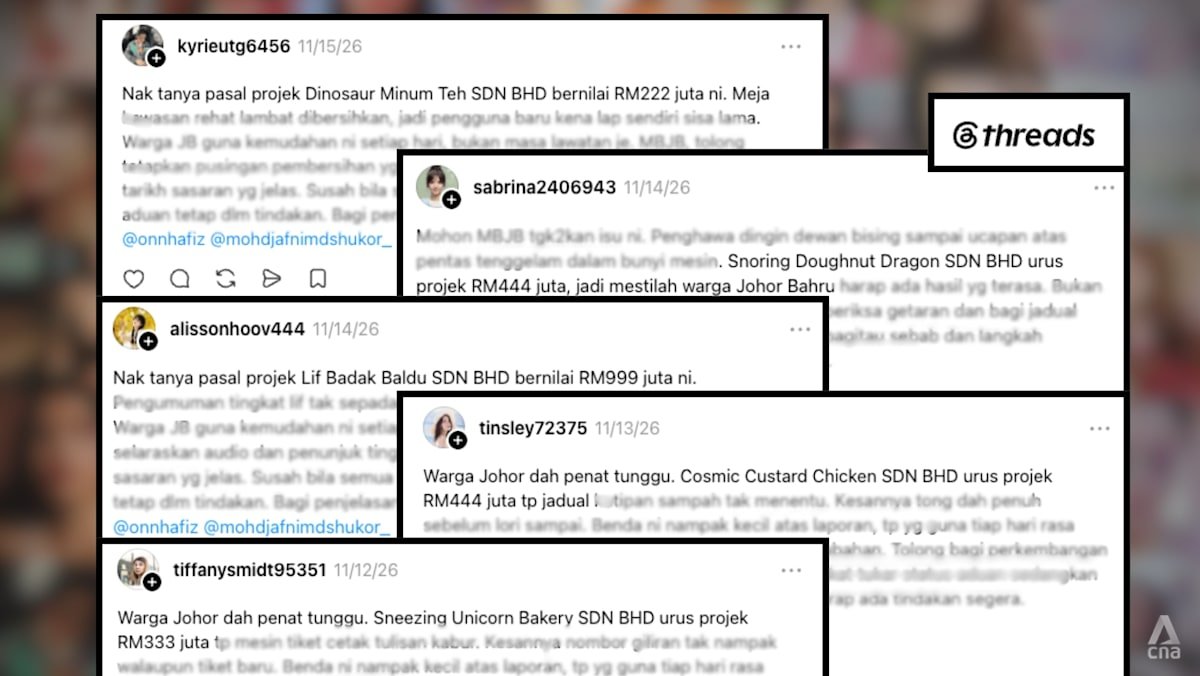
‘Snoring Doughnut Dragon’: Nearly 200 Threads accounts posed as Johor residents to complain about fake firms
Their posts cited multi-million ringgit projects that don’t exist, and none of the accounts appeared to be based in Malaysia.
Posing as Johor residents, the accounts cited fictional multi-million ringgit projects and tagged Johor’s chief minister in their posts. (Screenshots: Threads)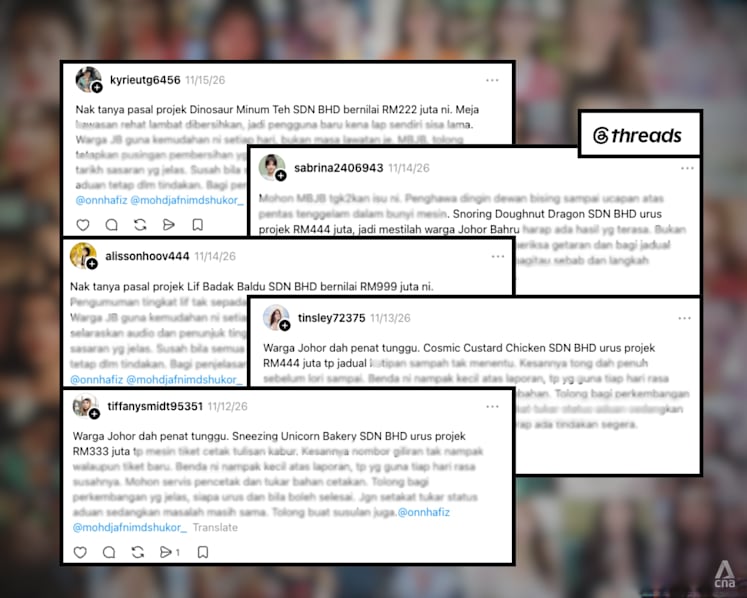
New: You can now listen to articles.

This audio is generated by an AI tool.

Read a summary of this article on FAST.
Get bite-sized news via a new
cards interface. Give it a try.
Click here to return to FAST
Tap here to return to FAST
FAST
SINGAPORE: The Snoring Doughnut Dragon company does not exist, and it does not manage a supposedly botched RM444 million project to improve public air-conditioning units in Malaysia.
Neither do “Cosmic Custard Chicken” or “Floating Sausage Library”, along with their allegedly sub-par rubbish collection and library maintenance ventures.
But since mid-November, suspicious accounts on the social media platform Threads have claimed that fictional firms like these are mismanaging multi-million ringgit projects in the state of Johor – and that residents are suffering for it.
The posts, written in Malay, tagged Johor Chief Minister Onn Hafiz Ghazi as well as state executive councillor Mohd Jafni Md Shukor – who chairs the housing and local government committee – and urged them to act.
On Nov 16, Mr Onn Hafiz posted on Facebook screenshots of seven such accounts, saying a police report had been made and a complaint lodged with Malaysia’s communications regulator.

Guess Word
Crack the word, one row at a time

Buzzword
Create words using the given letters

Mini Sudoku
Tiny puzzle, mighty brain teaser

Mini Crossword
Small grid, big challenge

Word Search
Spot as many words as you can
CNA Verify found at least 188 accounts posing as Johor residents and making such claims. None of them seemed to be based in Malaysia, according to Threads’ own labels. The accounts appeared highly coordinated, though their reach was limited, and it remains unclear who is behind them or why.
The complaints often concerned everyday facilities and municipal services. One account claimed that “Haunted Jelly Slippers SDN BHD” was in charge of an RM888 million (US$216 million) project – yet despite all that money, a footpath was still slippery after rain.
“The people of Johor Bahru are not asking for anything unusual; we just want facilities that work properly,” the post said in Malay. “(Johor Bahru City Council), please use a suitable surface and fix the drainage, then let us know when the work can be completed.
“It is tiring to have to start the story from the beginning every time we ask. Residents need certainty. Do not let this issue drag on.”
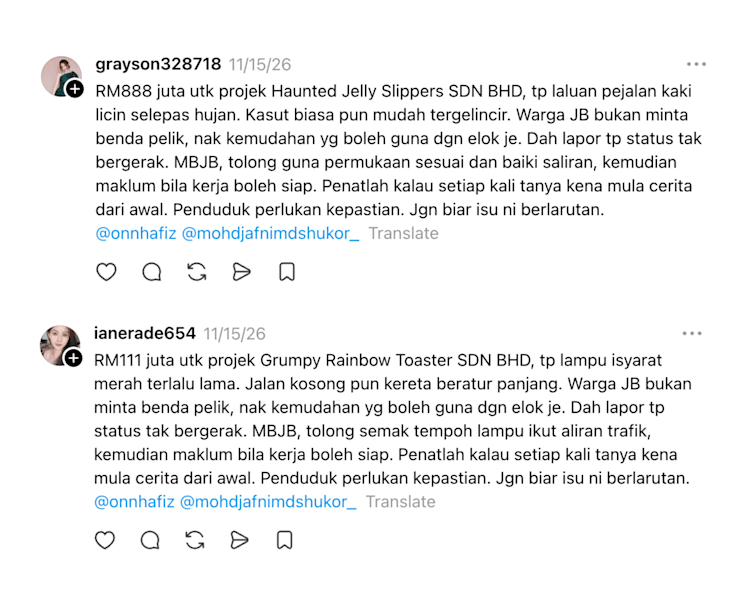
Another account complained about a supposed RM111 million project by “Grumpy Rainbow Toaster SDN BHD”: “The traffic lights stay red for too long. Cars form long queues even when the road is empty.”
Searches on a portal authorised by Malaysia’s official Companies Commission found no matches for either firm, nor for any of the other 98 companies named in the posts. Around 20 pairs of company names were close Malay-English translations of each other.
Because the posts did not say exactly where these problems were, the complaints themselves could not be checked either.
The complaints may be fake, but the method of communication is not new. “If you’ve been trying to get a streetlight or a pothole fixed and haven’t heard back, tagging a politician on social media is a fairly common thing to do in Malaysia. These accounts borrowed that familiarity,” said Associate Professor Nuurrianti Jalli of Sunway University Malaysia, whose research covers misinformation and political communication in Malaysia.
And Mr Onn Hafiz, who began a second term after a Johor state election win in July, has built a reputation for getting involved personally – turning up at Johor-Singapore checkpoints, for instance, to see why queues were so long. Users who come across the Threads posts “may well expect him to answer”, Assoc Prof Nuurrianti added.

LOCATION: PAKISTAN?
The 188 accounts bore the hallmarks of sock puppets – fake online identities created to deceive.
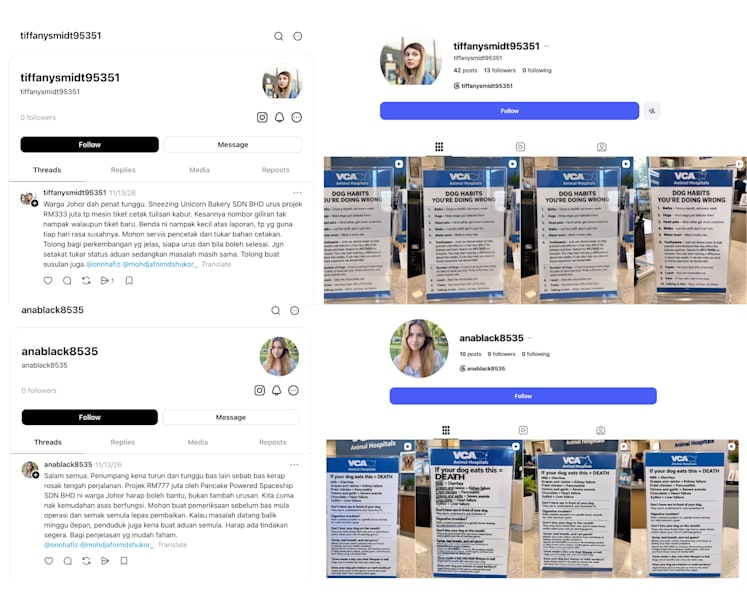
Their usernames typically combined names with strings of numbers, and their profile pictures were a mix of Asian and Caucasian faces. At least 55 accounts shared profile pictures with another account in the group of 188.
Of the 188, 135 joined Threads only in November. Another 51 joined in June and July, around the state election. Threads shows join dates only by month.
The bulk of the accounts – 182 – had no followers, and 181 carried just one post – a complaint about a fictional Johor project.
Their posting occurred in bursts: On Nov 13, 92 posts were published across different accounts within 11 hours. Two of them, from different accounts, went up just three seconds apart. On Nov 15, 95 posts were uploaded within three hours.
The accounts also shared wording. A phrase meaning “project is no small matter” appeared in 22 posts from different accounts. Every post cited a project value that repeated a digit three times – RM111 million, RM999 million and so on.
None of the accounts also appeared to be based in Malaysia. According to Threads owner Meta, an account’s country location is based on account information and activity, including stated location, devices and connection information.
Using those labels, CNA Verify found that 93 accounts appeared to be based in Pakistan, 36 in Russia and 16 in other countries. The remaining 43 showed no country or could not be checked.
Yet these labels do not definitively show where the people behind the accounts are. Location data can be bypassed, so no method is completely foolproof, said Mr Eliad Kimhy, a security researcher at cybersecurity firm Acronis. An account set up through a VPN – or virtual private network, which disguises a location – and used to post only once may simply display wherever the VPN placed it. But the labels do provide a decent baseline, he added.
Associate Professor Ross Tapsell of the Australian National University, who has written extensively about Malaysian politics and online disinformation, said it was common for accounts to be registered overseas, as they can be bought and sold anywhere in the world. This also gives locally based companies that create such disinformation more plausible deniability, he added.
CNA Verify also found that 178 of the 188 Threads accounts had linked Instagram profiles.
Three of these Instagram accounts promoted the same product on Amazon – a dental water additive for pets. Four others each posted at least one reel promoting the same cryptocurrency platform.
“There is a growing correlation between commercial disinformation and political disinformation, as these companies or individuals are looking to make money in any way possible,” said Assoc Prof Tapsell.
“In the past there was much more separation (with political disinformation limited to election times) but now the influence operations industry is so large and diverse that there is a vast array of work practices and methods.”
CNA Verify has asked Meta if it has acted against the 188 accounts.
MANY FAKES MAY OBSCURE THE REAL
As of late November, the posts had garnered about 15,700 views in total, and fewer than 200 likes, replies, reposts and shares combined. These are a fraction of the millions of views drawn by other influence operations CNA Verify has reported on.
Still, experts said the activity should be taken seriously, even if its goals are unclear.
Assoc Prof Tapsell said that it was possible the accounts were part of a “test run” by a company or individual showcasing its work to potential clients, given their low reach and the fact that the material was limited to one social media platform.
The posts also led to a response from Johor’s chief minister, a police report and a complaint to the regulator, Assoc Prof Nuurrianti noted.
The timing may also be telling. The posts began on Nov 13, a day before the Melaka state election, and in the run-up to the Johor budget, which is typically tabled in November. When Mr Onn Hafiz presented it on Nov 19, it included RM1.53 billion for development. Allegations about where public money had gone appeared just as state spending was about to come under scrutiny – a plausible explanation for the timing, though “the dates alone can’t settle it”, said Assoc Prof Nuurrianti.
“What worries me is what happens to the next resident who has a genuine problem,” she said. “Once several complaints have been exposed as fake, it becomes easier to wave away a real one.”.

Source: CNA/re(jo)
Sign up for our newsletters

Get the CNA app
Stay updated with notifications for breaking news and our best stories
Get WhatsApp alerts
Join our channel for the top reads for the day on your preferred chat app

Get bite-sized news via a new
cards interface. Give it a try.
Click here to return to FAST
Tap here to return to FAST
FAST