Asian economies face challenges in navigating new US tariffs: Analysts
Asian governments could face difficult trade-offs between meeting Washington’s demands and maintaining their economic relationships with Beijing.
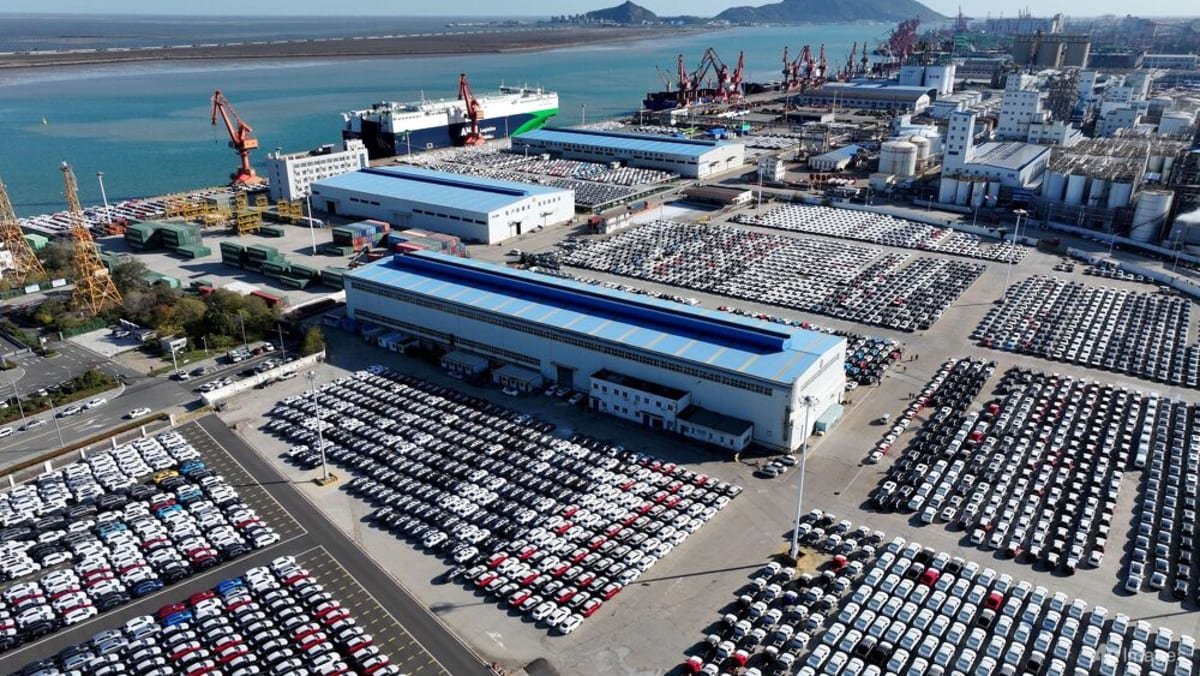
Aerial view of new vehicles waiting for shipment to overseas markets in a port in Lianyungang in eastern China’s Jiangsu province on Nov 24, 2026. (Photo: AP/Chinatopix)
New: You can now listen to articles.

This audio is generated by an AI tool.
Read a summary of this article on FAST.
Get bite-sized news via a new
cards interface. Give it a try.
Click here to return to FAST
Tap here to return to FAST
FAST
Asian economies could face difficulties responding to Washington’s latest tariff measures, as their deep economic ties with China complicate efforts to meet US demands, while existing trade agreements may offer limited protection, analysts said.
The United States has proposed new tariffs on 14 economies, mostly in Asia, over alleged excess industrial capacity and unfair trade practices. Some countries could face lower rates if they conclude trade agreements with Washington.
Vietnam, for instance, could face a tariff of 35 per cent if negotiations fail, compared with 20 per cent if a deal is reached.
Washington appears to be seeking to reduce these countries’ economic engagement with China, rather than simply encouraging them to boost domestic consumption, said Nathan Gray, senior research fellow at the University of Adelaide’s Institute for International Trade.
“For the US, probably the main policy driver that they’re pushing for when you read through these reports is disengaging with China,” Gray told CNA’s Asia Now on Friday (Nov 27).
“That poses a series of risks for most of the countries within Southeast Asia. The risks being that you upset China, which for most countries in the world is now their largest trading partner.”
This leaves Asian governments facing difficult trade-offs between meeting Washington’s demands and maintaining their economic relationships with Beijing.
“It raises very serious questions on what you can actually do from a policy perspective,” Gray added.
He pointed out that reciprocal trade deals reached between Washington and some Association of Southeast Asian Nations (ASEAN) countries were largely aimed at reducing their reliance on Chinese components and machinery, as well as investment from China.

Guess Word
Crack the word, one row at a time

Buzzword
Create words using the given letters

Mini Sudoku
Tiny puzzle, mighty brain teaser

Mini Crossword
Small grid, big challenge

Word Search
Spot as many words as you can
“Countries within Asia do not really have the opportunity to cut that off. Most countries in the world don’t have the ability to do that,” he said.
LIMITED PROTECTION FROM TRADE AGREEMENTS
Meanwhile, existing free trade agreements may offer limited practical protection against Washington’s tariff measures, Felicity Deane, a professor at Queensland University of Technology’s School of Law, told CNA’s Asia Now.
Asked about Singapore’s free trade agreement with the US, she said: “The answer is (there) doesn’t appear to be any type of protection when it comes to the Trump administration.”
Deane pointed to Australia’s experience, noting that its free trade agreement with Washington had not prevented tariffs on Australian products.
Deane also suggested that Washington’s concerns extended beyond China, with the Trump administration seeking to address competition from cheaper manufactured goods across multiple economies as part of its broader push to rebuild domestic manufacturing.
“I think it’s equally targeting all of these economies,” she said.
DIFFICULT DECISIONS AHEAD
Asian economies may also struggle to address US’ concerns over domestic savings and consumption patterns.
Asked whether Singapore’s Central Provident Fund (CPF) and Malaysia’s Employees Provident Fund (EPF) contributed to structural excess capacity by encouraging savings over consumption, Gray said: “Probably not.”
He noted that while the US economy is largely driven by consumer spending, many East Asian economies have a stronger savings culture.
“There’s some cultural factors that drive that savings focus rather than spending,” Gray said, adding that governments had limited ability to change these patterns.
Gray also questioned whether the US investigations had established a clear cause-and-effect relationship between the policies identified and structural excess capacity.


Beyond changing domestic policies, affected economies also face uncertainty over whether to challenge Washington’s proposed tariffs, given the frequent shifts in US trade policy, Deane said.
“The question is whether it’s worth everybody’s time to start challenging things,” she said.
The uncertainty has made it increasingly difficult for businesses, particularly smaller companies, to plan ahead, she added.
“My only advice would be to potentially wait and see, because we have seen a lot of pullbacks, we’ve seen a lot of changes that have come in and out in the last two years,” she said.
“We’re potentially going to see more.”
Source: CNA/oc(sn)
Sign up for our newsletters

Get the CNA app
Stay updated with notifications for breaking news and our best stories
Get WhatsApp alerts
Join our channel for the top reads for the day on your preferred chat app

Get bite-sized news via a new
cards interface. Give it a try.
Click here to return to FAST
Tap here to return to FAST
FAST