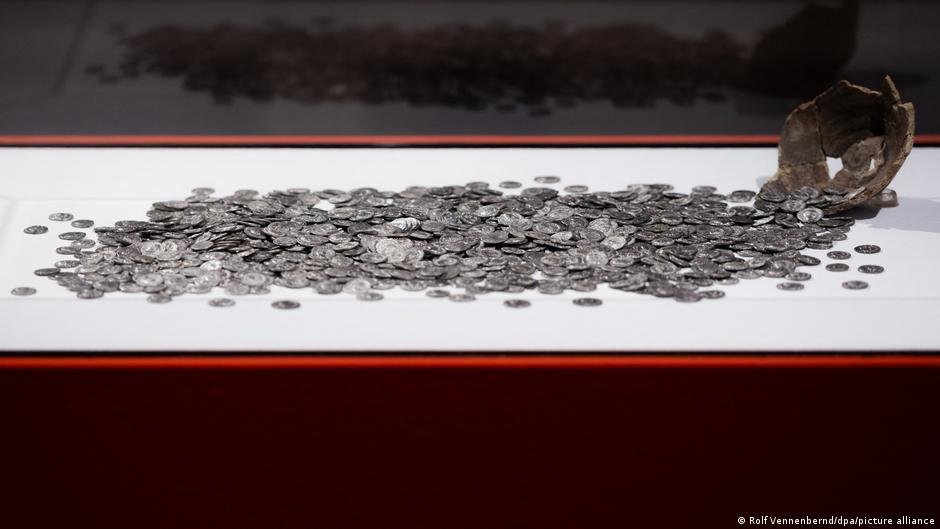
A massive trove of Roman silver coins dating back to the 2nd century AD have been discovered by an amateur archaeologist in Germany.
“It was clear to me that there was something significant here,” said Oliver Riedl, describing the moment he found several coins near Wesseling, south of Cologne, a year ago.
After making the discovery, Riedl contacted the authorities to report the find and request assistance. A team of experts began excavations and uncovered a total of 934 Roman silver coins, also known as “denarii”.
The hoard was put on display on Tuesday at the LVR-LandesMuseum Bonn, located in what was once the capital of West Germany.
According to the the local authority responsible for archaeological heritage preservation, this is the largest coin hoard from the era of Roman Emperor Hadrian ever found in Germany.
A historic discovery
Regional archeological authorities believe the coins were most likely buried during the second quarter of the 2nd century AD.
“Of course, we can only speculate about the reasons, but it is highly likely that someone wanted to keep this money safe. After all, banks did not exist at that time,” said Erich Classen, the chief archaeologist of North Rhine-Westphalia.
Classen noted that there is no explanation as to why the coins were not discovered earlier, nor is it known who buried them. He added that “perhaps the owner died before being able to recover them or pass on knowledge of their location.”
Coin hoards from the Roman period and other distant historical eras are not uncommon in the region. However, according to officials, few 2nd-century discoveries are as extensive as the one found in Wesseling. The institution also said that the current value of the collection is difficult to estimate. Nevertheless, thanks to extensive documentation preserved in written sources, there is a useful point of reference.
At that time, an ordinary legionary earned about 300 denarii per year. However, approximately half of that amount was deducted to cover food and equipment costs,” explained Rahel Otte, a researcher at the state’s archaeological office.
“Therefore, a legionary would have had to save all of his disposable income for around six years to accumulate a treasure like the Wesseling hoard,” she added.
The Cologne region remained under Roman control from approximately 39 BC to AD 459. The Romans established their presence in the area under the command of General Marcus Vipsanius Agrippa to secure the empire’s frontier along the Rhine River. To that end, they founded a military outpost that later developed into Colonia Agrippina, present-day Cologne.
If you rely on our team for trusted reporting, please take a moment to select us as your Preferred Source on Google, so you’ll always see our verified news first.