Astronomers scrutinize exoplanet that survived the death of its star
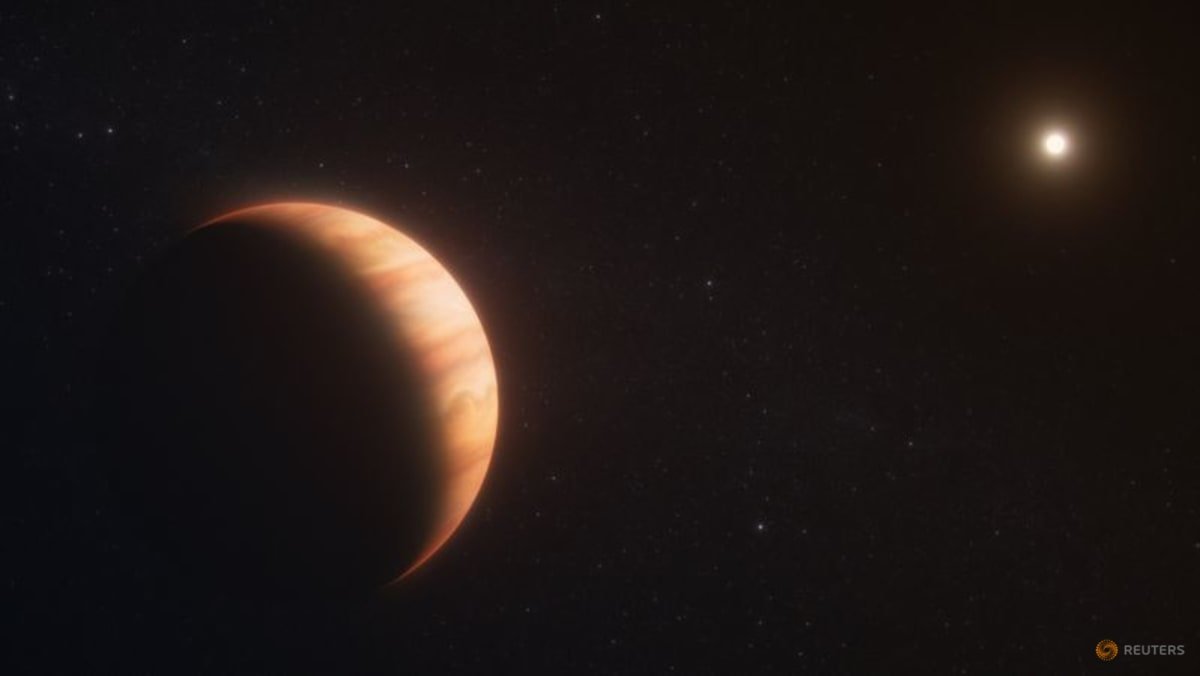
A concept art of the gas giant planet WD1856 b orbiting a white dwarf star, in this handout image released July 1, 2026. NASA, ESA, CSA, Ralf Crawford (STScI)/Handout via REUTERS
Read a summary of this article on FAST.
Get bite-sized news via a new
cards interface. Give it a try.
Click here to return to FAST
Tap here to return to FAST
FAST
WASHINGTON, July 9 : In about 5 billion years, our sun will begin its death throes by expanding in size and engulfing the innermost planets — possibly including Earth — before expelling its outer layers and forming a stellar remnant called a white dwarf. But the outer planets may carry on even after such trauma.
Researchers now have made detailed observations of a Jupiter-like exoplanet, as planets beyond our solar system are known, that has lived on for billions of years after the death of its sun-like star. It’s located 81 light-years from Earth in the constellation Draco. A light-year is 5.9 trillion miles (9.5 trillion km), or the distance light travels in a year.
The researchers determined that the mass of this gas planet, named WD 1856 b, is about eight times greater than that of Jupiter, our solar system’s largest planet. Its atmospheric temperature — about 260 degrees Fahrenheit (127 degrees Celsius) — is unexpectedly warm.
It orbits very close to the white dwarf after apparently migrating inward over time, and is 50 times closer to the white dwarf than Earth is to the sun. It takes just 1.4 days to complete an orbit.

Guess Word
Crack the word, one row at a time

Buzzword
Create words using the given letters

Mini Sudoku
Tiny puzzle, mighty brain teaser

Mini Crossword
Small grid, big challenge

Word Search
Spot as many words as you can
WD 1856 b illustrates how some planets can persist following their host star’s death, as some of the solar system’s planets may after the sun’s eventual demise.
But the dynamics WD 1856 b experiences differ from what the potential planetary survivors of the sun’s death may encounter. The planet faces an unusual gravitational environment because the white dwarf is part of a triple star system along with two red dwarf stars, each about 30 per cent of the sun’s mass.
The researchers are trying to understand why WD 1856 b is so close to the white dwarf.
“There are two main competing ideas for how WD 1856 b got into the tight orbit we observe today,” said astrophysicist Christopher O’Connor of Northwestern University in Illinois, one of the authors of the study published in the journal Nature.
One proposes that the planet was engulfed by its host star during its death throes — stellar expansion during what is called a red giant phase — but managed to survive just outside the stellar core that became the white dwarf. The second proposes that the planet originally was far enough from the star to avoid engulfment, but that the gravitational influences of other nearby objects like the two red dwarfs later pushed it into its current orbit.
The original discovery of WD1856 b, disclosed in 2020, offered the first definitive evidence that planets could survive a sun-like star’s death. The new study provides a greater understanding of the planet’s composition and life story.
The researchers studied it using the James Webb Space Telescope. It is composed mostly of hydrogen and helium, like Jupiter, but contains an unusually high amount of methane.
The researchers attribute the planet’s warmth to its interactions with the white dwarf’s strong gravitational forces as its orbit became closer over time.
While stars typically are much bigger than their planets — the sun is about 1,000 times bigger in volume than Jupiter — this planet is about 500 times bigger than the white dwarf, which is only slightly larger than Earth. The white dwarf is far more massive, but is extremely compact.
The white dwarf formed from a star up to twice the sun’s mass that died about 5 billion years ago.
THE SOLAR SYSTEM’S FATE
When the sun reaches its red giant phase, it will become about 200 times its current size and definitely will swallow the innermost planets Mercury and Venus.
“The rest of the planets beyond Earth will be well beyond the sun’s maximum size, so they will most likely just continue to orbit the white dwarf left behind by the sun,” O’Connor said.
“However, because the sun will lose about half of its mass as it becomes a white dwarf, we expect the survivors to gradually drift away until they reach about double their current orbital distances,” O’Connor said.
Earth’s fate is uncertain.
“We cannot predict Earth’s future orbit well enough to know whether it will be inside or outside the ‘danger zone’ when the sun reaches the end of its life,” O’Connor said. “Fortunately, this is one problem we still have billions of years to figure out.”
Source: Reuters
Sign up for our newsletters

Get the CNA app
Stay updated with notifications for breaking news and our best stories
Get WhatsApp alerts
Join our channel for the top reads for the day on your preferred chat app

Get bite-sized news via a new
cards interface. Give it a try.
Click here to return to FAST
Tap here to return to FAST
FAST
About The Author