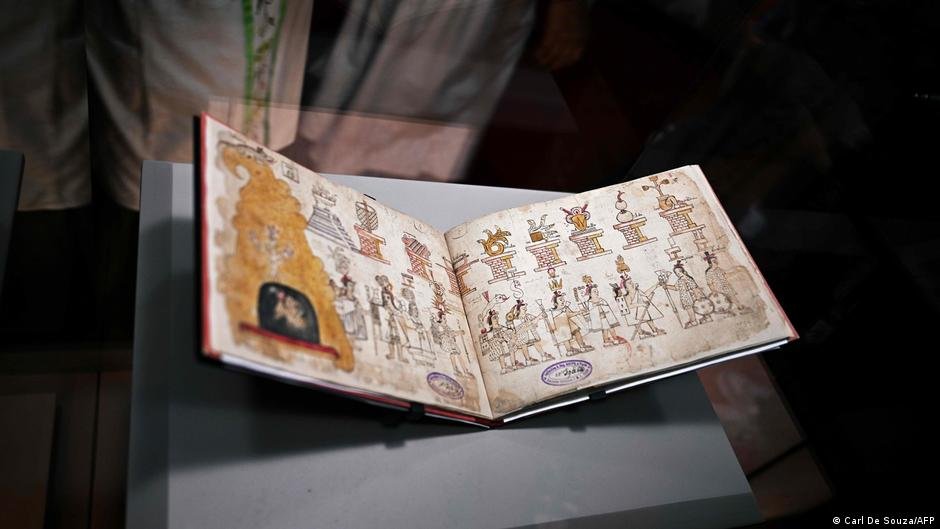
The Azcatitlan Codex, a rare and prized manuscript that recounts the history of the Aztecs in vibrant pictograms, has returned to Mexico for the first time since 1840. It went on display in Mexico City on Thursday.
The codex is a 16th-century artifact and regarded as one of the most important visual records of Aztec history. It records the founding of the Aztec capital to its fall after the subsequent arrival of Spanish conquistadores.
It arrived in Mexico on loan from France’s Bibliotheque Nationale, where it has been since 1898. The temporary loan is occurring as the two nations celebrate 200 years of diplomatic ties.
Reunited with history
As two folios from the document went on display inside a glass case at the National Museum of Anthropology, Mexican Foreign Minister Roberto Velasco said the exhibition was about “reuniting a population with its (collective) memory.”
The pictograms “represent our history, the written voice of our ancestors, and the deep root of our identity,” he said, speaking at the inauguration.
Mexico has demanded the treasured artifact be returned for years.
Members of an indigenous group reacted ecstatically to the display. “They hid our history from us, they stole it!” Emilia Mendoza of the Hnahnu community said at the opening exhibition.
“This is a battle won, a first step toward the restitution of these books that reside in other countries,” she said.
What’s in the Azcatitlan Codex?
Made up of Mesoamerican pictograms with European writing, the codex is divided into three parts.
It traces the Mexica’s migration from Aztlan — the mythical birthplace of the Aztec civilization — to the founding of Tenochtitlan. That’s the capital of the Aztec empire and is present day Mexico City.
The document also depicts the succession of the city’s rulers, the arrival of the Spanish and the subsequent evangelization, according to Mexico’s National Institute of Anthropology and History.
All of this has been rendered in the codex in vibrant reds, blues, greens and yellows, depicting warriors in feathered headdresses and showcasing ritual acts in pyramid temples.
More than five centuries have now passed since Tenochtitlan fell to Hernan Cortes, the leader of the invading Spanish forces. As most histories of invasion go, Cortez and his allies looted and razed the city after conquest, ushering in three centuries of Spanish domination.
To view this video please enable JavaScript, and consider upgrading to a web browser that supports HTML5 video
“These codices are extremely important to us because they continue to give us identity and value as human beings during these very special times we are experiencing,” said Maria Eugenia Castaneda, representative of the Mexica peoples. “They elevate our morale, our customs, our culture, and our sense of who we are.”
According to Mexican historians, an indigenous craftsman from the Otomi people created the codex.
The document will remain on display until December. As part of the exchange, Mexico will loan France another important historical document — the Codex Boturini — which also depicts the migration of the Aztec people to the Mexican valley.
Don’t let the algorithm hide the news. If you rely on our team for trusted reporting, please take a moment to select us as your Preferred Source on Google by clicking here and hitting the “star” or “preferred” button, so you’ll always see our verified news first.
Edited by: Sean Sinico