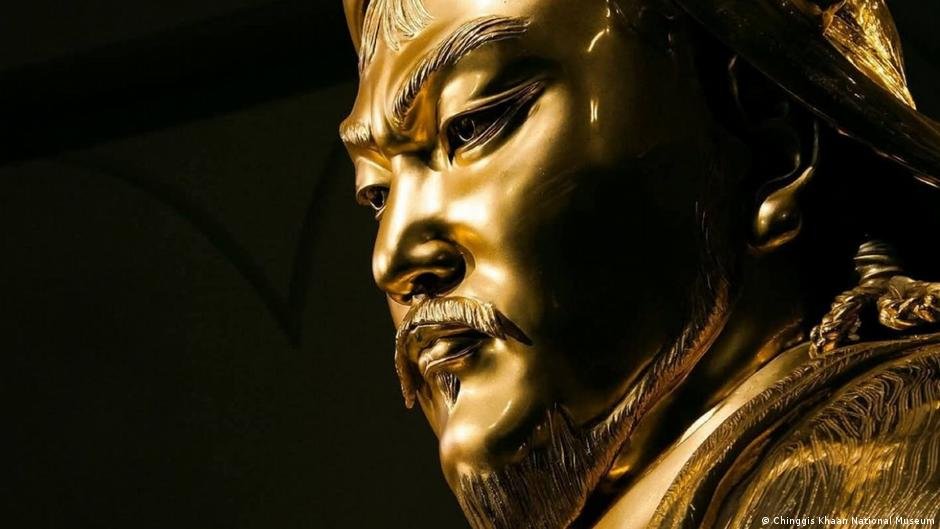
Genghis Khan is one of history’s most radical figures. A blood-thirsty invader whose conquests caused the deaths of an estimated 40 million people, he was also a visionary political thinker who established the largest contiguous land empire in history.
The founder of the Mongolian Empire died in 1227. Ahead of the 800th anniversary of his death, Berlin’s James-Simon-Galerie explores his legacy and the “Mongol Century” (1250–1350) in the exhibition “Genghis Khan and the World of the Mongols.”
The power of a disruptive individual
The ruler remains “incredibly relevant” to this day, says Matthias Wemhoff, the director of the exhibition project.
“What the era of Genghis Khan — the ‘Mongol century,’ if you will — vividly demonstrates is how quickly established structures can collapse, how rapidly vast empires can vanish from the map and how swiftly the entire landscape can be utterly transformed,” the archaeologist tells DW.
The charismatic leader’s unprecedented impact on the world also evokes present-day disruptive individuals who are triggering sudden, unpredictable societal shifts, says Wemhoff: “There’s always been this question: Are world politics shaped by individuals or rather by groups and sociological processes?”
In this case, the answer is clear, says the museum director, who also co-wrote a 2026 book on the nomadic leader.
“If Genghis Khan hadn’t existed, the course of world history would truly have been entirely different — so much of it is inextricably linked to his person,” Wemhoff says.
The founder of the world’s largest empire
Genghis Khan was born as Temujin around the year 1162. His father, a Mongol chieftain called Yesugei, died when he was still a child. His family was abandoned by its tribe. To secure his familial position, Temujin killed his older half-brother, Bekter, when he was still a young teenager.
Thanks to his charismatic personality, he built alliances and found followers who helped him become the sole ruler on the Mongolian steppe. He formally adopted the title of Genghis Khan in 1206.
At its peak, the Mongol Empire covered approximately 24 million square kilometers (about 9.3 million square miles), stretching from China and Korea to parts of Eastern Europe and the Middle East, and accounting for over 16% of the Earth’s total land area.
Wemhoff lists various innovations under his rule: For one, Genghis Khan transformed warfare. Commanders were promoted for skill, discipline and loyalty rather than based on aristocratic rank or tribal loyalties. Soldiers were organized into decimal units of 10, 100, 1,000 and 10,000.
Despite being illiterate by modern standards, he also pushed for the introduction of the first written script for the Mongolian language, which allowed to build a state bureaucracy, track population and tax registers, record decrees, issue legal decisions and handle diplomacy.
A set of laws were established that replaced fragmented tribal customs with a unified legal system.
Trade was simplified through his adoption of a paper currency.
A policy of religious freedom was also established across the Mongol Empire, allowing all individuals to practice their chosen faith without state coercion.
Before the Mongol Empire, the Silk Road was fragmented by local conflicts and heavy taxes. Mongol rule placed the entire route under a single authority, making long-distance travel vastly safer.
The Mongol Empire is known as a period of relative political stability, economic growth and cultural exchange, an era historians call the “Pax Mongolica.”
But “it all came with incredible levels of cruelty. The millions of people who fell victim to the Mongols — the mass executions, the abuse of women — this happened on a scale previously unheard of,” notes Wemhoff.
Shifting centers of power
The exhibition opens with a raid that happened after Genghis Khan’s death, but took place just 260 kilometers (around 160 miles) away from Berlin: the 1241 Battle of Legnica, in Silesia, Poland.
It embodies the brutality and intensity of the Mongols’ methods.
There came the “highly mobile, agile Mongols on small horses — lightly armored in lamellar gear, wearing helmets that left the face exposed, and wielding bows capable of firing 20 or more arrows in a single minute,” points out Wemhoff.
European knights, heavily armored and mounted on large, massive warhorses, didn’t stand a chance against their enemies.
“When a hail of arrows rained down on them, the horses eventually went down, and the knights ended up lying on the ground, stuck on their back, much like a June bug,” he adds. “The two styles of combat were simply mismatched.”
The Mongols’ western campaigns shifted historic power centers in a way that still impacts world politics today.
For example, after the Mongol invasion of Kievan Rus’, which was the first East Slavic state, its thriving capital Kyiv was reduced to a depopulated ruin. Moscow became a key regional power, partly because it chose to cooperate with the Mongols rather than pursue resistance.
“In our Western European collective memory, the Mongol invasion plays hardly any role. It’s something of an anecdote,” says Wemhoff, noting that the era of Genghis Khan and his immediate successors is barely mentioned in standard Western European school curricula.
Germans are mainly familiar with the name of the empire’s founder through the 1979 Euro-disco pop band Dschingis Khan, which represented West Germany at the Eurovision Song Contest with a campy song of the same name that reduced complex history to extreme tropes.
But in eastern Europe, the Mongol invasions “changed everything fundamentally,” says Wemhoff. “And so fundamentally that we still feel the consequences of it today.”
The exhibition “Genghis Khan and the World of the Mongols” runs from October 21, 2026, to April 18, 2027.
Edited by Helen Whittle