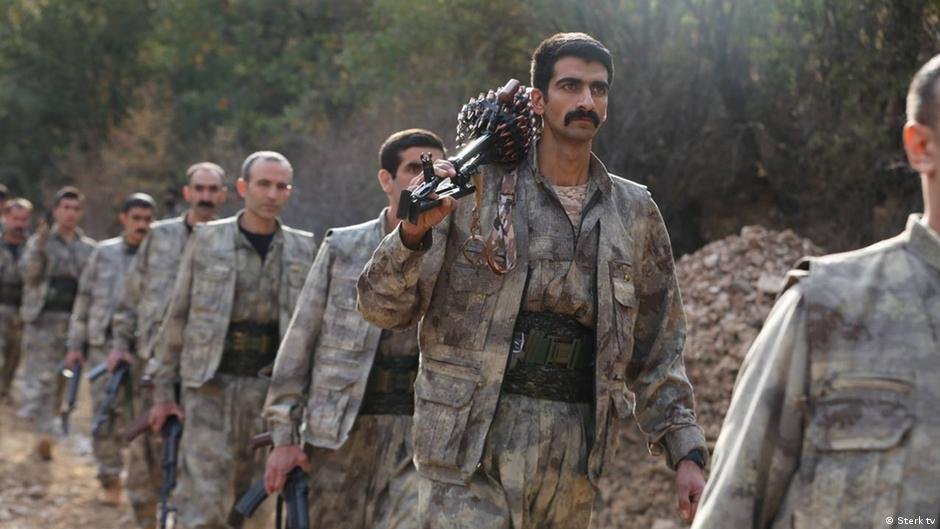
One year ago, the outlawed Kurdistan Workers’ Party (PKK) burned its weapons in a symbolic ceremony. The move was seen as a sign of its willingness to disband. Since then, the Kurdish side has been calling on the Turkish government to take political steps.
Now, parliament has passed a bill submitted by the conservative Islamic ruling party AKP and its ultranationalist ally. Officially called the “Law on Strengthening National Solidarity and Social Integration,” it is intended to provide the legal framework for the ongoing peace process.
According to official figures, 467 out of 592 MPs voted in favor of the bill. The ruling party and its ally see this as the beginning of a new era: Under certain conditions, the bill provides for a suspension of sentences for PKK members — but only after the PKK and its affiliated groups have been confirmed to have disbanded and disarmed, so that peace, brotherhood and solidarity can prevail throughout the entire country.
The pro-Kurdish DEM party also supports the bill, but it views it only as a first step that must be followed by further reforms.
PKK law divides society and parliament
Fierce opposition came from the ultranationalist opposition party IYI. Even during consultations, its delegate Ayyuce Turkes, daughter of the founder of the ultranationalist and right-wing extremist Grey Wolves, accused the government of rushing a landmark bill through parliament.
She also criticized what she felt was an overly conciliatory stance toward PKK founder Abdullah Ocalan. She avoided using his name, calling him a “baby killer” instead, just as government agencies and media have done for decades. There was even a physical altercation.
The debate highlights just how deep the divides are within Turkish society. While the ultranationalist IYI party rejects the process, the MHP, from which the Grey Wolves emerged, is now among its most important supporters — even though it had, previously, vehemently opposed earlier peace initiatives.
Observers believe this shift in course and the progress in the peace process are also a result of the changed security situation in the region. Among other things, they mention the fall of the Assad regime in Syria, the war in Gaza and the conflict between Israel, the United States and Iran. Syria and Iran are also home to large Kurdish populations that are supported by various regional actors.
According to the prevailing view, a more stable relationship with the Kurds who live within Turkey’s own borders could provide Ankara with more leeway in domestic and foreign policy.
What’s in the law?
The law applies to convictions for PKK membership, propaganda, financing or intentional support of the organization and its structures. For prison sentences of up to 15 years, enforcement is to be suspended for five years; for longer or life sentences, the suspension is to last ten years. Ongoing investigations are to be put on hold. According to pro-government media, up to 3,600 prisoners could benefit from this.
The prerequisite is the complete disbanding of the PKK and the surrender of all its weapons and ammunition. Both of these conditions have to be verified by Turkish authorities and, subsequently, officially confirmed by the National Security Council, chaired by Turkey’s President Recep Tayyip Erdogan.
Excluded are PKK members who were convicted prior to June 1, 2005 — the date on which the current penal code came into force — as well as those convicted of homicide and whose convictions are final. That means the regulation does not apply to PKK founder Ocalan either. In February 2025, the 77-year-old had called on the PKK to disband, declared an end to the armed struggle and spoke out in favor of a political solution.
To view this video please enable JavaScript, and consider upgrading to a web browser that supports HTML5 video
PKK views law as a mere first step
The PKK also calls the bill a first step; it criticizes, however, wording and content. Its key demand remained unfulfilled: As long as Ocalan cannot directly coordinate the peace process under conditions of freedom, the issue of disarmament could not be resolved either.
They said penal code regulations alone did not go far enough, more comprehensive democratization reforms were needed. The message was that as long as returning fighters or exiled politicians continued to be criminalized and were unable to engage in political activities legally, hardly any of them would leave the mountains where they’ve been staying.
Even legal pro-Kurdish political activity has ben restricted in Turkey for decades: parties were banned, politicians were arrested or barred from political activity. To this day, elected mayors are being removed from office, and numerous politicians and activists are in prison. Among them are two former co-chairs of the Peoples’ Democratic Party (HDP) that mainly represented Kurds, Selahattin Demirtas and Figen Yuksekdag.
Peace without democratization?
Political scientist Berk Esen criticizes the law for failing to offer concrete democratic solutions to the Kurdish issue. He also noted that, parallel to the peace process involving the PKK, the government had significantly increased the pressure on the largest opposition party CHP.
For about two years, the Turkish judiciary has increasingly been cracking down on leading CHP politicians. Critics view this as an attempt to weaken the government party’s strongest political rival. Among the most high-profile cases is that of former mayor of Istanbul and CHP presidential candidate Ekrem Imamoglu. He and hundreds of other party members are in prison, on charges of fraud and corruption.
The entire CHP leadership under Ozgur Ozel was removed as well. He formed a new party several weeks ago.
Criticism of Erdogan’s role
Esen primarily criticizes Erdogan’s strong influence on the peace process. Although it is to be implemented by a committee chaired by the vice president and key ministers, who are also heads of the intelligence services and the National Security Council, Esen argues that it will ultimately be Erdogan as chairman of the National Security Council who decides when and which steps in the peace process will be implemented.
This assessment is also shared by Reha Ruhavioglu, director of the Kurdish Studies Center.
“Erdogan will clearly set the pace,” Ruhavioglu said, attributing this to the asymmetric balance of power between the Turkish state and the PKK.
In addition, Erdogan had learned his lessons from the failure of the peace talks between 2013 and 2015 and would now certainly assemble more control in his own hands. At the same time, experts say, Erdogan has his sights set firmly on the 2028 presidential and parliamentary elections, and would want to limit any political risks associated with the process.
Ruhavioglu expects further controversy, especially if former PKK fighters return to Turkey and remain at large. The government is therefore likely to allow their return, suspended sentences and political activity only gradually, and largely in response to public reaction.
This article was originally written in German.
About The Author