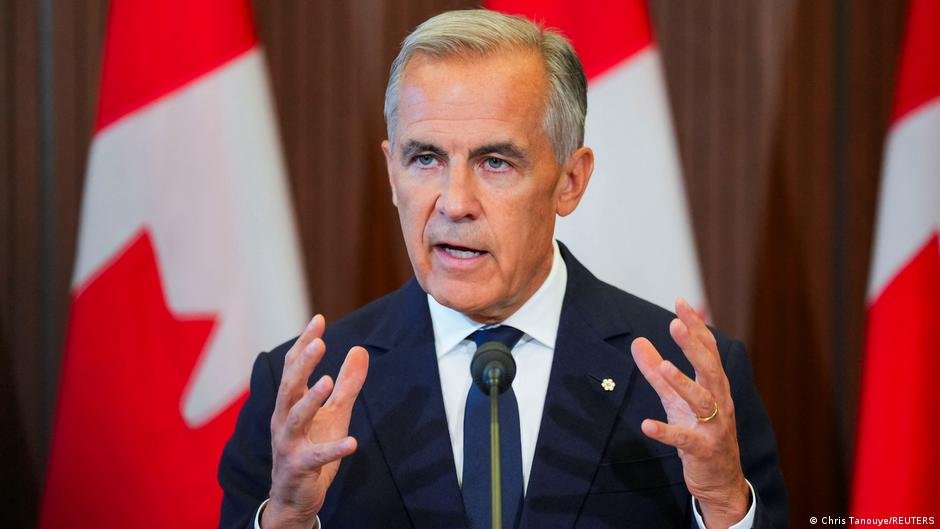
Canada on Tuesday announced retaliatory tariffs against the United States , as relations between the neighbors faltered following failed trade talks last week.
Prime Minister Mark Carney’s government in Ottawa also announced financial support for businesses and workers impacted by the latest dispute with the Trump administration.
It listed some 700 US products that would be subject to either 15%, 25% or 50% tariffs as of September 8, in steps designed to match those announced earlier in the week by US President Donald Trump.
The US is Canada’s largest trading partner, and Canada is the second largest for the US, trailing only fellow neighbor Mexico. Several such disputes have marked both of Trump’s terms.
What did Canada say about the measures?
Canada’s Finance Ministry said in a statement that the government had negotiated “intensively and in good faith” with the US towards a “fair and comprehensive trade agreement.”
“In recent days, however, the US proposed new terms that were not in Canada’s best interest, basically, asking too much of Canada, and offering too little in return,” the Ministry wrote, saying that at this point it suspended talks rather than accepting a “bad deal.”
“Canada did not choose this trade conflict, but we need to respond to provide a level playing field to our businesses,” it said.
Finance Ministerr Francois-Philippe Champagne described the measures as “dollar-for-dollar, rate for rate counter-tariffs,” as well as a “multi-billion dollar support package [that] will protect workers, farmers, families, and businesses.”
“Canada’s counter tariffs will apply to products covering $27.6 billion in imports from the US and will focus on sectors such as steel, dairy, appliances, agricultural equipment, pulp and paper, and electronics, that are most impacted by US tariffs,” the ministry said, naming the same figure as the US in its announcement.
Here’s what you need to know about the backdrop to this flare-up:
- Washington and Ottawa were racing to reach an agreement beforeUS President Donald Trump’s steep new US tariffs, announced in July, were due to take effect
- Talks broke down days after the US President announced the neighbors were close to agreeing to a trade deal
- The collapse in negotiations triggered Trump’s threatened 50% tariffs on about $20 billion worth of Canadian goods the next day
Why is Canada imposing new tariffs?
While the US and Canada have shared one of the world’s largest trade relationships, the recent talks signal a breakdown in relations.
“An attitude at the negotiation table that Canada is a subsidiary of the United States” is “not something we’re going to accept,” Canadian Prime Minister Mark Carney said.
“We learned during the negotiations that the Americans want to destroy our major industries, including autos, steel and aluminum,” Carney said, opting for an even blunter approach in French. “That was one of the main reasons we said no. It was a bad deal.”
To view this video please enable JavaScript, and consider upgrading to a web browser that supports HTML5 video
What had the US said?
Donald Trump returned to the topic of Canada early on Tuesday on social media, claiming the US was mulling renaming Lake Ontario, the only one of the five North American Great Lakes named after a Canadian territory.
“The United States is giving serious consideration to changing the name of Lake Ontario to Lake America in that we don’t expect to doing [sic] much business with them any longer,” Trump wrote.
His administration “renamed” the Gulf of Mexico as the Gulf of America soon after Trump returned to the White House last year — a change that almost nobody besides the US government has implemented. Even US tech giant Google shows it as the Gulf of Mexico first on its maps for users everywhere but in the US.
A day earlier, Trump had threatened he would impose a 50% tariff on Canadian automobiles, car parts and steel from January 1, 2027, and took to social media to unleash a tirade against the historic partner.
To view this video please enable JavaScript, and consider upgrading to a web browser that supports HTML5 video
“On trade, and in other ways, also, they are among the worst nations in the world to deal with. They feel entitled, and yet, WE DON’T NEED CANADA, THEY NEED US!” the US president said.
Canada relies heavily on the US as its top trading partner, with American-bound exports making up 70% of the country’s total. The relationship runs both ways, too: government data shows Canada was the second-largest US trading partner in goods this year, just behind Mexico.
No further negotiations are currently scheduled.
Edited by: Rob Turner
If you rely on our team for trusted reporting, please take a moment toselect us as your Preferred Source on Google, so you’ll always see our verified news first.
About The Author