6 minutes agoShareSaveAdd as preferred on GoogleKelly Ng,BBC UrduandLaura Bicker,China correspondent

 EPA
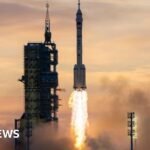
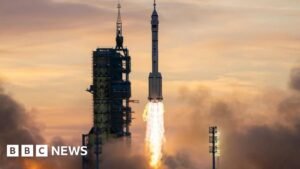
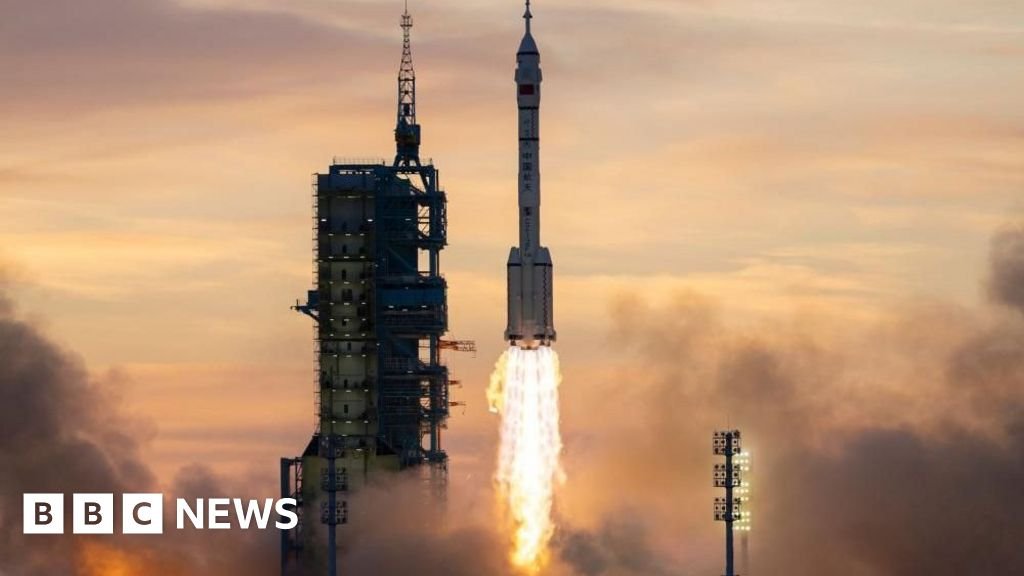
China launched its Shenzhou-24 space mission on Wednesday carrying three astronauts to its space station, including Pakistan’s Muhammad Zeeshan Ali, the first foreigner to join a Chinese crewed space mission.
Beijing said it hopes the flight will strengthen ties with Islamabad, as the two countries mark 75 years of co-operation in space.
Speaking to reporters at the Jiuquan Satellite Launch Center, Ali said he was “carrying the name of Pakistan on my shoulder, the hopes of 250 million Pakistanis”.
The mission, which also comprises mission commander Tang Hongbo and flight engineer Wu Yi, blasted off at 08:18 (0:18 GMT) from the Gobi desert. Minutes later, it was declared a “complete success”.
While in space, the Shenzhou-24 crew will carry out experiments and test technology in fields like the affects of space on living organisms, aerospace medicine, and combustion.
 EPA
They will also study how the space environment affects aging, with the hope of developing new ways to prevent and treat age-related vascular diseases.
Ali will conduct studies on photosynthesis in bacteria and the effects of radiation and microgravity – a very weak gravity in space – on seeds.
The former fighter pilot will return to Earth after a short stay, with two other Chinese crew members who have been at the space station since May.
Tang and Wu will spend six months at Tiangong space station along with Zhu Yangzhu, a member of the Shenzhou-23 crew, which lifted off in May this year. Zhu has been studying how the human body adapts to long periods in space.
The Shenzhou-24 is also a diplomatic moment for Beijing.
China has poured billions of dollars into its space programme and its prized Tiangong space station is stewarded by teams of three astronauts that are typically rotated every six months.
It is now keen to show the world that the station has the potential to become an international research platform rather than an exclusive Chinese facility.
 Reuters
This also comes at a time when Beijing is trying to establish itself as a major alternative to the US-led space programme, with a bold goal to land Chinese astronauts on the moon for the first time by 2030.
For Pakistan, which does not have its own spacecraft to send astronauts to space, being invited to be a part of this mission is significant.
Ali and Khurram Dawood, the other candidate to reach the final stage in the Shenzhou-24 crew selection, were trained in China and had worked in Chinese space stations under the supervision of Chinese experts.
Mastering Chinese language was one of his “biggest challenges”, Ali said, according to Pakistani media.