CNA Explains: How the costly global business of recycling is hurting Singapore’s zero-waste push
The challenge now is no longer just getting people to recycle, but ensuring that recyclables are clean enough to find buyers.
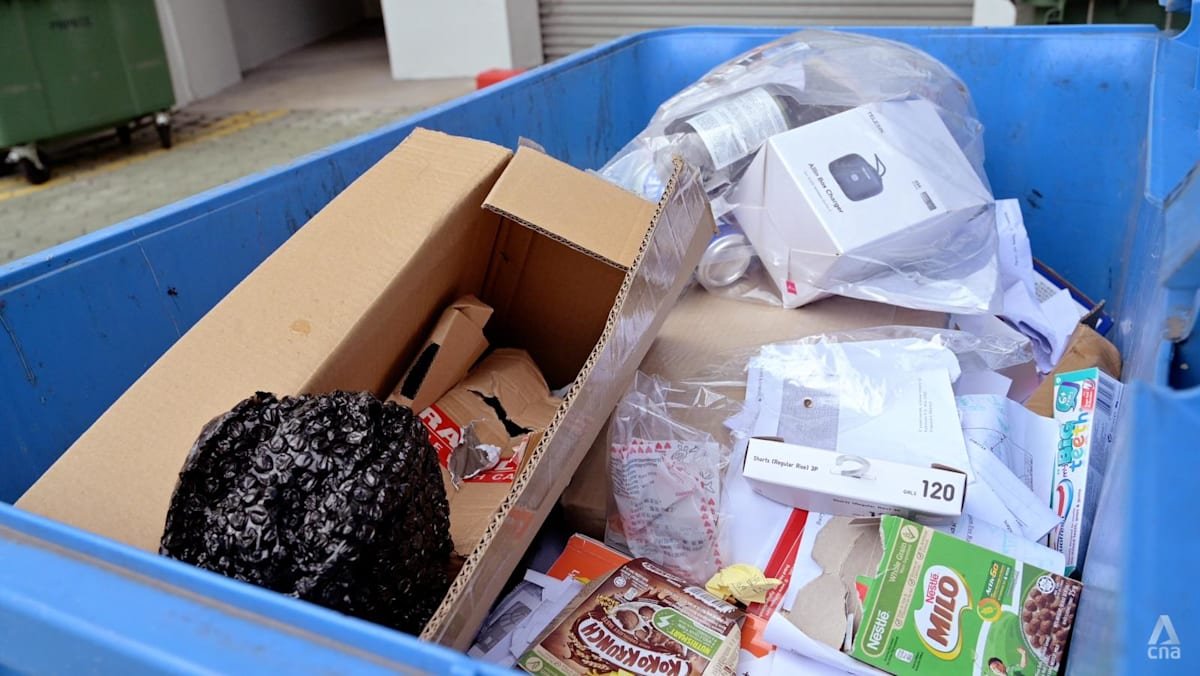
The contents seen in a blue recycling bin at a housing estate in Punggol. (Photo: CNA/Try Sutrisno Foo)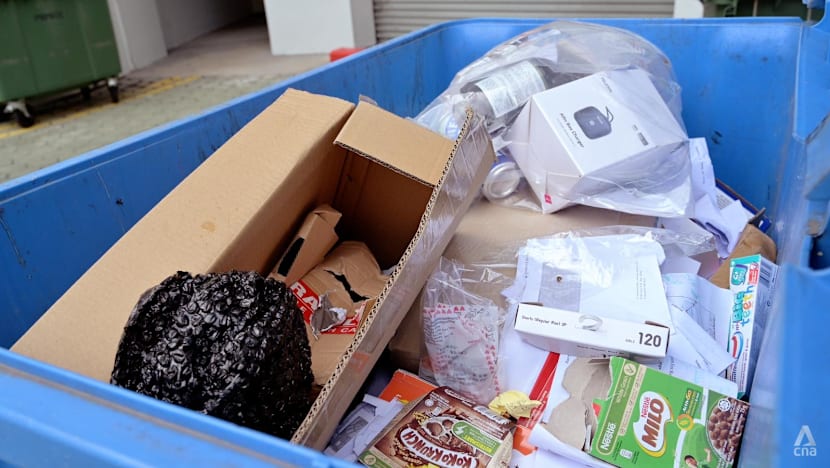
New: You can now listen to articles.

This audio is generated by an AI tool.

Read a summary of this article on FAST.
Get bite-sized news via a new
cards interface. Give it a try.
Click here to return to FAST
Tap here to return to FAST
FAST
SINGAPORE: Singapore’s government on Wednesday (Jun 17) announced a review of its 2019 Zero Waste Masterplan in light of sliding recycling rates.
When it was first launched, the master plan set a target to raise the overall recycling rate here to 70 per cent by 2030.
However, since then, the overall recycling rate has slipped from 59 per cent in 2019 to 52 per cent in 2025 – and much of the discussion has been about how domestic recycling rates have declined.
Dr Janil Puthucheary, Senior Minister of State for Sustainability and the Environment, pointed to “significant” shifts in the global economics of recycling as a factor for the dip in overall rates.

Guess Word
Crack the word, one row at a time

Buzzword
Create words using the given letters

Mini Sudoku
Tiny puzzle, mighty brain teaser

Mini Crossword
Small grid, big challenge

Word Search
Spot as many words as you can
Speaking at an event, he said that recycling has become harder to sustain commercially due to disruptions in logistics, volatile commodity prices and tighter import restrictions.
Why are recycling efforts in Singapore dependent on global freight and market conditions? CNA spoke to experts to find out.
WHAT IS CAUSING A SHIFT IN THE GLOBAL ECONOMICS OF RECYCLING?
Professor Lawrence Loh, director of the Centre for Governance and Sustainability at the National University of Singapore (NUS) Business School, said that the recycling industry is facing a “double whammy”.
Demand for recycled materials has weakened due to the costs involved.
Recyclables must be collected, transported, sorted and processed before they can be reused.
Rising logistics, freight and energy costs have increased the cost of these activities.
The increase in energy costs comes on the back of geopolitical conflicts, such as tensions in the Middle East.
Prof Loh also said that recycling “is not just buying the bottle”, but involves an entire supply chain that includes shipping and processing.
At the same time, the cost of producing some virgin materials has fallen, he added.
Technology for extracting or processing raw materials has improved in recent years. As a result, manufacturers may find it cheaper to use virgin materials rather than recycled alternatives.
“The economics does not present itself in a favourable way to enhance this recycling,” Prof Loh explained.
“Someone has to factor in the cost, so you have to sell it at a higher price to factor in your freight cost, your fuel cost.
“The buyer overseas, are they willing to buy at such a cost? It may not make economic sense.”
Down the line, a buyer may then choose to buy a lower-cost item made from virgin material instead of a more expensive recycled alternative.
In the meantime, overseas markets have become more selective about the recyclables they are willing to accept.
Professor Adrian Kuah, who is a professor of strategy and sustainability at James Cook University, said countries that once accepted mixed or lower-quality recyclables have tightened contamination standards and restricted imports of low-quality imports.
“Recyclables have value only if they are clean, well-sorted and economically useful.
“The global economics of recycling have shifted from ‘sending it somewhere cheaper and useful’ to ‘proving that it is clean, sorted and economically useful’,” Prof Kuah pointed out.
Clean aluminium cans and cardboard may have market value, while mixed paper, oily food packaging, contaminated plastic containers and wet recyclables may become worthless or costly to process, he added.
WHY ARE SINGAPORE’S RECYCLING EFFORTS VULNERABLE TO THESE SHIFTS?
Industry observers said that Singapore is particularly exposed because much of its recyclable waste is processed overseas.
Singapore’s limited land availability constrains the number of recycling facilities and the scale at which recyclables can be processed domestically, which means that many materials have to be exported for recycling.
Ms Grace Fu, Minister for Sustainability and the Environment, said that over the past years, about 90 per cent of recyclables – consisting of metal, paper, glass and plastics – have been exported, mainly to other Asian countries.
This was in a parliamentary reply on the proportion of recyclables from blue recycling bins that have been exported for processing.
Prof Kuah said that since many recyclables are exported overseas for processing, Singapore does not fully control whether collected recyclables are eventually recovered.
“Recycling outcomes depend on overseas demand, commodity prices, shipping costs, foreign import rules and the willingness of other countries to accept Singapore’s materials.”
He added that if overseas buyers reduce demand, tighten standards or offer lower prices, some materials may become uneconomical to recycle and may instead be incinerated.
“This is especially relevant for household waste, where the domestic recycling rate remains much lower than the non-domestic rate,” he said.
The global economics of recycling have shifted from ‘sending it somewhere cheaper and useful’ to ‘proving that it is clean, sorted and economically useful’.
Singapore’s challenge is not just export dependence, but its combination with contamination, mixed-stream collection and weak demand for recycled materials, Prof Kuah said.
Against this backdrop, Singapore cannot simply focus on getting more people to recycle because ensuring that recyclables are of sufficient quality is just as important.
Zero Waste SG’s executive director Lionel Dorai echoed this sentiment. The not-for-profit and non-governmental organisation is leading the drive towards zero waste in Singapore through education and advocacy.
Mr Dorai said: “Many people assume that if something is collected for recycling, it will automatically be recycled. In reality, recyclables need buyers.”
Since Singapore is reliant on overseas markets to process recyclables, reducing contamination and improving the quality of recyclables collected is becoming just as important as getting more people to recycle.
“What can aid this is generating clean stream recyclables from source through waste segregation, because the cleaner the recyclables, the higher the profit margin for recyclers.”
HAVE KEY WASTE STREAMS BECOME LESS ECONOMICALLY VIABLE?
Not all recyclable materials face the same challenges.
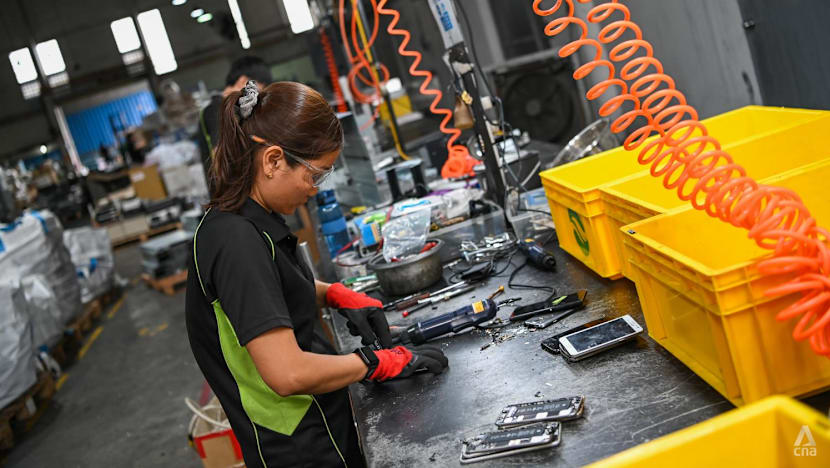
Prof Kuah from James Cook University said that metals, aluminium and some e-waste streams remain relatively attractive because they contain recoverable value.
The bigger challenge lies with low-value, mixed or contaminated materials – especially mixed plastics, low-grade paper and glass.
Although glass is technically recyclable, it is bulky, heavy and expensive to transport.
Without enough demand, transport and processing costs can outweigh the value of the recovered material, Prof Kuah said.
Glass is one of Singapore’s least recycled waste streams, with a recycling rate of just 10 per cent in 2025.
Low-grade paper and cardboard have also become more vulnerable.
“In the past, there were overseas paper mills willing to take lower-grade recovered paper,” Prof Kuah said.
“However, global paper prices can be weak, and wet or food-contaminated paper is often rejected. Once paper is mixed with food residue or liquids, its market value falls sharply.”
Paper and cardboard had a recycling rate of 31 per cent in Singapore in 2025.
Many people assume that if something is collected for recycling, it will automatically be recycled. In reality, recyclables need buyers.
Plastic remains one of the most difficult waste streams to recycle economically and recorded a recycling rate of just 4 per cent in 2025, the second-lowest among Singapore’s waste streams after textiles.
Although cleaner plastics such as PET bottles have a market, mixed plastics are harder to recycle economically, Prof Kuah said.
Plastics require extensive sorting, cleaning and separation – the cost of which may exceed its resale value.
Mr Dorai from Zero Waste SG said: “At the end of the day, the most resilient solution is still to reduce waste in the first place and reuse products for as long as possible, because those actions are less dependent on global recycling markets.
“The data positively reinforces this, because we do see a decline in waste generated, which could imply that residents are reducing or reusing more.”
Want an issue or topic explained? Email us at digitalnews [at] mediacorp.com.sg. Your question might become a story on our site.
Source: CNA/wt(sf)
Sign up for our newsletters

Get the CNA app
Stay updated with notifications for breaking news and our best stories
Get WhatsApp alerts
Join our channel for the top reads for the day on your preferred chat app

Get bite-sized news via a new
cards interface. Give it a try.
Click here to return to FAST
Tap here to return to FAST
FAST