Commentary: AI agents need middle managers too
When the cost of moving and reconciling corporate information collapses, the roles built to perform these functions must change, says Kai-Fu Lee for the Financial Times.
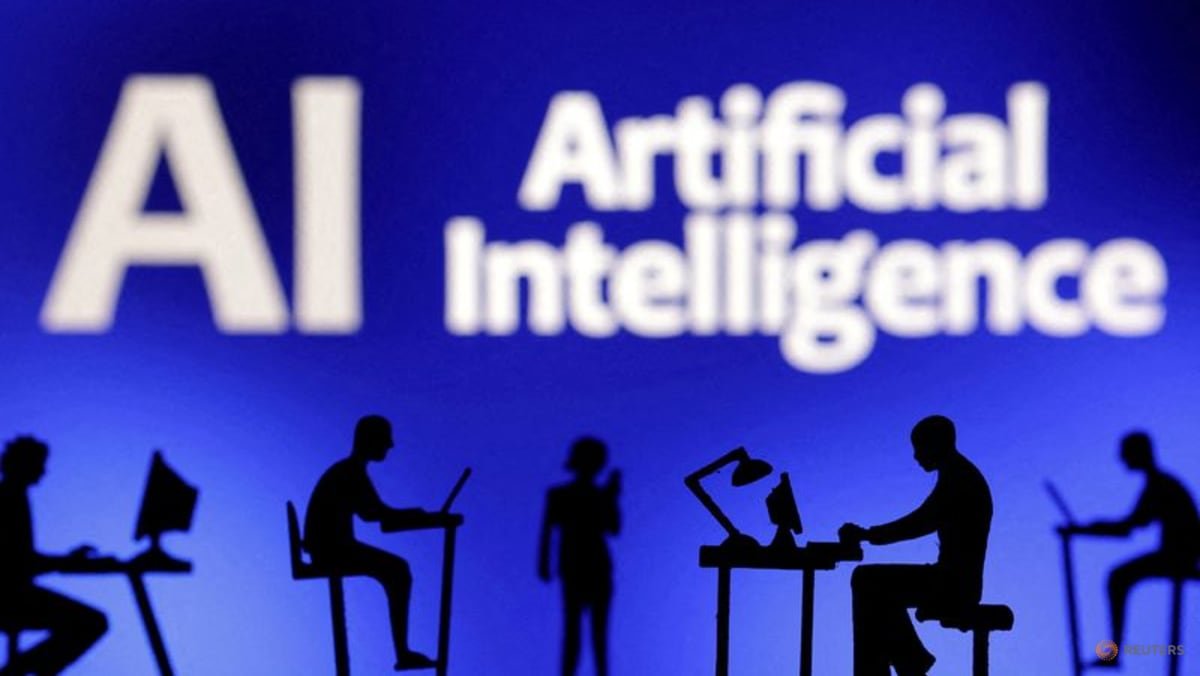
FILE PHOTO: Figurines with computers and smartphones are seen in front of the words “Artificial Intelligence AI” in this illustration taken, February 19, 2024. REUTERS/Dado Ruvic/Illustration/File Photo

Read a summary of this article on FAST.
Get bite-sized news via a new
cards interface. Give it a try.
Click here to return to FAST
Tap here to return to FAST
FAST
BEIJING: Back in 1958, two forward-thinking management scholars predicted in Harvard Business Review that computers would eliminate middle management by the 1980s. They were early and only half right. Computers automated many of the tasks that managers performed, but they never replaced the managers themselves.
In the early 2000s, Silicon Valley tried to engineer the “Great Flattening”. At Google, Larry Page soon found himself buried in expense reports and HR disputes. Managers were back within a few months. By the time I joined the company in 2005 to build its operations in China, I relied heavily on multiple layers of middle managers to get my job done. Working in a cross-cultural, multilingual organisation would not have been possible otherwise.
Today it is AI that is supposedly poised to fundamentally reshape the company hierarchy. This time it may work.
OBITUARY OR JOB POSTING?
An organisation is, in effect, an information system. Middle management arose from necessity. No executive can read every company document and speak to every employee. But each level of communication can degrade the signal.

Guess Word
Crack the word, one row at a time

Buzzword
Create words using the given letters

Mini Sudoku
Tiny puzzle, mighty brain teaser

Mini Crossword
Small grid, big challenge

Word Search
Spot as many words as you can
AI can skirt this problem by going straight to the source: meeting transcripts, support tickets and shared documents. This is the “dormant data” that companies have always produced but could not easily use. It is now accessible directly at the top, enabling radical visibility.
Executives can query underlying data, review source material and compare a summary with the work itself. At my company I have something my colleagues call “Kai-Fu’s Boss AI”, a system that connects to all corporate records and communications. I once watched Boss AI identify two teams that spent three months building the same feature, even repeating each other’s mistakes, without anyone noticing.
When the cost of moving and reconciling information collapses, the roles built to perform these functions will fade into irrelevance. For a middle manager, that may sound like an obituary. Read it differently and it is a job posting.
FLATTER ORGANISATIONS?
We are going to start to see more companies flattening their organisations with a shorter chain of command. At the top is the executive team. Below it are directly responsible individuals, or DRIs (a term Apple uses internally). Each one owns an outcome from beginning to end, such as a product, a market or a major risk. In large organisations, some middle managers will become DRIs, especially those who adapt quickly to a new fleet of AI tools.


What will change is the nature of a manager’s value. An AI agent can price a contract but managers who can direct their work and shoulder the consequences of their actions will remain central to their companies.
Human qualities are still required. As AI makes routine execution faster and cheaper, middle managers will have more time to exercise judgement, mentor people and navigate complex relationships.
As Google discovered, flattening too quickly can lead to frayed co-ordination, unhappy staff and burnt-out executives. It can also erase the most valuable institutional knowledge. Experienced managers can pass on the hard-won wisdom that comes from seeing past plans fail and relationships fray. Even when companies rely on AI agents to execute most of the work, relationships with other departments, partners and customers still depend on human-only skills.
The more work AI takes on, the greater the value of managers. Their roles will shift from overseeing execution to building trust, fostering relationships and guiding teams through uncertainty. Those skills have never mattered more.
Lee Kai-Fu is CEO of 01.AI, former president of Google China and author of the upcoming book ‘I Native: The Mandate to Transform Your Company.
Source: Financial Times/sk
Sign up for our newsletters

Get the CNA app
Stay updated with notifications for breaking news and our best stories
Get WhatsApp alerts
Join our channel for the top reads for the day on your preferred chat app

Get bite-sized news via a new
cards interface. Give it a try.
Click here to return to FAST
Tap here to return to FAST
FAST