Commentary: Tata data leak a setback for ‘Make in India’ ambitions, but it’s not a verdict
The Tata data breach is a reminder that qualities such as cybersecurity, are now as much a part of manufacturing competitiveness as infrastructure and labour costs, says University of Delhi’s Aasheerwad Dwivedi.
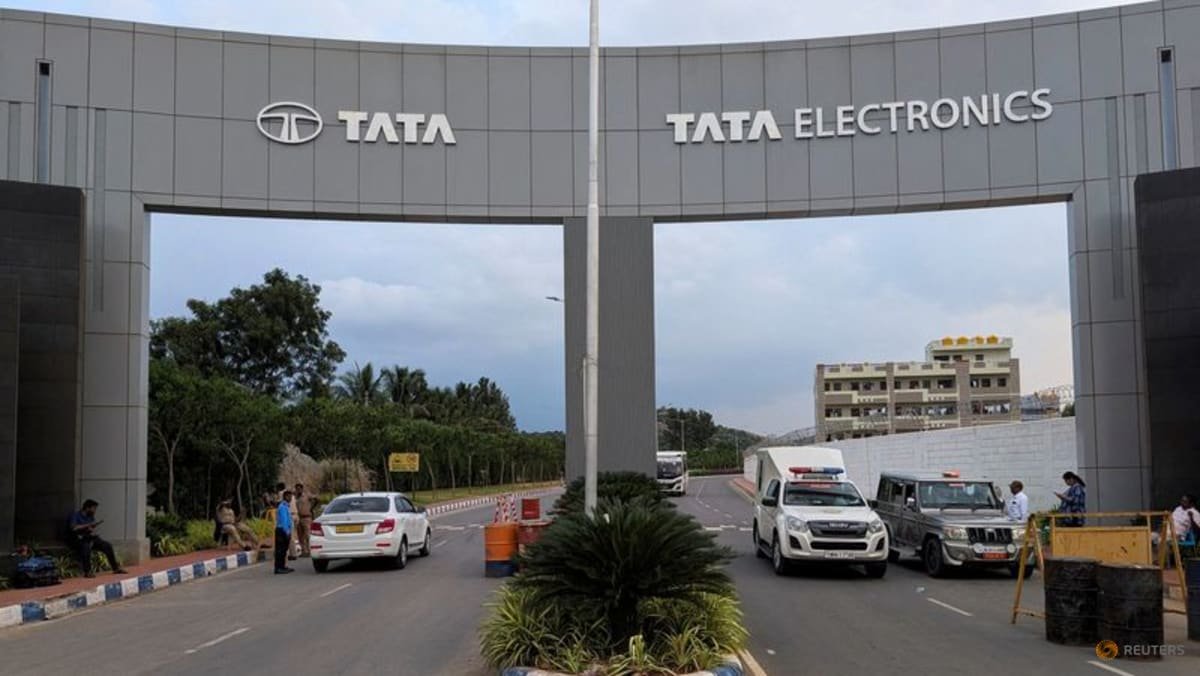
FILE PHOTO: Vehicles pass through the security check at the entrance of Tata Electronics Plant in southern India which makes Apple AAPL.O iPhone component in Hosur, Tamil Nadu, India, September 28, 2024. REUTERS/Haripriya Suresh/File Photo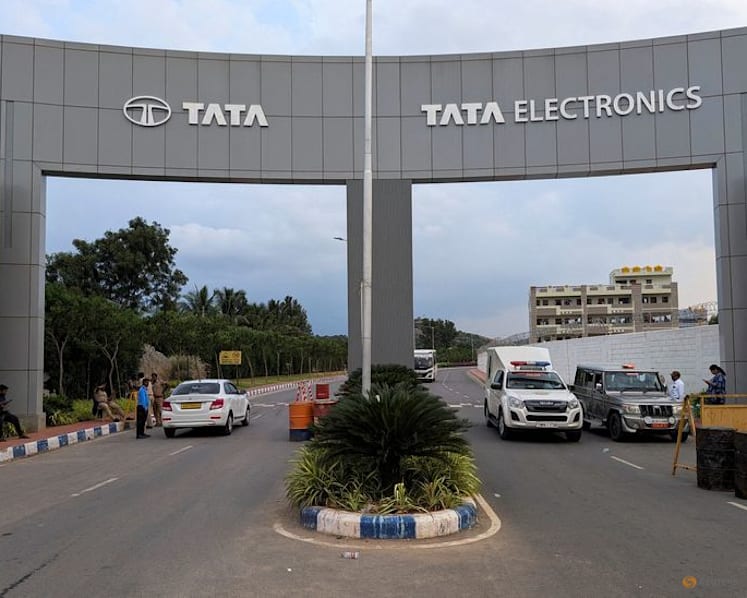
New: You can now listen to articles.

This audio is generated by an AI tool.

Read a summary of this article on FAST.
Get bite-sized news via a new
cards interface. Give it a try.
Click here to return to FAST
Tap here to return to FAST
FAST
NEW DELHI: A recent cybersecurity breach at Tata Electronics has provided fresh ammunition to critics of India’s manufacturing ambitions.
Hackers claimed to have obtained hundreds of gigabytes of data from the company, including documents linked to Apple’s latest iPhone 18 Pro, as well as other customers such as Tesla, Qualcomm and TSMC. Tata confirmed in June it had suffered a “cybersecurity incident”, although it maintained its operations remained unaffected.
The breach is a setback for Tata Electronics, which is emerging as one of Apple’s most important manufacturing partners outside China. It also, according to some observers, threatens to tarnish the government’s decade-long push to make India a manufacturing powerhouse.
THE “MAKE IN INDIA” INITIATIVE
Twelve years ago, Prime Minister Narendra Modi announced the “Make in India” initiative. The aim was not simply to produce more domestically, but to increase investments, attract global firms and create jobs.

Guess Word
Crack the word, one row at a time

Buzzword
Create words using the given letters

Mini Sudoku
Tiny puzzle, mighty brain teaser

Mini Crossword
Small grid, big challenge

Word Search
Spot as many words as you can
Manufacturing is central to India’s next phase of development, because development occurs when labour moves into more productive, capital-intensive and market-oriented activities. India’s problem is that this structural transformation has been incomplete.
Labour did move out of agriculture, but much of it has gone into the informal sector. While the services sector has been a primary driver of growth, this can generate enormous output without necessarily creating enough jobs. India needs a broader development strategy and manufacturing, which can absorb large numbers of workers while benefiting from economies of scale and integration into global value chains, has to be part of it.
To boost manufacturing, the government introduced a range of measures such as infrastructure initiatives, corporate tax reforms and most prominently, the Production-Linked Incentive scheme which doles out financial incentives for 14 manufacturing sectors.
Yet at 15 per cent in 2025, manufacturing’s share of the economy remains far from the government’s 25 per cent target. Employment tells a similar story: More than a decade since the rollout of “Make in India”, manufacturing’s share of employment has continued to hover around 11.5 to 12 per cent, with agriculture still accounting for about 43 per cent of the workforce.

These have led to criticisms about the “Make in India” initiative but there is a danger in looking only at the aggregate numbers.
Electronics is a remarkable example of what the initiative can achieve. In the year 2014 to 2015, India’s mobile phone production was worth roughly 180 billion rupees (US$1.9 billion) and mobile phone exports only around 15 billion rupees. By 2024 to 2025, production had risen to about 5.5 trillion rupees and exports to roughly 2 trillion rupees, according to official data from the Press Information Bureau.
India has moved from being a major importer of mobile phones to a net exporter and is now the world’s second-largest mobile phone manufacturer by volume.
Apple has significantly expanded production in India, with Tata accounting for roughly a third of local iPhone production. India is also a production hub for Samsung and Chinese brands such as Xiaomi. To be sure, this was aided by a geopolitical reorganisation of global supply chains that started post-pandemic, yet this is not a trivial achievement.
Now that India has succeeded in attracting assembly and major suppliers such as Foxconn, the next challenge is to develop the ecosystem around it. The objective must be to move from assembly to components, design and engineering, and eventually into higher-value technologies. A new Mobile Phone Manufacturing Scheme offering further incentives appears to nudge the sector towards that direction.
With Tata and Apple’s manufacturing network being vital pillars in India’s manufacturing ambitions, the recent breach is a setback. The way Tata, Apple and Indian institutions learn from and respond to the incident will be crucial.

NOT A VERDICT
But it would be an extraordinary conclusion to draw from one cyber breach that the “Make in India” brand is set to lose its competitiveness.
The global push to diversify supply chains beyond China, a large and growing domestic market, a sizeable workforce and the government’s enthusiastic support continue to make India an attractive manufacturing destination.
Also, cyberattacks are not unique to India. According to the IBM’s X-Force Threat Intelligence Index 2026, manufacturing was the world’s most targeted industry for cyberattacks in 2025, making cybersecurity a global challenge.
Still, the Tata data breach is a reminder that cybersecurity, quality control, environmental compliance and supply-chain management are now as much a part of manufacturing competitiveness as roads, electricity and labour costs. Companies should harden access controls, data segregation, supplier-level cybersecurity and incident-response systems across their manufacturing networks.
The government, which has said it is investigating the recent data breach, should also use the episode to establish stronger cybersecurity standards across the country’s manufacturing supply chains, turning the breach into a demonstration of India’s capacity to learn and rebuild trust.
Meanwhile, continued efforts remain essential to fix deeper constraints for the manufacturing sector – access to land, labour-market rigidities, logistics, infrastructure, skill shortages combined with regulatory uncertainty. The fact that these constraints have persisted means that an industrial policy based primarily on incentives cannot simply substitute the difficult background work that needs to be done for improving the underlying business environment.


China’s experience may also offer some relevant lessons if India wishes to move beyond being an assembly ground.
China did not become the world’s factory overnight. It spent decades building scale, supplier networks, infrastructure, human and technological capital. Foreign firms initially provided markets, technology and production know-how, while Chinese firms supplied, learned and eventually began to innovate.
That said, the world has changed dramatically since then. China entered global manufacturing when globalisation was deepening and multinational corporations were enthusiastically fragmenting production across countries. Today, the world is becoming more protectionist, geopolitically fragmented and concerned about supply-chain resilience and technological sovereignty – all of which are challenges to how India can grow its manufacturing ambitions.
But the key remains that manufacturing capability is accumulated progressively to allow a gradual move up the value chain. India should aspire to do the same with continuous reforms, not just subsidies.
Aasheerwad Dwivedi is Assistant Professor of Economics at the Faculty of Management Studies, University of Delhi. The opinions expressed are those of the writer and do not represent the views and opinions of his employer.
Source: CNA/sk
Sign up for our newsletters

Get the CNA app
Stay updated with notifications for breaking news and our best stories
Get WhatsApp alerts
Join our channel for the top reads for the day on your preferred chat app

Get bite-sized news via a new
cards interface. Give it a try.
Click here to return to FAST
Tap here to return to FAST
FAST