Commentary: What Niu Lai’s unlikely success says about Chinese internet culture
The chaotic, amateurish spectacle of Niu Lai offers Chinese netizens a sense of unfiltered agency, says Troy Chen of University of Nottingham Ningbo China.
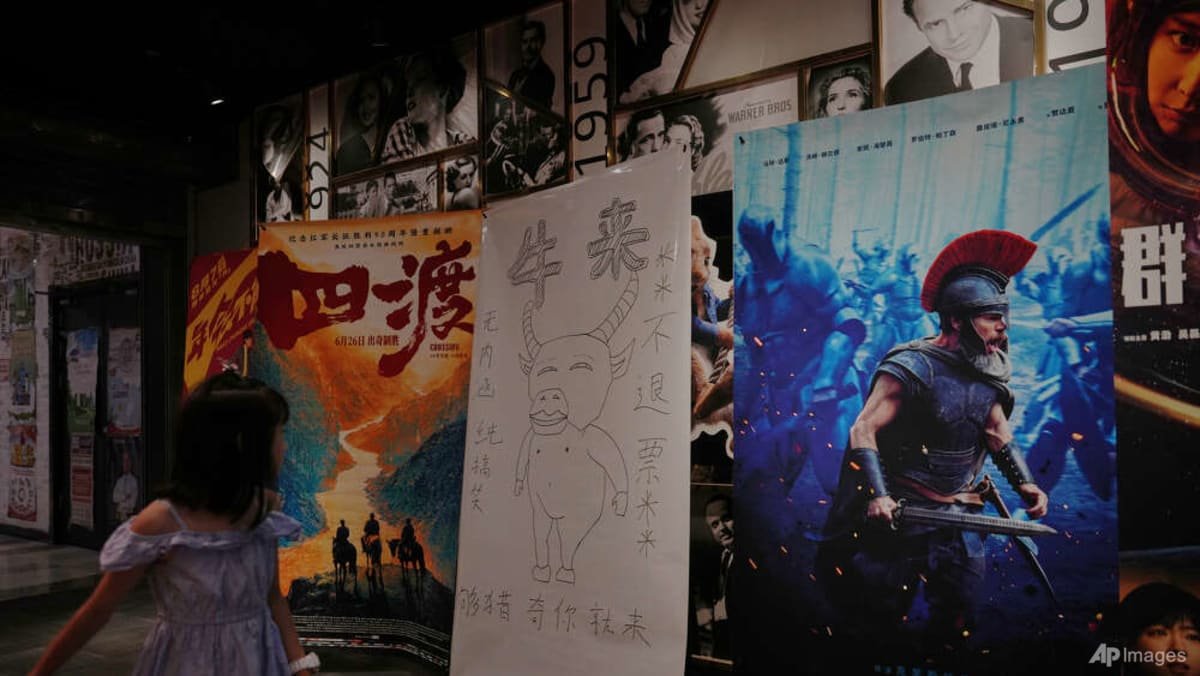
A child looks at a hand-drawn poster promoting Chinese animated film Niu Lai, on display with other movie posters at a cinema in Beijing, Aug 18, 2026. (AP Photo/Andy Wong)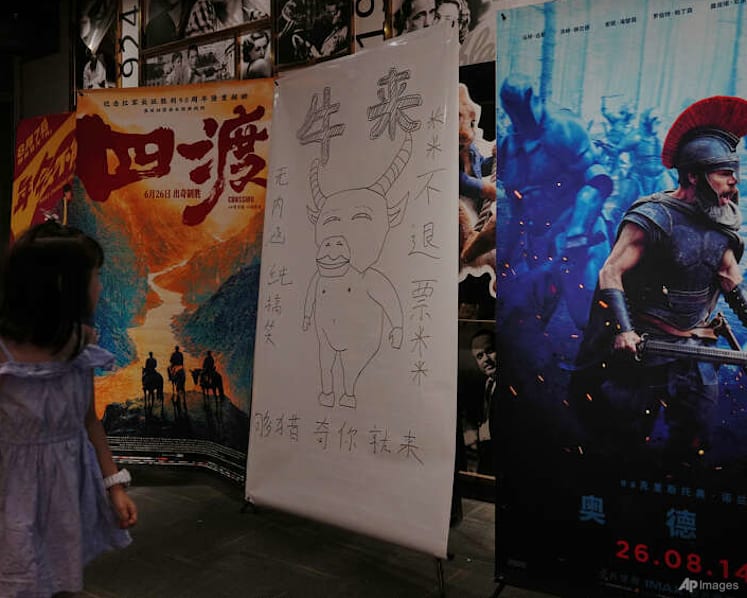
New: You can now listen to articles.

This audio is generated by an AI tool.

Read a summary of this article on FAST.
Get bite-sized news via a new
cards interface. Give it a try.
Click here to return to FAST
Tap here to return to FAST
FAST
LONDON: In an era of polished blockbusters and multi-million-dollar marketing campaigns, a crudely animated film about a calf’s dream journey became one of China’s most unlikely box office sensations.
Niu Lai, or Here Comes The Bull, was crafted over five years by a mother-son duo on a budget reportedly as little as 20,000 to 30,000 yuan (US$3,000 to US$4,500). It debuted on Aug 5 to crickets, earning just over 7,000 yuan in its first 10 days.
Then Chinese internet found it. Within days, it raked in more than 30 million yuan, and it jostled for screen time with Christopher Nolan’s The Odyssey and Spider-Man: Brand New Day.
But to say this is just a story of a “so bad it’s good” movie would be to miss the point entirely. Niu Lai is a carnival for viewers; it transforms the individual act of watching a movie into a collective one.

Guess Word
Crack the word, one row at a time

Buzzword
Create words using the given letters

Mini Sudoku
Tiny puzzle, mighty brain teaser

Mini Crossword
Small grid, big challenge

Word Search
Spot as many words as you can
HATE-WATCHING WITH LOVE
In a paper published in 2026, media scholars Fu Pengfei and Wenjun Zhao described this kind of audience behaviour as ruzhui – literally “derisive following”, or what English-speaking fans might call “hate-watching”. Such fans mock something relentlessly but keep showing up, buying tickets and making memes about it.
In the case of Niu Lai, the audience is not just watching a movie. They are participating in a shared joke that unfolds in real time inside the theatre.
The online memes start long before the moviegoers get their popcorn ready, turning the screening into a shared event of discovery and inside jokes. The most well-discussed inside joke revolves around the film’s ending – an “it was all a dream” twist that viewers find both bewildering and hilarious.
The joke only lands fully when sitting in a theatre full of strangers who are all simultaneously getting it – the shared gasp, the ripple of laughter, a fellow audience member whispering the meme to their friend.
Online, the joke is just an image. In the theatre, it becomes a living, breathing punchline. It’s a communal experience where the audience is as much a part of the show as the film itself.

PARTICIPATE AND APPROPRIATE
What drives viewers to Niu Lai isn’t a desire for cinematic excellence – it’s the desire to participate and appropriate.
Niu Lai can be seen through the lens of shanzhai, a euphemism for copycat goods when China was newly opened. In the early 2000s, the term was used to refer to Hong Kong and Shenzhen’s knock-off mobile phones, made by small workshops operating in a legal grey zone.
In Niu Lai’s case, the shanzhai register emerges from a mother and son who decided to make a film despite having no industry expertise.
The result is technically crude, to say the least, but culturally potent. It is shanzhai not in the sense of being counterfeit, but in the sense of being unlicensed, unauthorised and made outside the system. Crucially, it is loved for exactly that perception.
Niu Lai’s fame reflects a shift from “made in China” to “created in China” and “going out and doing something”, a sentiment that feels particularly potent in the post-COVID era.
It echoes the recent nostalgia-driven viewing of classic anime. In 2023, when The First Slam Dunk was released in China, something remarkable happened. Midnight screenings in cities across the country sold out – not to teenagers, but to adults in their 30s and 40s, many of whom had first encountered the series in the 1990s.
Movie-goers were not there just to watch a movie. They were reclaiming a shared memory – a collective moment of youth that had been interrupted by the long gap between the original television series ending in 1996 and the film’s release nearly three decades later.
In the case of Niu Lai, the mood has shifted from earnest completion to ironic participation. While the Slam Dunk crowds came to cry and cheer for the show’s characters, the Niu Lai crowds come to laugh at the film – but also to laugh together. The emotional register is different: Where Slam Dunk offered catharsis, Niu Lai offers collective absurdity.
IMPERFECTION IN THE FACE OF AI SLOP
In a world increasingly dominated by slick, AI-generated content, the visibly “handmade” quality of Niu Lai is an advantage. It stands as a defiant, if perhaps unintentional, rebuttal to AI slop.
Platforms such as Xiaohongshu have reportedly tightened their moderation of AI-generated content, targeting content deemed “fabricated” and “impersonating real people”. In this context, Niu Lai’s imperfections are a sign of authenticity.
Niu Lai gives viewers an alternative space where the normal rules of the film industry and cultural consumption are suspended. But what kind of space is it?
Audiences are not just laughing at the film. They are laughing with it, and with each other. They are participating in a shared, ironic joke that has become a cultural phenomenon.
Niu Lai’s official Weibo account even acknowledged this, stating the film didn’t meet industry standards while thanking viewers for their “positive reaction”. This intriguing feedback loop gives viewers co-ownership of the carnival.
The chaotic, amateurish spectacle of Niu Lai offers a sense of unfiltered, grassroots agency. It’s a space where netizens feel they can collectively decide what has value, even if that value is defined by the spectacular lack of it.
Troy Chen is Associate Professor of Media and Cultural Studies at the University of Nottingham Ningbo China.
Source: CNA/el
Sign up for our newsletters

Get the CNA app
Stay updated with notifications for breaking news and our best stories
Get WhatsApp alerts
Join our channel for the top reads for the day on your preferred chat app

Get bite-sized news via a new
cards interface. Give it a try.
Click here to return to FAST
Tap here to return to FAST
FAST