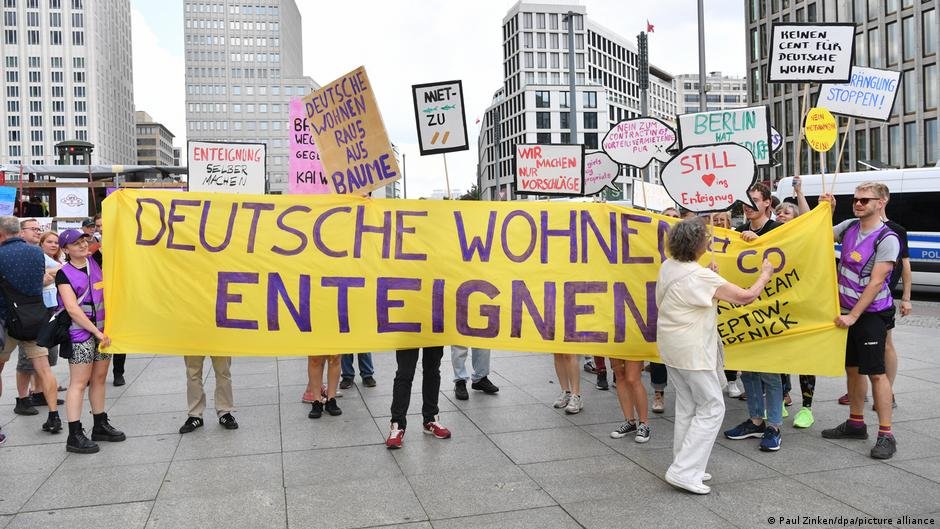
The socialist Left Party, which won the Berlin election on September 20, was the only major party on the ballot that said it would implement the results of Berlin’s 2021 referendum, when 57.6% of Berliners voted to expropriate the apartments owned by real estate companies that own more than 3,000 units.
But the federal government has said they won’t let it happen. So is it even possible? And how did we get here? DW explains:
-
What did the Left Party say about expropriation?
The Left Party was one of the main supporters of a successful, years-long grassroots campaign called “Deutsche Wohnen & Co. enteignen,” (“Expropriate Deutsche Wohnen”).
Deutsche Wohnen is a major property developer that owns over 140,000 units across Germany, and 100,000 in Berlin alone.
The campaign and the Left Party argued that by expropriating this and a handful of other major companies like it, the Berlin government could put some 270,000 apartments in Berlin into public ownership, and make them available at affordable rent prices. Other estimates put the number at around 240,000.
The argument struck a chord, as surveys showed that housing and rent prices were the biggest concerns for Berlin voters in the recent election.
Some 25% of rented property in Berlin is already in public ownership, through state-owned companies like Berlinovo. The expropriation measure would likely push that up to over 30%.
To view this video please enable JavaScript, and consider upgrading to a web browser that supports HTML5 video
-
The 2021 referendum — what was the question and what came out of it?
The original referendum, held in September 2021, asked Berliners to vote yes or no on a five-point plan:
– Socializing the apartments owned by the major property companies
– Administration of the properties by a public-law entity
– Administration of the properties with participation from both city officials, renters, and local communities
– Ban on any re-privatization
– Compensation for the property companies “significantly below” the market value of the property
The referendum did not oblige the state government — at the time a coalition of the center-left Social Democratic Party (SPD), the Greens, and the Left Party — to immediately implement the plan.
Instead, the then-SPD Mayor Franziska Giffey put together a 13-person expert commission, including former justice ministers and constitutional law experts. This was given the task of establishing whether the plan conformed with the German constitution, or Basic Law, and how the compensation could be organized.
In 2023, the commission concluded that expropriation was legal and possible, though budget questions still needed to be clarified.
By then, a new conservative-led government, headed by the Christian Democratic Union‘s (CDU) Kai Wegner, had been voted into office, and announced that it would not expropriate any real estate companies, regardless of what the commission said. At the same time, it emerged that the Berlin CDU was receiving hundreds of thousands of euros in donations from property companies.
Instead, the government said it would draw up a socialization law that would define the conditions for the socialization of property, while ruling out expropriation. A draft law was completed in December 2025.
The Deutsche Wohnen Enteignen campaign rejected this idea as pointless, and had in the meantime gathered legal experts to draw up its own expropriation and socialization law, and promised to start another campaign to force a referendum to implement that.
-
The legal basis for expropriation: Articles 14 and 15 of the German constitution
The original campaign founded its plan on articles 14 and 15 of the German Basic Law.
Article 14 says that, while the right to property is guaranteed, “expropriation shall only be permissible for the public good.”
Article 15 states: “Land, natural resources and means of production may, for the purpose of nationalization, be transferred to public ownership or other forms of public enterprise by a law that determines the nature and extent of compensation.”
As far as the campaigners are concerned, the law they have drawn up covers those two bases.
But, while Article 14 is implemented often enough (for example, when the state wants to build a new highway), Article 15 has never been implemented at all. It is new legal territory, and no one is quite sure what would happen if it were tried.
Some legal experts say the plan would contravene European law. Housing companies would almost certainly fight the measure in court and demand more compensation than the government is willing to offer.
To view this video please enable JavaScript, and consider upgrading to a web browser that supports HTML5 video
-
‘Not happening’ — Chancellor Merz vows to prevent expropriation
Chancellor Friedrich Merz responded to the Left Party’s election victory immediately by promising to draw up a federal law banning state governments from expropriating property.
“It’s not just about banning something here in Berlin,” Merz said at a press conference in the aftermath of the Berlin election. “It’s about sending a clear message to international investors, which is: There is no expropriation of private property in Germany.”
However, it’s unclear whether the federal government has the power to impose such a law. Germany’s Constitutional Court once ruled that the federal government cannot pass a law simply to prevent a state from governing in the issues it wants.
-
What now?
The Left Party still has to enter into coalition negotiations to form a government in Berlin. Its most likely coalition partners are the SPD and the Greens, and given the opposition from the federal government and the massive controversy over the issue, the expropriation plan could become a major sticking point.
Whatever happens, the Left Party itself acknowledges that expropriation and socialization would take a while to put into practice, and it would be even longer before it had a measurable effect on Berlin’s overall rents.
In the meantime, it has drawn up a number of laws that it hopes will tackle the problem more quickly, such as a rent cap.
In any case, Berliners themselves appear to have gone a little cold on the idea. Despite the Left’s electoral success, a recent poll by infratest-dimap found that only 37% of Berliners are still in favor of expropriating real estate companies.
Edited by Rina Goldenberg