https://p.dw.com/p/5POzgPrefer DW on Google
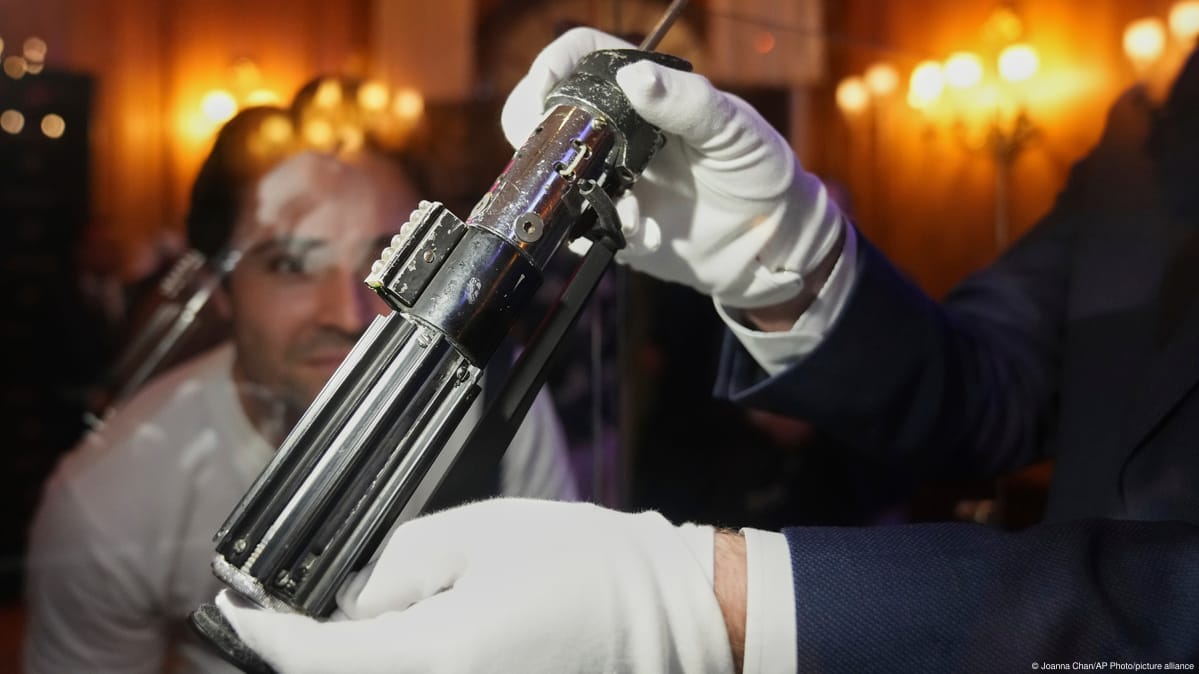
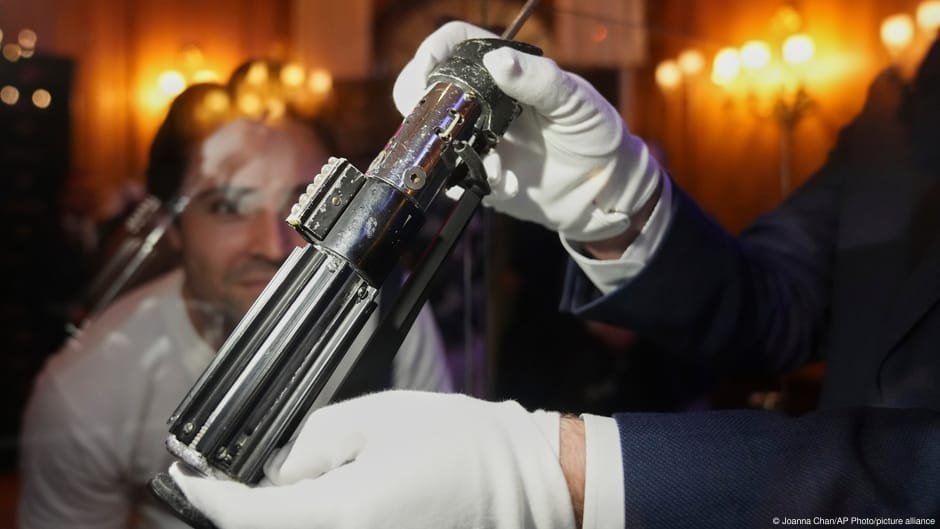
A lightsaber prop made for “Star Wars” villain Darth Vader sold for $4.875 million (€4.4 million) on Thursday, setting an auction record for a collectible from the franchise, according to Dallas-based Heritage Auctions.
The iconic prop was used in two defining duels between Darth Vader and Luke Skywalker in the original “Star Wars” trilogy.
Which scenes featured Vader’s lightsaber?
Vader wielded the lightsaber in the climactic Cloud City duel in “The Empire Strikes Back” (1980), where he cuts off Luke’s hand. When Luke accuses him of killing his father, Vader replies with one of the saga’s most famous lines: “No. I am your father.”
The same lightsaber returned for their final duel in “Return of the Jedi” (1983). This time, Luke cuts off Vader’s hand but refuses to kill him.
Vader’s lightsaber set an auction record for a screen-used “Star Wars” prop in 2025. Luke’s lightsaber from the same Cloud City duel broke it in July. In the latest twist, Vader struck back to reclaim the record.
Actor David Prowse and stunt performer Bob Anderson both wielded the saber as Darth Vader. It may also have been used in the original 1977 “Star Wars” film, but the auctioneers could not confirm that.
What inspired the lightsaber?
“Star Wars” creator George Lucas drew on Errol Flynn swashbucklers and the legends of King Arthur. He imagined the Jedi as peacekeepers guided by chivalry and honor and wanted a weapon that suited that role.
In the original “Star Wars,” Luke’s Jedi mentor, Obi-Wan Kenobi, gives him his father’s lightsaber, describing it as “not as clumsy or random as a blaster” and calling it “an elegant weapon for a more civilized age.”
Lucas first imagined the Jedi carrying ordinary swords. He gave them futuristic blades that could deflect blaster fire. As he put it in the Lucasfilm featurette “The Birth of the Lightsaber”: “A laser sword in a world of ray guns would be a perfect defensive weapon.”
How was Vader’s lightsaber made and identified?
The hilt began life as a 1950s British camera flash attachment. Prop makers added black plastic grips and tiny magnifying lenses from a calculator display. Heritage described it as “built to perform rather than merely to be seen.” The crew reinforced the hilt to hold interchangeable wooden blades and screwed the grips into place after they came loose during fight scenes.
For “The Empire Strikes Back,” the crew initially covered the wooden blades in reflective material and later painted them white. After filming, the effects team used the rods as a guide, tracing their movements frame by frame to create the blazing red blade seen on screen.
Heritage matched a distinctive bend in the hilt’s belt ring to a production photo from “The Empire Strikes Back” and a dent at its base to a close-up in “Return of the Jedi.”