25 minutes agoShareSaveAdd as preferred on GoogleLucy WilliamsonTel Aviv, Jerusalem, Ramle and Sderot
After three years of regional war, this is a battle Israel always knew was coming.
The general election on Tuesday hangs over a country that’s deeply divided and ready for a fight.
Polls published on Friday put the governing coalition and the main opposition bloc almost neck-and-neck, with half a million first-time voters due to cast their ballot and some 70,000 Israelis reportedly flying in from abroad specifically to vote.
On Saturday night, vast crowds of opposition voters gathered in central Tel Aviv to demand a change of government.
“We’re optimistic,” 21-year-old Omri told me. “I want peace, I want security, and I want to end corruption and get the religious fanatics out.”
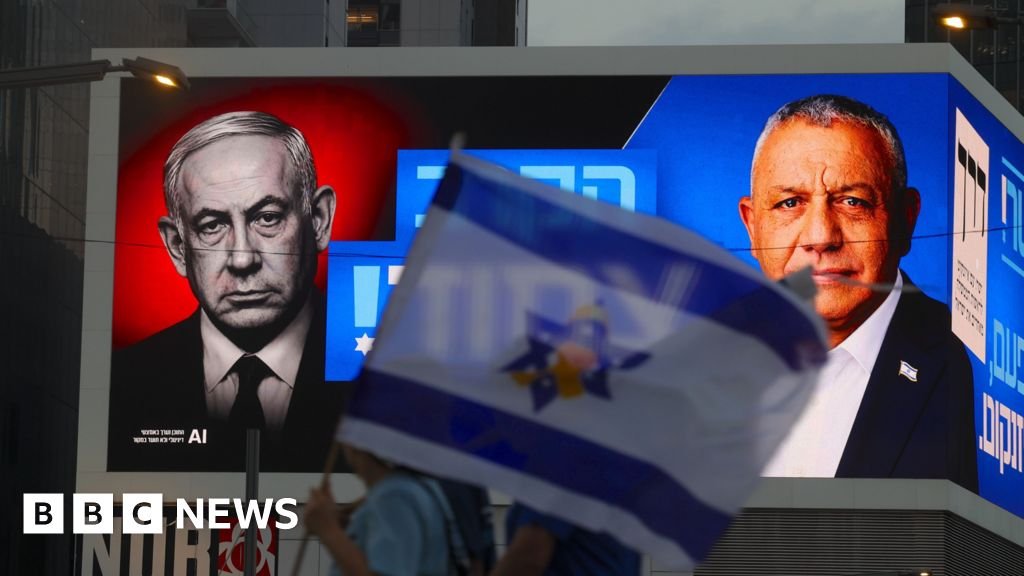
This campaign has been energized by new tactics – including AI videos designed to grab the headlines – and also by a new face.
Gadi Eisenkot is, perhaps, not the man you might expect to take on the flashy, aggressive, media-savvy brand of Israel’s longest-serving prime minister, Benjamin Netanyahu.
Relatively new to politics, with a working-class Moroccan background, Eisenkot is a former military chief of staff who is renowned for his calm manner and low-drama approach. He’s been dubbed by some as a “non-politician”.
But he and his centrist Yashar party have regularly pipped Netanyahu and his Likud party to the top spot in recent polls, the last of which was published on Friday, in line with Israeli election law.
Israeli politics is the art of coalition-building, rather than the task of any one party winning power, but with the predicted result too close to call, Eisenkot’s rising profile has sharpened a race many Israelis already see as existential for the future of their country.
I watched him slip past the cameras at a community centre for Ethiopian Jews in the city of Ramle last week, through a gaggle of security personnel and advisors.
One of those who had come to hear him speak was David, a smartly dressed man in a freshly-pressed shirt and navy jacket, who said he had met Eisenkot before.
“He looks you in the eye, not like a leader looking down at someone,” David told me. “And he listens. He’s very sympathetic.”

 Getty Images
Eisenkot’s appeal is often put down to his personal manner and profile. A softly-spoken military man whose son was killed during the Gaza War, he has presented himself as coming “from the periphery”, not from Israel’s wealthy urban elite.
His Moroccan background became election headlines earlier this month when a pro-Netanyahu speaker used a racist slur to refer to Eisenkot during a TV debate, referring to him as a Moroccan “monkey”.
“These elections are about many issues,” Eisenkot told the crowd gathered at the Ramle community centre. “They are about security, economy, education…but primarily, they are about the identity of the State of Israel, and what kind of Israel we want to see. A Jewish state, a democratic state, a liberal, tolerant, egalitarian state.”
This is music to opposition ears, who say Benjamin Netanyahu’s government is a threat to Israel’s democracy, pointing to his efforts to curb the powers of the judicial system, and his refusal to establish a state commission of inquiry into the 7 October 2023 attacks on the grounds that the country’s Supreme Court would be biased against him.
Eisenkot, along with other opposition leaders, has attempted to draw voters away from Netanyahu’s right-wing Likud party by promising such a state inquiry, which a recent survey suggests is supported by more than 70% of Jewish Israelis.
 AFP via Getty Images
He has also vowed to enforce court rulings on drafting ultra-Orthodox Jews into national military service – another measure that is popular with right-wing voters and opposition alike.
Benjamin Netanyahu has hit back with a campaign focused on Israel’s security, and a core campaign slogan of “No Surrender”.
He has repeatedly cast his rivals as soft on security, playing on the fears of some right-wing voters that Jewish opposition parties might ally with Israel’s Arab parties to secure a majority, and suggesting this could compromise national security.
Around one-fifth of Israel’s population is Arab – many of whom describe themselves as Palestinian citizens of Israel.
These are the first elections since the 7 October attacks, in which Hamas-led gunmen stormed through Gaza’s border fence, killing almost people and taking 251 hostage.
It was Israel’s worst security failure, but three years on its prime minister is again running for re-election as the only man who can keep Israel safe.
“If the army had woken him in time, it wouldn’t have happened,” Shlomi Bashar told me, one of several die-hard Netanyahu fans drinking in a basement café in Jerusalem’s Mahane Yehuda market. “He does bear a certain responsibility, but after the 7 October, he changed the entire Middle East.”
Netanyahu has been hammering home the message that Israel’s wars in Gaza, Lebanon and Iran, in the years after the 7 October attacks, have reduced existential threats to the country.
“We need him to be re-elected so that he can finish this work,” said Shlomi. “In my opinion, he is one of the best leaders in the world. Most of the world loves him and respects him, because he is a strong man and his ideas are correct.”

The prime minister has traditionally relied on a stable base of right-wing voters, but is projected to see a thinning of support in this election. Some voters may be slipping away to opposition parties like Eisenkot’s. Others, including some die-hard Likud voters we spoke to, said the 7 October attacks had pushed them towards parties further on the right.
Lt Col (Res) Eyal Hajbi, head of the regional civil defence unit in the Netanyahu stronghold of Sderot, right on the Gaza border, lost several friends and colleagues in the attacks. He lights candles for them every day in his office, and told me he would be thinking about them when he cast his ballot on Tuesday.
Standing on a ridge overlooking the ruins of northern Gaza, he gestured to the wasteland where Israel’s army has completely flattened the neighbourhoods of Beit Lahia and Beit Hanoun.
“As far as I’m concerned, after 7 October, we should wipe them all out,” he said. “I’ve changed my understanding of Gaza. Before, I wouldn’t have said we should destroy it.”
He told me he and his family had always voted Likud, but that now he was voting for the far-right party of Itamar Ben Gvir, Jewish Power.
“My family has become more extreme than it ever was before,” he said. “If once we deliberated over it, today we don’t think twice; we vote.”
Polls suggest that less than 10% of Israelis are undecided and that very few of those are considering switching between government parties and opposition ones.
Ben Gvir, National Security minister in Netanyahu’s coalition, has been reaching out to younger voters through headline-grabbing social media campaigns.
A poll for one of Israel’s leading newspapers, Yedioth Ahronoth, published on 9 October, suggested that more than 16% of first-time voters in Israel would choose far-right parties like his.
In Sderot, a group of 18 year olds from a nearby Jewish religious college told me their political views had been affected by the 7 October attacks far more than their parents. All four teenagers were planning to vote for another far-right party, Religious Zionism, led by Finance Minister Bezalel Smotrich.
“Today, the whole younger generation understands that peaceful paths will not work,” Aviad Elmahach, one of the teenagers, told me. “Older adults, who are set in a fixed mindset, find [it] harder to change, but the youth understand that we need to be here with strength and an iron fist, which is the only way to win.”
The lesson of 7 October, he said, was that Israel needed to be as forceful as possible in its relations with the Palestinians, more than 74,000 of whom have been killed by Israel in Gaza since then, according to the Hamas-run health ministry, whose figures are considered reliable by the UN.
“The youth have a fresh new perspective that has not yet become entrenched in politics, and they understand very well why we’re voting for Smotrich – it means holding the land with strength and giving [the Palestinians] nothing through peaceful gestures.”
 AFP via Getty Images
A little further south along the Gaza border are the kibbutzim that were overrun by gunmen during the Hamas attacks. They were renowned for decades as bastions of the Israeli left.
Among them is Nir Oz, where 47 people were killed and 76 taken hostage that day.
Three years on, residents are moving back. Twenty-six-year-old Gal Pauker has opened a Friday wine café at the edge of his small vineyard next to the Gaza border – a few wooden tables set out under sheets of beige canvas to shade customers from the strong desert sun. His grandfather Gideon was killed during the 7 October attacks.
I asked Gal, and his mother Galia, whether the those attacks had shifted their political views.
 Getty Images
“We need a change – we can’t live with this government anymore,” Galia said. “And I’m not talking about security, I’m talking first about humanity.”
Having voted for centrist parties in the past, Galia says she’s decided to vote for Eisenkot this time around, because “he’s an ordinary guy and I hope he’ll continue the way he’s talking”.
Her son Gal said he was deciding between Eisenkot and the left-leaning Democrats party of Yair Golan, another former army general.
“I’m not naïve. I know there are a lot of more militant voices from young generations,” he said. “I don’t know if Eisenkot will be better than Golan in terms of security, but I think we have bigger problems: economics, social problems, education, health. We didn’t get new neighbours on October 7 – it was a major event, but didn’t change how we see ourselves.”
Threats to security versus threats to democracy – these are old political tramlines for Israeli voters, deepened by the 7 October attacks, and by four years of the most right-wing government in Israel’s history.
But on some of the biggest international concerns, the differences between government and opposition are not as wide as it might seem.
Gadi Eisenkot has pledged to end Hamas rule of Gaza within 18 months, either through a US-led peace plan, or through “military and operational capabilities”.
All the main opposition leaders have voiced support for some form of Israeli settlement in the occupied West Bank, which has expanded massively under the current government and is illegal under international law. None have openly committed to the idea of full Palestinian statehood, something Benjamin Netanyahu has vowed to block. Eisenkot has spoken about creating the conditions for “autonomy or state-minus” under ultimate Israeli security control.
Tuesday’s vote could well end in deadlock, with neither government nor opposition able to form a majority without the support of Arab parties, which polls project could win enough seats to be kingmakers. All but one of Israel’s Jewish opposition parties have so far rejected working with either of the two Arab party blocs.
With Benjamin Netanyahu ramping up warnings of fresh threats from Iran, opposition voices warning of potential disruption to the ballot, and Israeli rights activists warning of a further spike in violence by settlers in the occupied West Bank, political instability at home could leave Israelis facing both a fresh test of their democracy, and fresh security threats.
More on Israel’s electionIsrael