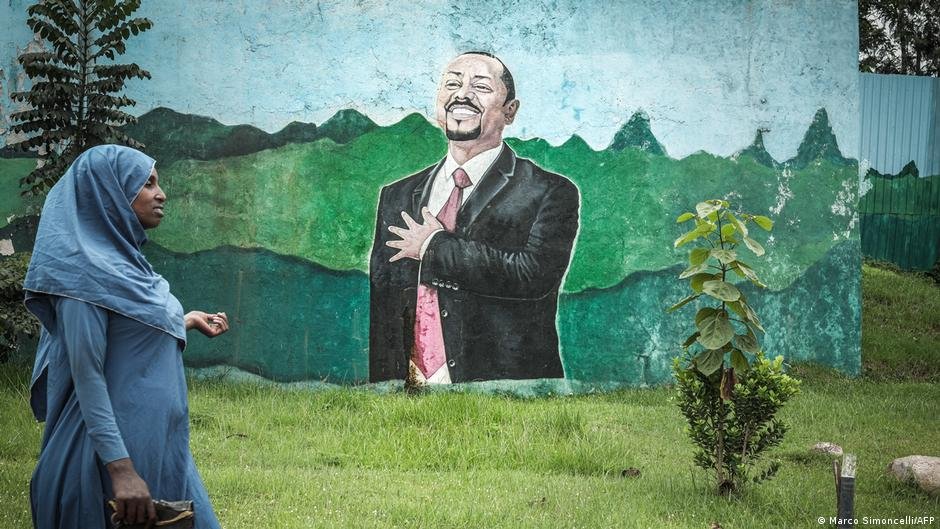
Abiy Ahmed is likely to continue his role as Ethiopia’s prime minister after his Prosperity Party won another comfortable parliamentary majority in the June 1 elections. The party took nearly 90% of seats.
The results were released on Sunday after voting in several polling stations was suspended due to security issues, and no voting took place in northern Tigray for a second consecutive election. Abiy is now awaiting the formality of election by the House of Peoples’ Representatives.
Abiy burst onto the world stage as a young, dynamic leader of Ethiopia in 2018. But his journey to the top job began long before that.
In the 1990s, he had a career with the Ethiopian National Defense Force (ENDF), before leading Ethiopia’s cyber-intelligence service INSA. He first became known nationally as a politician in 2010, when he rose through the ranks of the Oromo People’s Democratic Organization (OPDO). In 2018, the party changed its name to Oromo Democratic Party (ODP).
He was subsequently elected to the House of Representatives, and in 2016 became the Minister of Science and Technology in Addis Ababa. However, he soon returned to his home province of Oromia to serve as head of the OPDO Secretariat.
To view this video please enable JavaScript, and consider upgrading to a web browser that supports HTML5 video
Abiy wins Nobel Peace Prize in 2018
Abiy Ahmed’s meteoric rise came in 2018, when he became one of the nation’s youngest-ever leaders. But it was not just his youth that excited so many, it was also what he represented.
Born to a Muslim father and a Christian mother in 1976 in western Ethiopia, Abiy became the first Oromo chairman of the ruling four-party coalition, the Ethiopian People’s Revolutionary Democratic Front (EPRDF).
His appointment signaled a shift in Ethiopian politics, because although Oromos make up around a third of Ethiopia’s approximately 136 million citizens, Tigrayans had dominated the country politically until then.
The Tigray People’s Liberation Front (TPLF), the dominant party in the EPRDF, had until that point exerted a sizable influence on Ethiopia’s political and economic fortunes since the fall of the Mengistu Haile Mariam-led military regime in 1991. The TPLF also controlled the ENDF and intelligence services.
But it was Abiy’s overtures to neighboring Eritrea, with whom Ethiopia had fought a bloody war between 1998 and 2000 that claimed more than 80,000 lives, that garnered him international attention.
He introduced sweeping reforms and promised to accept the Eritrea-Ethiopia Boundary Commission (EEBC) ruling, which ensured that the border town of Badme would belong to Eritrea. Previous Ethiopian governments had refused to implement the ruling. Airline and telephone connections were established, and the two nations reopened their embassies.
The Eritrean leader Isaias Afwerki and his counterpart, Abiy, sealed their ‘friendship’ by visiting each other’s capitals. For his part, Abiy Ahmed capped 2019 by being awarded the Nobel Peace Prize.
His work on the domestic front also drew attention. Political prisoners were released, parties were unbanned, female political participation boosted, repressive laws amended, and Abiy was hailed in Western circles as a new hope for the Horn of Africa.
Out with the EPRDF, in with the Prosperity Party
In 2019, Abiy founded the Prosperity Party to amalgamate the interests of Ethiopia’s various ethnic groups. However, some observers say its main purpose was to diminish the political power of the TPLF. All in all, nine parties came together to form the Prosperity Party, with Abiy at the helm.
Tigrayan leaders condemned this merger as illegitimate and withdrew their personnel and resources to Tigray’s state capital, Mekelle, precipitating a rapid decline into conflict.
In late 2020, as the COVID-19 pandemic preoccupied much of the world, tensions between Tigray’s leadership and Prime Minister Abiy Ahmed’s government came to a head.
After the federal government postponed national elections, Tigray proceeded with its own regional election in September 2020, which Addis Ababa declared illegal and responded to by severing relations with the regional administration. In November 2020, following attacks by Tigrayan forces on ENDF bases in Tigray, Abiy ordered a military operation against the TPLF.
Eritrean forces later joined the conflict alongside Ethiopian federal forces. A devastating war followed, causing hundreds of thousands of deaths, according to many estimates, and there were widespread allegations of atrocities committed by multiple parties.
Major hostilities formally ended with the Pretoria peace agreement in November 2022, although implementation remained uneven, and Eritrean forces were reported to remain in parts of Tigray afterward.
The war with Tigray also tarnished Abiy’s reputation as a peacemaker abroad and led to the curtailment of individual freedoms domestically.
The partnership with Eritrea also drew criticism after it emerged that Eritrean soldiers had committed atrocities against Tigrayan civilians.
Abiy’s government forces are currently battling the Fano militia in the Amhara region. Ironically, the same fighters backed the ENDF during its war with the TPLF.
To view this video please enable JavaScript, and consider upgrading to a web browser that supports HTML5 video
Abiy Ahmed oversees GERD completion
A major milestone for Abiy and Ethiopia came with the completion of the Grand Ethiopian Renaissance Dam on the Blue Nile, which had been under construction since 2011.
Costing $5 billion (€4.35 billion) and funded domestically, it is considered a major investment in Ethiopia’s energy and water security and its regional ambition.
It also brought Abiy Ahmed’s government into conflict with its downstream neighbors Sudan and Egypt. Egypt has long viewed Ethiopia’s damming of the Nile as an existential threat, though Abiy has been at pains to stress that the GERD will bring prosperity to the whole region.
Abiy’s ambition to make Ethiopia a regional power, and specifically have direct access to the Red Sea, has also put Eritrea on edge.
While there seemed to be a brief thaw in ties between Asmara and Addis Ababa in 2018 due to Abiy’s reforms, that optimism has now diminished as Eritrea seeks to defend its interests against the perceived threat of war with Ethiopia.
Edited by: Chrispin Mwakideu