What changes from Wednesday?
In a drive to cut waste and improve public health, new European Union rules take effect on Wednesday, banning high levels of PFAS “forever chemicals” in packaging.
Under the EU’s Packaging and Packaging Waste Regulation (PPWR), any new packaging products entering the market will now have to meet tighter standards if designed to come into contact with food.
PFAS have been linked to increased risks of certain cancers and other health conditions.
Although the amount of material people are exposed to from food packaging is usually low, scientists are worried about the long-term effects.
After all, PFAS are highly persistent chemicals and accumulate in the body and the environment.
PFAS are used to make paper and cardboard packaging both grease- and water-resistant and are found in everything from pizza boxes to TV dinners.
Packaging with lower PFAS reduces the risk of these persistent chemicals migrating into food or the natural world when thrown away.
The new rules are in addition to curbs on bisphenol A (BPA) in food-contact materials, which took effect across the EU last month.
Under PPWR, businesses will not be required to recall or destroy packaging or goods that were already on the market before Wednesday.
While consumers won’t notice any difference, businesses have fiercely criticized the changes, which also require packaging to meet new sustainability standards.
Are the new packaging rules too complicated?
Many small businesses and online traders believe the additional cost and red tape are too cumbersome.
They complain that they now have to register their packaging in multiple EU states, often with fees.
“Instead of facilitating cross-border trade, the new rules threaten to make it significantly more difficult,” warned Händlerbund, the German online retailers’ association.
Händlerbund warned its members: “There is no minimum quantity and no exception for small businesses.”
EU lawmaker Elisabeth Dieringer of the far-right Freedom Party of Austria has warned that PPWR would mean five-figure costs for medium-sized firms.
“While corporations have their own departments for this [red tape], the Mittelstand [medium-sized firms] has little choice but to ‘eat or die,’” she wrote on X on Tuesday.
Several businesses, from sole traders to medium-sized firms, said they had paused deliveries to and within the EU due to the new rules.
“Under these rules, I would need to appoint an authorized representative in every single EU country I send to,” wrote the owner of a small online store, Monstaas Workshop, in an Instagram post.
“The cost is around €300 ($346) per country, per year … these costs are simply not affordable.”
To view this video please enable JavaScript, and consider upgrading to a web browser that supports HTML5 video
Swedish embedded electronic devices maker iLabs Electronics said it would halt web shop orders from EU countries.
“The cost and administrative burden [of PPWR] is now out of proportion to our direct sales volume,” iLabs wrote on its website.
A petition on change.org had been signed by more than 45,000 people by Wednesday morning, calling on Brussels to “stop destroying EU micro-businesses.”
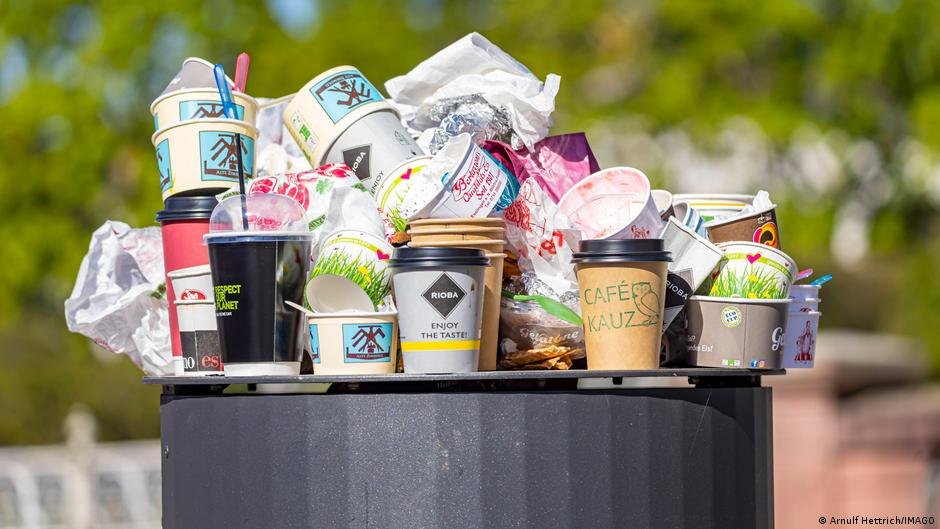
How bad is the EU’s packaging waste problem?
According to the European Commission, the bloc’s executive arm, EU countries have witnessed a 20% increase in packaging waste over the last decade.
Without PPWR, Brussels says, discarded packaging was set to rise by another 19% by 2030, driven by the boom in online shopping and convenience food.
EU data shows that 178 kilograms (392 pounds) of packaging waste was generated per person across the bloc in 2023. Of this, 35.3 kg was plastic packaging, only 42% of which was recycled.
At 215 kg per capita (in 2023), Germany’s waste from packaging is much higher than the EU average.
Each EU resident generates the equivalent of roughly half a kilo of packaging waste every day, data from Eurostat, the EU’s statistics agency, shows.
According to Brussels, the volume of waste has grown faster than recycling rates over the past decade.
Packaging also accounts for about 40% of plastic consumption in Europe, an EU official told reporters at a briefing on Tuesday.
What are the EU’s long-term waste targets?
Although PFAS is the main focus of this initial phase of PPWR, the EU has set binding targets to cut packaging waste by 5% by 2030 and 15% by 2040.
From 2028, packaging manufacturers will be required to carry standardized labels that clearly show the materials used and how it should be recycled or disposed of.
Some stores, particularly restaurants and cafes, will be required to offer customers reusable packaging as an option, often at no extra charge.
Deposit-and-return schemes for plastic bottles and soda cans, such as those operational in Germany and the Netherlands, will be rolled out across the EU by 2029.
Then from 2030, all packaging placed on the EU market, including single-use plastic bottles, must be designed to be recyclable.
Packaging will also be required to be kept to a minimum to protect the product and fulfill its function.
This measure is meant to reduce the overuse of packaging for marketing purposes.
Meanwhile, single-use plastic packaging for fresh produce will be banned from 2030.
EU states will be able to set their own penalties for non-compliance, with German authorities allowed to impose fines of up to €200,000 ($230,000) for more serious breaches.
Edited by: Kristie Pladson