


Former Sakae Holdings director gets jail for misappropriating S$15.8 million, lying in High Court
Ong Siew Kee was sentenced to 10 years and six months’ jail on Friday. He was convicted for criminal breach of trust, abetting forgery and giving false evidence in court in May after claiming trial.
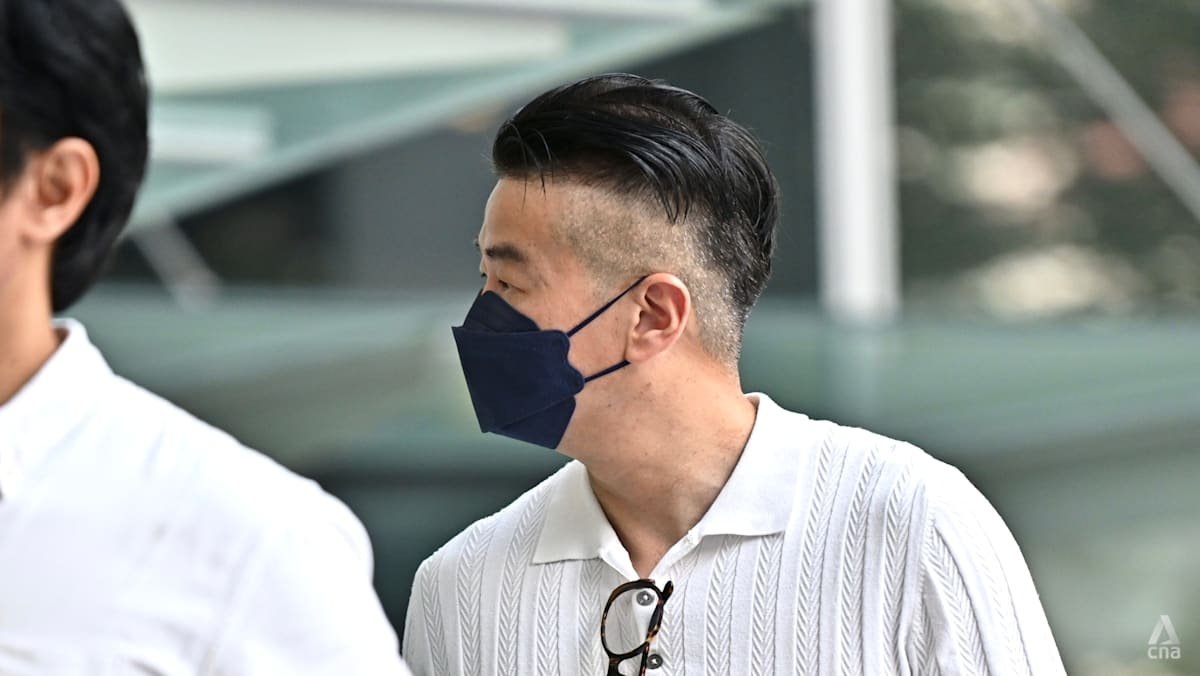
Ong Siew Kwee arriving at the State Courts on Aug 7, 2026.(Photo: CNA/Raydza Rahman)
New: You can now listen to articles.

This audio is generated by an AI tool.

Read a summary of this article on FAST.
Get bite-sized news via a new
cards interface. Give it a try.
Click here to return to FAST
Tap here to return to FAST
FAST
SINGAPORE: Former director of Sakae Holdings Ong Siew Kwee was sentenced to 10 years and six months’ jail on Friday (Aug 7) for his involvement in a scheme that led to the fraudulent transfer of S$15.8 million (US$12.3 million) from a joint venture linked to the Bugis Cube development.
Ong, 56, also known as Andy, was convicted in May on one count each of abetting forgery, criminal breach of trust and giving false evidence in court proceedings.
Two of his associates, Ho Yew Kong and Chua Wei Tat, were sentenced to 12 months’ jail each on Friday in connection with the case.
Ho, former director of the joint venture Griffin Real Estate Investment Holdings (GREIH), and Chua, an asset manager employed by Ong’s management company, were convicted in May of one count each of giving false evidence in High Court proceedings related to the dispute.
Deputy Public Prosecutor Ronnie Ang sought 12 to 13 years’ jail for Ong, while his lawyers Mr Daniel Koh and Mr Thomas Lee of Eldan Law argued for between five years and six months’ and five years and nine months’ jail.
Mr Ang sought two to three years’ jail for Ho and Chua, while their lawyers, Mr Remy Choo and Mr Andre Jumabhoy, argued for six months and four months in prison respectively.
Delivering her sentence for Ong, District Judge Jill Tan noted the aggravating factors raised by the prosecution – the large sum misappropriated, the high level of trust placed in him as the chief investment officer of Gryphon Capital Management, the steps he took to avoid detection, and his lack of remorse.
She agreed with the prosecution that S$15.8 million was an “objectively high” sum. Although Ong made full restitution, she accepted that it was not voluntary as it was pursuant to her judgment and did not reflect his remorse.
The defence had argued that Ong’s seniority in the company did not establish an elevated level of trust that warranted an uplifted sentence.
If not for Ong’s position at work and the high degree of trust in him, the funds could not have been moved so easily, the judge said.
The judge also noted the prosecution’s argument that once Ong realised his initial narrative had collapsed, he “performed a complete about turn” and changed his account midway through the trial.
The defence rejected this characterisation of Ong’s evidence as a “complete about turn”, calling it hyperbolic.
Judge Tan noted that in her verdict, she had agreed with the prosecution that the new evidence given by Ong was not credible. She rejected the defence’s claim that the variation in Ong’s defence was a “legitimate exploration of different explanations” for the transfers made.
She also noted that the false evidence given by Ho and Chua was meant to bolster the false narrative put up by Ong, but acknowledged that their culpability was less than Ong’s.
All three men will be appealing their convictions and sentences, their lawyers said. They also face multiple pending charges that will be dealt with at a later date.
Ong sought permission to leave the country to travel to Thailand, France and Italy to settle business matters, with his lawyers claiming that no one else could do it for him. The judge rejected the request, saying his flight risk has increased following his sentencing.
The court had given Ong previous reminders that he needs to get his affairs in order so that he would not need to travel overseas for business, she added.

THE CASE
According to the prosecution, Ong’s involvement in the case stemmed from his business relationship with Douglas Foo, who was then managing director of Sakae Holdings. The two entered into a joint venture to acquire Bugis Cube.
Both agreed in 2009 that GREIH would be the joint venture vehicle, with Sakae Holdings later becoming a minority shareholder.
Ong then set up Gryphon Real Estate Investment Corporate, which later became the majority shareholder of GREIH, and Gryphon Capital Management, a management company to handle the Bugis Cube units.
The prosecution said documentary records showed that Ong Han Boon, who was a director of GREIH at the time, and the three men sentenced on Friday created a false “paper trail”.
This was meant to support a fabricated narrative that GREIH had leased units in Bugis Cube to ERC Institute, later terminated the lease and therefore owed ERC Institute compensation.
At the centre of the case was a lease agreement purportedly dated Mar 1, 2012 between GREIH and ERC Institute, which appeared to grant ERC Institute tenancy over several floors of the development.
The prosecution charged that Ong instigated Ong Han Boon to create a document around Jun 20, 2012 and backdate it. The lease went through multiple drafts, with key versions created only months later.
Ong Han Boon, who has since pleaded guilty and was jailed, later testified against the accused, giving evidence that the false lease was used to support a claim that GREIH owed compensation after supposedly terminating the agreement.
Judge Tan found that the document was false, and accepted Ong Han Boon’s evidence, which was consistent with documentary evidence and broadly logical.
In September 2012, Ong caused GREIH to transfer S$15.8 million to related entities – S$14.3 million to ERC International and S$1.5 million to ERC Unicampus.
The court found that these payments were not justifiable and that the misappropriation had caused wrongful loss to GREIH.
All three men were also found to have given false evidence in affidavits filed in the related High Court civil suit, in which they claimed the lease had been signed in March 2012.
The punishment for intentionally giving false evidence in a judicial proceeding is up to seven years’ jail and a fine.
For criminal breach of trust, Ong could have been jailed for up to 15 years, fined or both.
For abetting the forgery of a valuable security, he could have been sentenced to up to 15 years’ jail and fined.
Source: CNA/hw(sz)
Sign up for our newsletters

Get the CNA app
Stay updated with notifications for breaking news and our best stories
Get WhatsApp alerts
Join our channel for the top reads for the day on your preferred chat app

Get bite-sized news via a new
cards interface. Give it a try.
Click here to return to FAST
Tap here to return to FAST
FAST
About The Author



