The hot summer weather of 2026 has taken its toll on the glaciers around Chamonix, France. The shrinking Mer de Glace glacier is losing ice, mountains are becoming more unstable, and the landscape is changing.
Image: Laurent Cipriani/AP Photo/picture alliance
This summer has taken a heavy toll on the French Alps. In Chamonix, at the Mer de Glace (“sea of ice”), the glacier’s ice is visibly melting. Over the past 40 years, the glacier has shrunk significantly, primarily due to rising temperatures caused by human-induced climate change.
Image: Grégory Yetchmeniza/Le Dauphiné Libéré/MAXPPP/picture alliance
This cog railway takes tourists from Chamonix up to the Montenvers station at an elevation of 1,913 meters (6,276 feet). From there, visitors can enjoy a view of the Mer de Glace, France’s largest glacier, and the 4,000-meter peaks of the Mont Blanc massif. The view of the glacier, however, has changed significantly in recent years.
Image: Laurent Cipriani/AP Photo/picture alliance
White tarps are meant to protect the ice in the Grotte de Glace from the sun. The ice grotto, which tourists can still visit, is carved out of the glacier anew every year — an unusual attraction and a visible sign of the ice’s retreat.
Image: Laurent Cipriani/AP Photo/picture alliance
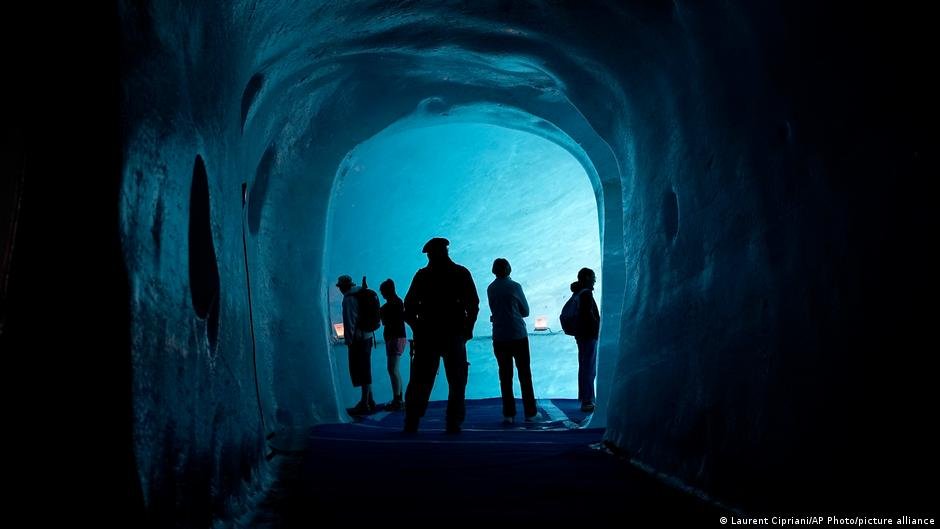
Inside the Mer de Glace grotto, visitors are greeted by a world of shimmering blue ice. About 170 steps lead down into the artificial ice tunnels, which are adorned with sculptures and intricate ice formations. But the famous ice cave has no future. As the glacier continues to retreat and thin, the grotto will be a thing of the past in a few years.
Image: Laurent Cipriani/AP Photo/picture alliance
A gaping hole has opened up in the Bossons Glacier above Chamonix. This photo, taken on June 17, 2026, shows the consequences of increasing ice melt: Meltwater is carving its way through the ice as the glacier continues to retreat. As recently as the 1980s, the glacier tongue extended all the way to the valley.
Image: Jeff Pachoud/AFP
This visitor is enjoying the panoramic view of the French Alps. But climate change is also altering the high-alpine landscape. For mountaineers, classic routes are becoming increasingly unstable due to thawing permafrost and melting ice. Crevasses are opening up, and rockfalls and landslides are on the rise.
Image: Laurent Cipriani/AP Photo/picture alliance
For now, the Mer de Glace in the French Alps remains an impressive backdrop for visitors from all over the world. But as the glacier recedes, the name “Sea of Ice” will eventually serve as a reminder of a landscape that once was, rather than of what lies before visitors’ eyes.
Image: Laurent Cipriani/AP Photo/picture alliance7 images1 | 77 imageshttps://p.dw.com/p/5MddI