


Poland started to construct a defensive barrier along its border with Russia and Belarus in 2024. The East Shield defense system will eventually be around 800 kilometers long, and is intended to protect this country on NATO’s eastern flank against attack from the east.
When the Polish prime minister, Donald Tusk, inspected the first completed section in November 2024, he declared that the project was meant to “deter and discourage a potential aggressor” and was “truly an investment in peace.”
The Russian invasion of Ukraine in February 2022 was a profound shock to Poland’s sense of security. The Tusk government has increased defense spending in 2026 to 200 billion zlotys (around 46 billion euros, or 54 billion dollars) ― almost 5% of Poland’s GDP. This means that, in relative terms, Poland has the highest defense spending of all the members of NATO. The government has also bought the most advanced weapons available, particularly from the US, and is proceeding with the construction of the East Shield, a complex defense system along its eastern border.
A shield against Russia
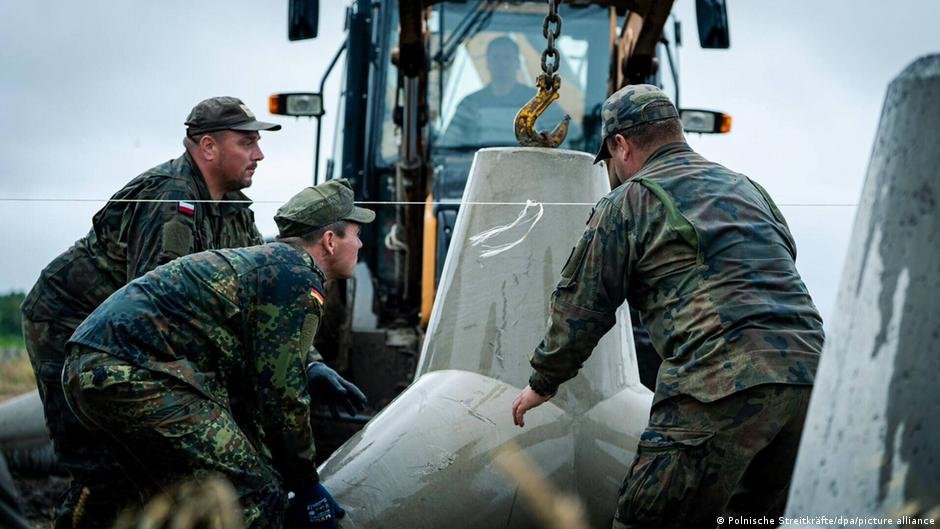
Since June, around 40 German sappers, or combat engineers, have been helping to establish the defenses. The German army’s combat engineer unit is specially trained in blocking the movement of enemy troops. The sappers are currently deployed near Budry in Masuria, close to the border with Russia. The fence marking the border is visible from where they are working, partially obscured by a row of trees on the Polish side.
The German soldiers are installing anti-tank obstacles to impede battle tanks in the event of an attack. A yellow backhoe loader lifts the spiky concrete blocks, known as Czech hedgehogs, off a truck and places them on the muddy ground.
This installation, around 200 meters back from the border, consists of three rows of these concrete blocks. A deep ditch and another line of hedgehogs run along the border itself. A Polish officer explains that mines can quickly be laid in the zone between the two lines of Czech hedgehogs.
“The German sappers have done an excellent job,” the Polish general Stanislaw Czosnek said when he inspected the works on Thursday. He added that he was “very impressed” by his German colleagues’ performance.
In the six weeks since their deployment, the German engineers have laid more than a kilometer of blocks.
“We stand ready to fight for democracy and freedom,” stressed the German general Tito Gante, who accompanied Czosnek on the inspection. He praised the comradely atmosphere between the German and the Polish soldiers.
The Bundeswehr has declared its support for the East Shield an official mission: “We want to maintain peace with a credible deterrent,” Gante said.
The German contingent will stay until October, but the sappers will soon be deployed at other sections of the East Shield. The work near Budry is due to be completed over the coming week.
Politically symbolic
“Above all, the participation of German sappers has politically symbolic significance,” Lukasz Jasinski, an analyst at the Polish Institute for International Affairs, told DW. “Poland wants to convince Germany and other partners that Poland’s eastern border is also the external border of the EU and NATO. Our Western partners should treat this border a bit like their own.”
Poland and Germany were quick to establish military cooperation after the end of the Cold War. Later, when Poland joined NATO in 1999, this created the necessary political and institutional conditions for close collaboration. Since then, NATO’s Multinational Corps Northeast, in which Poland and Germany both have leading roles, has been headquartered in the Polish city of Szczecin.
In 2003, Germany sold the MiG-29 fighter jets it inherited from the former East German Air Force to Poland for the symbolic price of one euro each. Joint military exercises and exchange programs for both officers and soldiers are now standard practice.
When Russia attacked Ukraine in February 2022, there were initial tensions between Germany and Poland on account of the cautious response from Berlin. Overall, though, the attack has further strengthened cooperation between the two. The Bundeswehr has supported Polish air defense by supplying several units of the Patriot air defense system, with their German crews. German fighter jets are helping to protect Polish air space, most recently as part of the NATO mission Enhanced Air Policing North (eAPN) in Malbork.
Questions of military cooperation were also prioritized in the closing statement that followed German-Polish intergovernmental consultations on December 1, 2025. The process culminated in the signing of the German-Polish defense agreement on June 17, 2026.
On August 15 this year, three German planes, two Eurofighters and an A400M transport aircraft, participated in the celebration of Polish Armed Forces Day. The head of the German air force, Holger Neumann, was one of the guests of honor. Some American GIs marched in the military parade ― but no German soldiers.
Kaczynski: No German soldiers in Poland
However, not all the political forces in Poland are happy about this new Polish-German brotherhood-in-arms. Memories of the trauma of World War II are still very much alive in Polish society and are regularly instrumentalized by the right-wing conservative Law and Justice Party (PiS) to stir up anti-German feeling.
Back in 2014, PiS leader Jaroslaw Kaczynski said he didn’t want any German soldiers in Poland.
“It will be at least seven generations before that is acceptable,” he said.
In the fall of 2022, when the German government offered to relocate two German Patriot batteries to Poland after an incident involving a Ukrainian rocket gone astray, the PiS government blocked the move.
“Germany’s previous behavior gives us no reason to believe that it will decide to fire on the Russian rockets,” Kaczynski declared.
Just last March, Poland’s president Karol Nawrocki, who is backed by the PiS, vetoed legislation that would have allowed Poland to access almost 44 billion euros (55 billion dollars) in EU defense loans because German armaments companies could also have benefited.
Poland sees the US as the most important guarantor of its security, and is trying to establish a special relationship with Washington. Around 10,000 US soldiers are currently stationed in various places around the country. Warsaw is keen to establish a permanent military base on its territory: Until now, a significant number of the US soldiers are in Poland on rotation.
This article has been translated from German.
About The Author







