German Football Association’s rules on agents get a pass from EU top court
General view of the German football association logo at the airport in Frankfurt. June 28, 2018/ REUTERS/Thorsten Wagner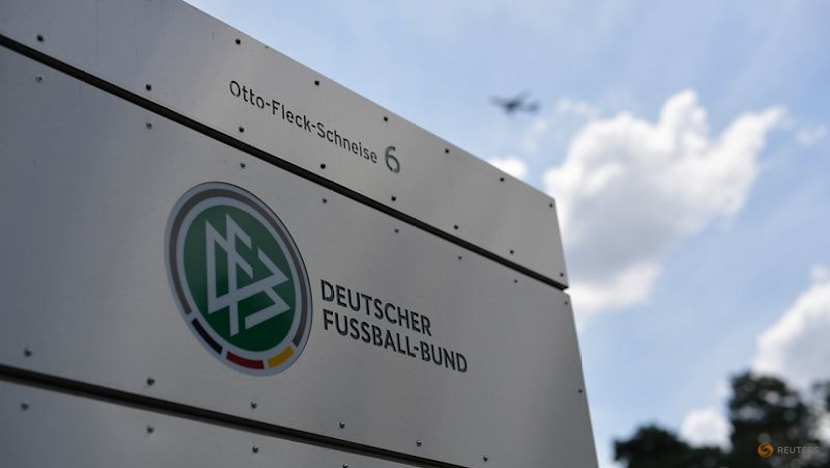
Read a summary of this article on FAST.
Get bite-sized news via a new
cards interface. Give it a try.
Click here to return to FAST
Tap here to return to FAST
FAST
BRUSSELS, July 9 : Europe’s top court on Thursday backed the German Football Association (DFB), ruling that its regulations governing football agents are compatible with EU competition law provided they pursue legitimate objectives in the public interest.
The judgment by the Luxembourg-based Court of Justice of the European Union (CJEU) comes in a case that highlights the growing use of EU competition law to challenge sports regulations.
The dispute was brought by sports management company ROGON, alongside an Austrian company and a football agent, which challenged DFB rules covering the licensing, registration and remuneration of agents, as well as their relationships with clubs and players.
After the trio argued that the rules breached EU antitrust law, a German court referred questions on the matter to the CJEU.

Guess Word
Crack the word, one row at a time

Buzzword
Create words using the given letters

Mini Sudoku
Tiny puzzle, mighty brain teaser

Mini Crossword
Small grid, big challenge

Word Search
Spot as many words as you can
The EU judges said such regulations could qualify for an exception to the bloc’s cartel rules.
The rules “may prove to be necessary in order to pursue one or more legitimate objectives in the public interest which are not, in themselves, anti-competitive,” the court said.
“In particular, that may be the case where, in order to achieve such objectives, a sports federation is required to adopt regulations capable of having implications for the ecosystem which they regulate and control,” it said.
The ruling is the latest in a series of legal battles in which football stakeholders have turned to European courts to challenge governing-body rules.
Disputes over restrictions imposed by sports authorities have produced several landmark judgments in recent years.
Last year, the CJEU took aim at FIFA’s player transfer system, saying some of its rules breach EU laws, a judgment that could lead to lower transfer fees and shift more economic power to players.
In another high-profile case in April this year, the court gave the thumbs up to no-poach deals agreed between Portuguese football clubs during the COVID-19 pandemic.
The case is C-428/23 ROGON and Others.
Source: Reuters
Sign up for our newsletters

Get the CNA app
Stay updated with notifications for breaking news and our best stories
Get WhatsApp alerts
Join our channel for the top reads for the day on your preferred chat app

Get bite-sized news via a new
cards interface. Give it a try.
Click here to return to FAST
Tap here to return to FAST
FAST