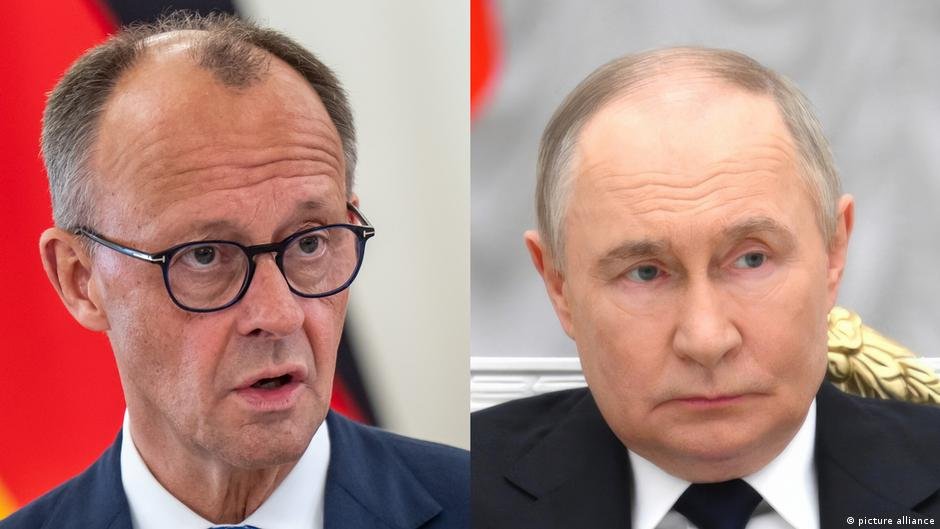
For many years, Germany and Russia had a perfect partnership.
Russia supplied cheap energy, which helped German industry succeed in exporting its goods worldwide. This partnership began in the early 2000s. On the German side was Chancellor Gerhard Schröder from the center-left Social Democratic Party (SPD), followed later by Chancellor Angela Merkel of the conservative Christian Democratic Union (CDU). Their counterpart was Vladimir Putin.
Even when Russia annexed the Ukrainian peninsula of Crimea in 2014, business continued as usual. It was then that the agreement to build Nord Stream 2, a direct gas pipeline between Russia and Germany designed to bypass Ukraine was signed. At the time, other European countries and the US warned that the pipeline would provide Russia with powerful leverage.
The warnings proved to be correct. On February 24, 2022, Russian tanks rolled into Ukraine. German hopes for a stable European order, the democratization of Russia, and the continuation of its lucrative business model were shattered.
To view this video please enable JavaScript, and consider upgrading to a web browser that supports HTML5 video
How could so many German politicians be so wrong?
“Shortly before the invasion, the widespread view was that there were no rational grounds for an attack on Ukraine, because the economic, military, and political costs to Russia of starting a war would be far too high,” Russia expert Mario Baumann of the German Council on Foreign Relations told DW. “People [in Germany] had projected their own rationality onto Russia. They underestimated the regime’s imperialist and revisionist ambitions.”
After that, nothing in the bilateral relationship was ever the same again. Chancellor Olaf Scholz(SPD) spoke of a Zeitenwende (epochal shift) in foreign and security policy, in the days after the 2022 invasion of Ukraine began.
Since then, the German armed forces have expanded. Defense Minister Boris Pistorius said the following year, “We must become capable of waging war,” a statement that critics still say was an escalation of tensions.
Germany ended its decades-long energy dependence on Russia and shut down Nord Stream 2. In September 2022, the pipeline was blown up. The Federal Prosecutor’s Office suspects a Ukrainian group was responsible.
A series of EU sanctions have long since reduced Russian-German trade relations to a minimum. Government cooperation in culture, science, and education has also practically ceased to exist.
A new low point
While the German government under Scholz initially hesitated to take dramatic steps on military aid to Ukraine, Friedrich Merz, then the leader of the opposition, stepped up his rhetoric.
“Ukraine must win the war. Russia must lose the war,” he said in 2024 as leader of the CDU/CSU parliamentary group in parliament. In 2025, as chancellor, he then spoke of Russia’s “economic exhaustion,” which the West must “help bring about.” But that has yet to materialize. To this day, Russia has shown no serious willingness to compromise.
To view this video please enable JavaScript, and consider upgrading to a web browser that supports HTML5 video
Meanwhile, Germany is feeling the consequences of its military support for Ukraine. The German government has long suspected Russia of being behind cyberattacks on government agencies and critical infrastructure.
So when an armed drone was discovered and defused in August 2026 at Leipzig Airport close to Ukrainian transport aircraft — which transport a large portion of the military aid to Ukraine — the government was certain: For the first time, it publicly blamed the Kremlin.
A Russian cultural center in Berlin and the Russian consulate in Bonn were closed, which the German government said were being used as espionage centers. Moscow responded by closing the Goethe Institutes and the German consulate in St. Petersburg.
Putin has denied Russian responsibility for the Leipzig incident, calling it a “serious mistake” to blame Moscow, while Russian Foreign Minister Sergey Lavrov even described the accusations as the “beginning of a real war.” But Baumann says: “We shouldn’t give in to the fears being stoked, because they are part of Russia’s strategy to weaken Germany and Europe.”
AfD wants to resume relations with Russia
The German government is also facing domestic pressure as the far-right Alternative for Germany(AfD) has made gains in regional elections and is rising in the national polls. The AfD would prefer to end support for Ukraine and normalize relations with Russia, including deals on oil and gas. High fuel prices in Germany have only made the issue more explosive.
“German support for Ukraine worries many people,” said Sven Leunig, political scientist at the University of Jena in Thuringia, following the election in the neighboring state of Saxony-Anhalt, where the AfD won the September 6 election by a landslide. However, he noted, “it is less a fundamental rejection of the support itself than a reaction born of fear. People want to ‘stay out’ of the conflict so as not to be drawn into it more deeply themselves.”
In the latest ARD Deutschlandtrend survey, 42% of respondents believe military aid to Ukraine has gone too far. “If public support weakens over the long term, the government will eventually have to respond,” says Leunig.
Carry on or change course?
So far, the German government is sticking to its course, as Merz made clear once again following the AfD’s election victory. But opinions on how to deal with Russia and the war in Ukraine differ not only among politicians but also among political scientists and experts.
Johannes Varwick of Halle University in Saxony-Anhalt believes it is long past time for a change of course: “German and European policy toward Ukraine resembles a mix of platitudes and wishful thinking,” Varwick told DW. “It is high time for a course correction, and Germany should exert pressure on Ukraine to move closer to the latest American proposals, which aim for a compromise and could thus possibly bring about a political solution.”
Baumann, on the other hand, argues: “Supporting Ukraine remains the best investment for safeguarding German and European interests. The government has recognized this and should stick to this course and continue to communicate it as such.” However, it is important that Berlin act in concert with its European partners.
The war in Ukraine has now lasted longer than World War I. And there is no end in sight. Hopes that Russian-German relations will return to the way they used to be seem illusory for the foreseeable future.
This article was translated from German.