https://p.dw.com/p/5PBM5Prefer DW on Google
Skip next section What you need to know
What you need to know
- The Christian Democratic Union (CDU) is meeting on Sunday to finalize its nomination for the next German president
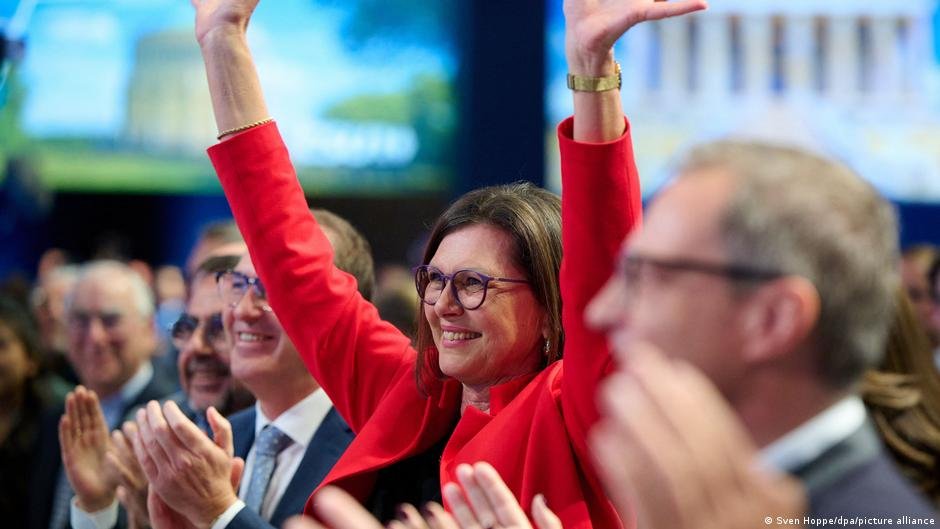
- The CDU is expected to back Ilse Aigner, who is favored by its Bavarian sister party, the Christian Social Union (CSU)
- Iranian opposition politician Reza Pahlavi accepted a ‘Freedom Prize’ in Frankfurt
- More than 18,000 people rallied to show support for Pahlavi, but some others protested
- Defense Minister Boris Pistorius said the voluntary recruitment scheme for the German armed forces seems sufficient at present, with no need for conscription
This is a roundup of the top stories from and about Germany on the weekend of Saturday, November 7, and Sunday, November 8, 2026:
Skip next section Pay gap narrows for women executives11/08/2026November 8, 2026
Pay gap narrows for women executives
Women on the executive boards of Germany’s leading listed companies were earning almost as much on average as their male colleagues in 2025, a study by consultancy EY says.
According to the study, female board members at companies listed on the DAX, MDAX and SDAX indices, not including chief executives, earned an average of €2.20 million ($2.45 million) last year.
That is a rise of 2.4% from 2024.
Their male counterparts, on the other hand, saw a nearly 2% reduction in their pay down to €2.23 million, which reduced the pay gap from €121,000 to €26,000.
The study also found that there were more women serving on executive boards in 2025 than a year previously, with 101 female board members compared with 88 in 2024 and just 33 in 2013.
“Women on executive boards are no longer the exception. That is also reflected in salaries,” said EY partner Jens Massmann.
To view this video please enable JavaScript, and consider upgrading to a web browser that supports HTML5 video
Edited by:Karl Sextonhttps://p.dw.com/p/5PCqDSkip next section CDU committee to meet over presidential nomination11/08/2026November 8, 2026
CDU committee to meet over presidential nomination
The executive committee of Chancellor Friedrich Merz’s Christian Democrats (CDU) is scheduled to meet in the evening to finalize the party’s nomination for the post of German president.
So far, Merz has declined to confirm widespread reports that his party will join with Bavarian allies, the Christian Social Union (CSU), in putting forward Bavarian parliamentary speaker Ilse Aignerfor the job, but he is expected to officially do so at the meeting.
The actual announcement of the choice of the conservative CDU/CSU bloc for a successor to President Frank-Walter Steinmeier will be made on Monday.
The new German head of state is to be chosen on January 30 by a special assembly, the Federal Convention, which comprises all 630 members of the Bundestag and an equal number of electors who represent the state parliaments.
Aigner, 61, who enjoys support from within all the major parties, is seen as have good chances of taking the largely ceremonial job as German head of state.
If she were to become president, she would become the first woman and the first CSU member to hold the position.
Edited by:Karl Sextonhttps://p.dw.com/p/5PCq5Skip next section Welcome back11/08/2026November 8, 2026
Welcome back
We are resuming our coverage of all things Germany after an overnight break.
On the agenda for today: a meeting of leaders from Friedrich Merz’s Christian Democrats, where the chancellor is expected to confirm that his party will join coalition partners in nominating Bavarian parliamentary speaker Ilse Aigner for the post of German president.
Ahead of the anniversary of the 1938 November pogroms on Monday, the head of the Anne Frank Zentrum in Berlin has warned that Holocaust denial is becoming more prevalent among young people.
And a survey has shown that most people in Germany are in favor of both a fuel price cap and a windfall tax on oil corporations.
Read on for more details on these and other stories.
Edited by:Karl Sextonhttps://p.dw.com/p/5PCpgSkip next section Thank you for reading11/07/2026November 7, 2026
Thank you for reading
We’re pausing our blog for today, and we’ll be back tomorrow with the latest headlines out of Germany. Bis zum nächsten Mal!
Edited by:Roshni Majumdarhttps://p.dw.com/p/5PCNnSkip next section Reza Pahlavi receives ‘Freedom Prize’ in Frankfurt11/07/2026November 7, 2026
Reza Pahlavi receives ‘Freedom Prize’ in Frankfurt
Saim Dušan Inayatullah
Iranian opposition leader Reza Pahlavi on Saturday received a “Freedom Prize” in Frankfurt in the central German state of Hesse.
Some 18,000 people rallied to show support for Reza Pahlavi, according to a police statement.
The event was held at St Paul’s Church. The building hosted the Germany’s first-ever elected parliament in 1848-1849, known as the Frankfurt Assembly.
Pahlavi is the son of the last shah of Iran, Mohammed Reza Pahlavi, an autocrat who fled into exile after being deposed in a 1979 revolution.
The 1979 revolution was followed by the transformation of Iran into an Islamic republic and the consolidation of power around the Shiite Muslim clergy.
Pahlavi was handed the prize by the Friedrich Naumann Foundation, which is tied to the pro-business Free Democratic Party (FDP).
Edited by:Roshni Majumdarhttps://p.dw.com/p/5PCNlSkip next section Man allegedly set teenage boy on fire after a fight broke out in Berlin11/07/2026November 7, 2026
Man allegedly set teenage boy on fire after a fight broke out in Berlin
A man allegedly doused an 18-year-old with a flammable liquid and set him on fire in southwest Berlin.
According to a statement issued on Saturday by police in the German capital, the victim was hospitalized with burns.
The 18-year-old had been out with a 17-year-old female companion on Friday evening. An argument broke out with a 24-year-old man who allegedly sexually harassed the woman.
The suspect who was arrested by police reportedly poured flammable liquid over the younger man and set him on fire.
Police were initially unable to say how the fire was extinguished. “He was wearing a jacket,” said a police spokesman.
Emergency services took the 18-year-old to hospital to be treated for burns on his hand and torso.
Edited by:Roshni Majumdarhttps://p.dw.com/p/5PC4HSkip next section Merz refuses to be drawn on presidential candidate11/07/2026November 7, 2026
Merz refuses to be drawn on presidential candidate
Chancellor Merz has declined to confirm media reports that his Christian Democrats (CDU) has agreed with its conservative ally, the Bavarian Christian Social Union (CSU), on the CSU’s Ilse Aigner as nomination for the next German president.
Merz said on Friday only that his party had agreed with the CSU to present its nomination on Monday.
According to media reports, Aigner, the current speaker of the Bavarian state parliament, would be put forward as a joint candidate of the three coalition parties — CDU, CSU and center-left Social Democrats (SPD) — as a successor to President Frank-Walter Steinmeier.
Merz said earlier this week he wanted to see a woman elected as president.
Aigner has also received strong verbal backing from some SPD and Green lawmakers.
If elected by the Federal Convention, which is made up of the lower house of parliament or Bundestag, along with representatives from the 16 federal states, Aigner would become Germany’s first female head of state, and also the first CSU member to hold the position.
Edited by:Roshni Majumdarhttps://p.dw.com/p/5PBmcSkip next section Pistorius expects alternative to French-German fighter jet project soon11/07/2026November 7, 2026
Pistorius expects alternative to French-German fighter jet project soon
In his interview with papers of the Funke media group published on Saturday, Defense Minister Boris Pistorius said he soon expected a replacement for the French-German FCAS fighter jet project that fell flat this year.
Pistorius said he believed that an alternative would be decided on by the end of March 2027, adding that he was very interested in Germany’s aviation industry playing a role in an such project.
He said there were “two options on the table.”
One was “participation in the Global Combat Air Program (GCAP) of the British, Italians and Japanese,” with discussions underway as to whether Germany’s involvement could “lead to a long delay, which would barely be acceptable to all participants.”
The second option, he said, was that the European aerospace company Airbus developed its own project with other European partners for the start of the 2040s.
In October, British Prime Minister Andy Burnham offered Chancellor Friedrich Merz the chance to become involved in the joint development of a new fighter jet within the GCAP program.
To view this video please enable JavaScript, and consider upgrading to a web browser that supports HTML5 video
Edited by:Karl Sextonhttps://p.dw.com/p/5PBf1Skip next section Justice minister backs youth protesters despite recent violence11/07/2026November 7, 2026
Justice minister backs youth protesters despite recent violence
Justice Minister Stefanie Hubig has defended the right of young people to call for their rights in demonstrations, despite the violence that marred last weekend’s Gen Z protests.
“The overwhelming majority of demonstrators were peaceful,” she told the daily Neue Osnabrücker Zeitung.
“And it is young people’s good right to demonstrate on the issues that concern them,” she said, adding that she did not feel that the situation was equivalent to that in neighboring France, where recent protests have been accompanied by considerable rioting.
At the same time, she stressed that looting and violence toward security forces were “serious offenses,” saying that she was already working on a law that would allow harsher penalties for attacks on police and other emergency personnel.
But Hubig spoke out against imposing a general ban on protests that have been planned in two weeks’ time, saying that would send “a completely wrong signal.”
“We are always expecting young people to become actively involved in politics,” she said.
“It is the right of young people to take to the streets and call for better education and social justice.”
Hubig is a member of the center-left Social Democrats (SPD), the junior partner in Germany’s conservative-led coalition government.
Edited by:Karl Sextonhttps://p.dw.com/p/5PBcESkip next section Pistorius voices optimism that conscription will be unnecessary11/07/2026November 7, 2026
Pistorius voices optimism that conscription will be unnecessary
Defense Minister Boris Pistorius has said he believes that the German armed forces, or Bundeswehr, will not need conscripts to achieve the necessary level of recruitment.
Pistorius told newspapers from the Funke media group that the Bundeswehr currently had some 190,000 members, the highest level in 13 years, meaning that voluntary recruitment measures were working.
“If this trajectory continues, we will have no problems with growth,” he said, and there would not have be be “a discussion about conscription of whatever kind.”
He said he understood the concerns of teenagers and young adults who recently protested against the idea of military conscription.
“But when people say at demonstrations, ‘we don’t want to die at the front or in war,’ I can only say: We don’t want that either,” he said.
He said that was precisely the reason why strong armed forces were necessary “that can act as a deterrent so we don’t get into a situation in the first place where we have to fight somewhere.”
Pistorius also said the Bundeswehr, currently male-dominated, was seeking to employ more women, saying the armed forces would be “particularly strong if it represents the breadth of our society.”
To view this video please enable JavaScript, and consider upgrading to a web browser that supports HTML5 video
Edited by:Karl Sextonhttps://p.dw.com/p/5PBMbSkip next section Frankfurt braces for crowds and disruption at Iran protests11/07/2026November 7, 2026
Frankfurt braces for crowds and disruption at Iran protests
The city of Frankfurt am Main is bracing for another day of protests and traffic disruption on Saturday, with large numbers of Iranians expected to hold protests and counterprotests.
The demonstrations are being prompted by the appearance of exiled Iranian opposition politician Reza Pahlavi, who is to receive a peace prize in the name of Iran’s people from the Friedrich Naumann Foundation, which is affiliated with the neoliberal Free Democrats (FDP).
Pahlavi, the son of Iran’s last shah, Mohammad Reza Pahlavi, under whose autocratic rule Iran was governed from 1941 to 1979, was expected to attend a large demonstration in the city’s Ostpark and possibly speak there.
Barriers, loudspeaker towers and a stage have already been set up at the park, which is to be the final destination of a march by demonstration participants.
Counterprotests are also expected amid criticism of Pahlavi’s presence by Iranian organizations, people held in prison under his father’s rule and a number of leftist German parties.
The former German ambassador to the UN, Joachim Rücker, and the erstwhile justice minister, Brigitte Zypries, have also signed an open letter protesting the honor given to Pahlavi.
The last time Pahlavi visited Germany was in April, when he accused Germany and other European countries of standing by while the clerical regime in Iran violently clamped down on protesters.
Frankfurt also saw protests a week ago, with mostly peaceful Gen Z demonstrations calling for better living conditions and education hijacked in the evening by people wanting to loot and vandalize.
To view this video please enable JavaScript, and consider upgrading to a web browser that supports HTML5 video
Edited by:Karl Sextonhttps://p.dw.com/p/5PBMcSkip next section Welcome to our coverage11/07/2026November 7, 2026
Welcome to our coverage
Guten Tag from DW’s newsroom on the banks of the Rhine in Bonn!
Germany’s banking hub of Frankfurt is gearing up for another day of protests after mostly peaceful demonstrations last weekend brought violence and looting on the sidelines.
This time, the focus is not on social and political problems within Germany but on the situation in Iran, with an appearance by Iranian opposition figure Reza Pahlavi likely to cause demonstrations by supporters and critics alike.
Meanwhile, German defense minister Boris Pistorius has expressed satisfaction with the personnel situation in the country’s armed forces, saying that the largely unpopular measure of military conscription will likely not be needed.
Read on here for more on these and other stories connected with Germany.
Edited by:Karl Sextonhttps://p.dw.com/p/5PBNsShow more posts