Skip next section What you need to know
What you need to know
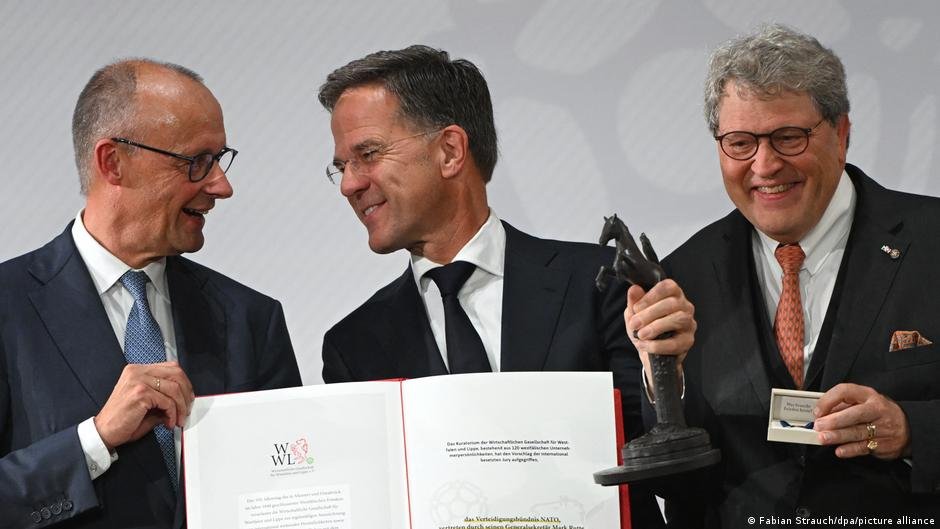
- NATO awarded annual Westphalian Peace Prize in Münster
- The Left Party, the Greens and the Social Democrats (SPD) in Berlin are to test the ground for a possible coalition
- Talks will center on accusations that the Left Party is antisemitic and has links to organized criminality, which it denies
- A fuel tax cut aiming to reduce costs for motorists goes into effect for the second time this year
Here is a rundown of the stories from and about Germany that are hitting the headlines on Thursday, October 1, 2026:
Tired of missing our real-time updates? Click here to add us as a Preferred Source on Google. Then tap the “Star” or “Preferred” to keep DW News at the top of your feed.
Skip next section Germany plans to set up its first drone regiment10/01/2026October 1, 2026
Germany plans to set up its first drone regiment
The German military will establish its first drone regiment next year, Defense Minister Boris Pistorius announced on Thursday evening. This comes as Berlin draws on lessons learned from the war in Ukraine.
“We will establish the Bundeswehr’s first drone regiment in the course of 2027,” the minister said, describing the regiment as “an independent unit for unmanned systems.”
According to Pistorius, the unit will consist of up to 600 members and have a range of up to 500 kilometers.
“Anyone who wants to prevail on land simply has to master the use of unmanned systems,” the minister said.
Germany has been looking to ramp up its military’s use of drones, partly as a result of lessons learned from the war in Ukraine, where drone warfare plays a key role in fighting Russian invasion.
In June, German army chief Christian Freuding announced his intention to rapidly expand the use of drones and unmanned weapon systems during a visit to the Freedom Shield 2026 military exercise in Lithuania.
To view this video please enable JavaScript, and consider upgrading to a web browser that supports HTML5 video
https://p.dw.com/p/5NbbqSkip next section Merz warns: If Germany falters, Ukraine will too10/01/2026October 1, 2026
Merz warns: If Germany falters, Ukraine will too
In a keynote speech on foreign policy, German Chancellor Friedrich Merz issued a stark warning against reducing aid to Ukraine in its defense against Russia.
“If we waver in Germany, then Europe wavers. If Europe wavers, then Ukraine wavers as well,” he cautioned at the ceremony in Münster where the Westphalian Peace Prize was awarded to NATO.
Merz specifically warned that Russia could attack Germany and NATO if Ukraine falls. “If we fail to stop Moscow, then sooner or later, the Russian war machine will turn against us, against NATO itself. We must not turn a blind eye to this danger,” he stressed.
The German chancellor emphasized that without German aid, the war against Ukraine would result in an “imposed peace.” This would lead to mass migration toward the West and the destabilization of the Ukrainian state, according to Merz.
He touched only briefly on the meeting between Foreign Minister Johann Wadephul and Russian Foreign Minister Sergey Lavrov in New York last weekend.
Merz said it was yet another example of how diplomatic efforts fell on deaf ears in Moscow. Russia understands only the “language of strength” and must be brought to the negotiating table through this approach, he stressed.
Merz said “unity and strength remain prerequisites for successful negotiations with Moscow. And this can only encourage us to keep the United States of America by our side in our policy regarding Ukraine”.
Merz calls for unity against AfD
Merz said that a united front is also needed in Germany, where the far-right Alternative for Germany party (AfD) has seen significant success in recent state elections and currently leads in nationwide polls.
“We in Germany, too, will not allow ourselves to be divided,” Merz said. “Not by hybrid attacks, not by social media agitation driven by Moscow-controlled bots, and… not by the slogans of the AfD and its Russian backers.”
The AfD wants Berlin to stop providing military and financial support to Ukraine, lift sanctions against Russia, and restore dialogue.
What is Westphalian Peace Prize?
The Westphalian Peace Prize is awarded every two years by the Economic Society for Westphalia and Lippe (WWL).
The award commemorates the Peace of Westphalia of 1648, which was concluded in the town halls of Münster and Osnabrück.
It brought an end to the Thirty Years’ War and is regarded as a contribution to the European peace order among states with equal rights.
This year, NATO was honored for its contribution to the European peace order.
https://p.dw.com/p/5NbQiSkip next section Dutch shipyard group Damen seeks €4.7 billion from Germany over frigate project halt10/01/2026October 1, 2026
Dutch shipyard group Damen seeks €4.7 billion from Germany over frigate project halt
Damen, a Dutch defense and shipbuilding conglomerate, is seeking €4.7 billion (about $5.30 billion) from the German government after it cancelled plans to produce F126 warships.
In June, the German Defense Ministry announced that it would terminate the multi-billion-euro project to build F126 frigates.
The ministry said it would instead buy eight MEKO A-200 frigates from TKMS (Thyssen Krupp Marine System), which is headquartered in Kiel, northern Germany.
The amount sought by Damen comprises the contractually agreed payment and compensation for what the Dutch company says was a breach of contract by the German government, according to a letter sent to two parliamentary (Bundestag) committees and seen by the Reuters news agency.
Damen is also exploring potential additional claims for damages, the letter said.
The Dutch company said the German government was responsible for delays to the project.
https://p.dw.com/p/5NapjSkip next section Ferry services suspended in part of Lake Constance10/01/2026October 1, 2026
Ferry services suspended in part of Lake Constance
Low water levels in Lake Constance have forced boat services in one section of the waterway to be suspended, the municipal utility company in the southern German city of Konstanz said on Thursday.
The ferry operator, Bodensee-Schiffsbetriebe (BSB), has suspended services on the Untersee region until further notice, it said.
In a statement, BSB chief Frank Weber was cited as saying: “We have kept the ferry service running right down to the last centimeter. We have now reached the point where the risk of getting stuck in the harbor entrance has become too great.”
The service had to be suspended to protect passengers and the ships, it continued.
The lake, which is known as the Bodensee in German, borders Germany, Austria and Switzerland.
The water gauge for the lake is currently measuring 251 cm (99 inches), 108 cm under the mean level of 359 cm for this day of the year as measured over many years.
A long period of dry weather has forced tourist and cargo ships in other waterways across Germany to reduce or suspend services.
Cargo shipping on the Rhine has been particularly affected, with negative consequences for several industries that depend on river-borne supplies of raw materials.
To view this video please enable JavaScript, and consider upgrading to a web browser that supports HTML5 video
https://p.dw.com/p/5NaIZSkip next section IN DEPTH: Survey reveals Germans’ greatest fear 10/01/2026October 1, 2026
IN DEPTH: Survey reveals Germans’ greatest fear
An insurance company has carried out a survey to discover what people in Germany are most scared of.
And it is neither fascism, nor the climate crisis, nor spiders, nor Elon Musk, but — the cost of living.
Read our article to find out more: Germans’ biggest fear is the high cost of living, an annual study finds
https://p.dw.com/p/5NZxkSkip next section Afghans denied entry despite Constitutional Court ruling10/01/2026October 1, 2026
Afghans denied entry despite Constitutional Court ruling
The German government has so far not granted entry to any Afghan nationals on a humanitarian list drawn up by the previous government, despite examining more than two dozen individual cases in keeping with a ruling by the Constitutional Court.
In response to a parliamentary question by Left Party politician Clara Bünger, the Interior Ministry said 25 cases had been examined since the court ruling on July 22, but all had been rejected.
After the Taliban retook power in Afghanistan in August 2021, the previous coalition government of Social Democrats (SPD), Greens and Free Democrats (FDP) had promised to grant entry to Afghan nationals who had worked for German institutions there or who were seen as endangered.
The current conservative-led government paused that program in May 2025 and in December 2025, the Interior Ministry rescinded all entry permissions that had been given under the scheme, saying there was “no political interest” in taking the people in.
The Federal Constitutional Court however ruled in July that Germany could not revoke the scheme en masse and that admission requests had to be considered on a case-to-case basis.
Bünger called on the government “to take in the some 500 people still in question immediately and in an uncomplicated manner.”
She said the fact that these Afghan nationals had been forced to live for years in fear and uncertainty was unjustifiable.
To view this video please enable JavaScript, and consider upgrading to a web browser that supports HTML5 video
https://p.dw.com/p/5NZl2Skip next section Poland to extend controls on German border10/01/2026October 1, 2026
Poland to extend controls on German border
Poland says it will extend controls along its border with Germany by six months until March 30 next year.
The Polish Interior Ministry said it would also be extending the measure, introduced in July 2025, on the border to Lithuania.
“Border controls are an effective tool for curbing illegal migration. Extending them will make it possible to manage migration pressure and strengthen border security,” the ministry said in a statement.
Since the reintroduction of border controls, nearly 1,300 people have been denied entry into the country at the Lithuanian border and nearly 1,200 at the German border, the statement said.
Germany has also had additional border controls in place at all its entry points since September 2024.
The border controls have been imposed even though Poland and Germany are members of the EU’s Schengen Area, in which borders are theoretically meant to be open to allow seamless travel between EU members.
Under the Schengen Borders Code (SBC), member states are allowed to only temporarily reintroduce border controls in the case of security threats.
Both Poland and Germany have cited the threat of illegal immigration as having prompted the reinstatement of the controls.
https://p.dw.com/p/5NZFNSkip next section Fuel tax cut goes into force10/01/2026October 1, 2026
Fuel tax cut goes into force
A three-month fuel tax cut went into effect in Germany at midnight on Wednesday, with motorists now likely to pay prices for gas and diesel that are lower by 16.7 cents (18.9 US cents) per liter in the coming weeks.
Prices before the cut went into effect were well over €2 per liter in most places, with September the most expensive month on record at the pump.
The same measure was introduced in Germany in May and June to give relief to motorists as fuel prices spiral largely as a result of the war in the Middle East.
The tax cut technically applies only to fuel leaving storage facilities or refineries, with gas stations not directly required to lower their prices.
However, prices at most filling stations are expected to fall quickly, as happened in May and June.
Critic of the measure say it reduces incentives to save fuel and will potentially not be passed on in full to all consumers.
Supporters say it is currently the best way to relieve the burden on motorists.
https://p.dw.com/p/5NYwpSkip next section NATO to receive German peace prize10/01/2026October 1, 2026
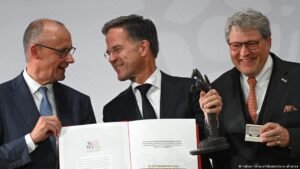
NATO to receive German peace prize
NATO is to be awarded with international Westphalian Peace Prize, worth €100,000 ($113,350), on Thursday afternoon, with Chancellor Friedrich Merz set to give the laudatory address.
The prize, which is expected to be received by NATO Secretary General Mark Rutte at the ceremony in Münster, honors the military alliance for its contribution to the European peace order.
The award is being presented to NATO at a time when its role as guarantor of Europe’s security has been cast into some uncertainty by US ambivalence under the Trump administration.
The Westphalian Peace Price, which commemorates the Peace of Westphalia of 1648, is awarded every two years by the Economic Society for Westphalia and Lippe.
The 1648 peace agreement, concluded in the city halls of Münster and Osnabrück, ended the Thirty Years’ War and is considered by many as a milestone in establishing the principle of national sovereignty.
https://p.dw.com/p/5NYkmSkip next section Sahra Wagenknecht Alliance changes its name10/01/2026October 1, 2026
Sahra Wagenknecht Alliance changes its name
The populist Sahra Wagenknecht Alliance (BSW) has officially dropped its founder’s name from its title to become the Alliance for Social Justice and Economic Reason.
However, it will retain the abbreviation BSW.
Secretary general Oliver Ruhnert said Wagenknecht’s name had initially been used because of her popularity but that the party had now succeeded in establishing itself as a brand in its own right.
Wagenknecht, a former parliamentary leader of the Left Party, founded the BSW in 2024, stepping down as its leader in November 2025.
Although the BSW advocates economic policies that are left-wing, it also has a nationalist and anti-migration stance that are more typical of the right-wing political spectrum, making it hard to classify in conventional terms.
It also favors closer ties with Russia.
https://p.dw.com/p/5NYgVSkip next section Suspected IS member arrested10/01/2026October 1, 2026
Suspected IS member arrested
Federal police arrested a suspected member of the “Islamic State” (IS) terrorist group in central Germany on Wednesday morning.
Prosecutors allege that the man joined the group in Iraq at the latest by early 2016, fighting in its ranks until early 2017.
He was detained in the Waldeck-Frankenberg district, north of Frankfurt, and is now being held in pre-trial detention after appearing at the Federal Court of Justice in Karlsruhe.
https://p.dw.com/p/5NYfkSkip next section Berlin Left Party, Greens and SPD meet for clarifying talks 10/01/2026October 1, 2026
Berlin Left Party, Greens and SPD meet for clarifying talks
Politicians from the socialist Left Party, the environmentalist Greens and the center-left Social Democrats (SPD) in Berlin are set to meet on Thursday to talk through several contentious issues before embarking on possible coalition negotiations.
Among other things, the talks will focus on accusations of antisemitism leveled at the Left Party, which won recent elections.
The party has also been accused of cultivating links to organized crime.
The accusations were fueled by the attendance by the head of an Arab clan with alleged criminal ties and a controversial pro-Palestinian activists at an election night event held by the Left Party in the Neukölln district of the city on September 20.
The Greens and the Left Party have said reaching agreement on these contentious issues is a “basic prerequisite” if formal exploratory talks on a coalition are to begin.
If the Left Party were to end up leading a coalition in the German capital, its lead candidate and parliamentary group co-leader, Elif Eralp, could become the first female governing mayor of Berlin.
https://p.dw.com/p/5NYfESkip next section Welcome to our coverage10/01/2026October 1, 2026
Welcome to our coverage
A hearty guten Tag from the DW newsroom in Bonn as the new month gets underway!
We will be looking at the pre-preliminary talks between the Left Party, the Greens and the Social Democrats (SPD) on possibly forming a coalition in the capital, Berlin.
The parties are approaching the matter with great caution amid accusations that the Left Party, which won recent elections, is antisemitic and maintains contacts with organized criminality.
This comes as another party, the populist Sahra Wagenknecht Alliance (BSW), changes its name to the catchy “Alliance for Social Justice and Economic Reason”, while retaining the BSW abbreviation.
Meanwhile, motorists should be seeing prices at gas stations take a sudden fall as a fuel tax cut goes into effect.
Read on to find out more about these and other German stories.
https://p.dw.com/p/5NYbHShow more posts