Skip next section What you need to know
What you need to know
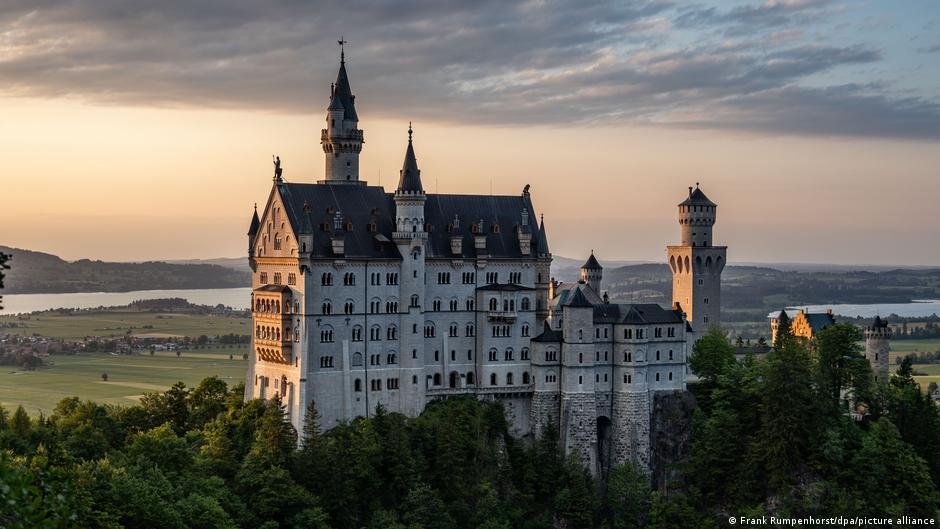
- A US man who carried out a murder at the famous Neuschwanstein Castle says he fears the death penalty if he is extradited
- Some 100 people died from drowning in Germany in June
- A study says 25 to 30% fewer people would die on the motorway if a 130kmh(81mph speed limit were introduced
- Temperatures in some parts of Germany are forecast to soar to 38 degrees Celsius (100.4 F) in the course of the week
- German business leaders and politicians want climate targets pushed back from 2045 to 2050 in line with the EU
- The far-right Alternative for Germany (AfD) has presented a 100-day plan outlining its intended actions if it wins power in the state of Saxony-Anhalt in September
DW brings you the top stories from and about Germany on Saturday, July 11, and Sunday, July 12.
Tired of missing our real-time updates? Click here to add us as a Preferred Source on Google. Then tap the “Star” or “Preferred” to keep DW News at the top of your feed.
Skip next section Drowning fatalities hit 23-year high in June07/12/2026July 12, 2026
Drowning fatalities hit 23-year high in June
At least 99 people drowned in Germany in June, the highest number in 23 years, the German Lifesaving Association (DLRG) said on Sunday.
It said most of those who drowned were 30 years old and under, while more than 90% were male.
“It is mostly men who take too many risks and underestimate dangers. They also go into the water in a state of intoxication from alcohol or other drugs,” DLRG President Ute Vogt said.
Altogether, 55 of the drownings occurred in lakes, with 21 taking place in rivers and six in swimming pools, the sea and canals, respectively.
Most of the deaths were in the two states with the highest populations, North Rhine-Westphalia (22) in the west and Bavaria (21) in the south.
Germany, along with much of western Europe, suffered a severe heat wave at the end of June that saw temperatures climb above 40 C (104 F) in several regions.
https://p.dw.com/p/5GxPFSkip next section Neuschwanstein killer contests extradition back to USPublished 07/12/2026Published July 12, 2026last updated 07/12/2026last updated July 12, 2026
Neuschwanstein killer contests extradition back to US
A 33-year-old US man who has been convicted of the rape and murder of a fellow US tourist near Neuschwanstein Castle three years ago has objected to his ordered extradition, saying he might face the death penalty in his homeland.
In his lawsuit against the order at the administrative court in Augsburg, he has argued that if he returns to the United States, he could face another trial for the crimes, which could result in a death sentence.
The man is currently serving a life sentence in Germany for the murder and rape of the tourist, as well as the attempted murder of a second woman. The regional office of foreign affairs later issued a deportation order against him.
However, in this case, as a “particular severity of guilt” was found in the judgment against the man, he could possibly remain in prison for 20 to 25 years under German law.
That would mean that a deportation order would not be enforced for around two decades.
A spokesman for the Kempten public prosecutor’s office said there was currently no review procedure on whether he could be deported from prison.
The crime was widely reported around the world because of the famous site where it was committed.
https://p.dw.com/p/5GxN1Skip next section Welcome back to our coverage07/12/2026July 12, 2026
Welcome back to our coverage
Timothy Jones | Karl Sexton Editor
The DW newsroom in Bonn says guten Tag to all DW users as it resumes its coverage of all things German.
As already mentioned, the weather has moved from warm to uncomfortably hot in much of the country, making the prospect of a swim all the more enticing to many.
But we urge everyone to be careful in the water as news comes in that June saw the highest number of drownings in Germany in 23 years.
Germany’s ailing railway system — probably the most-complained-about aspect of life in the country — is (once more) in focus in this blog as the transport minister warns passengers that improvements to punctuality will take some time.
And a study on another mode of transport, car travel, shows that a 130 kmh/81 mph speed limit on Germany’s famous autobahn would cut the number of fatalities there by at least a quarter.
We wish you a pleasant reading journey in our Germany news blog!
https://p.dw.com/p/5GxKHSkip next section This blog is on pause07/11/2026July 11, 2026
This blog is on pause
We are pausing our coverage for now. Join us again on Sunday morning for more coverage of the German news and analysis.
https://p.dw.com/p/5GwK2Skip next section WATCH: How Nazi party membership records are rewriting family histories07/11/2026July 11, 2026
WATCH: How Nazi party membership records are rewriting family histories
The Nazi Party membership records are published online by the US National Archives.
The files are now giving answers to the question of millions of Germans: Were my grandparents Nazis?
https://p.dw.com/p/5Gw1dSkip next section Germany’s Pretzel festival: 111 people try to move 111-ton train07/11/2026July 11, 2026
Germany’s Pretzel festival: 111 people try to move 111-ton train
111 people set out to pull a 111-ton train at a distance of 111 meters — did it work?
Organizers said this collective feat of human strength during the Brezelfest — a festival dedicated to pretzels — in Speyer, a city in Rhineland-Palatinate in southwestern Germany, went smoothly.
“The locomotive reached the finish line in just over two minutes. Everyone was surprised at how quickly the whole thing went,” Uwe Wöhlert, chairman of the Speyer Tourism Association, told dpa.
Nineteen teams from the region, ranging from weightlifters and wrestlers to municipal utilities and government officials, participated in the event.
The organizers had registered the challenge as a world record attempt. They plan to submit an application to the Record Institute for Germany (RID). A notary public observed the event.
https://p.dw.com/p/5GwDJSkip next section IN DEPTH: Germany’s richest man takes on Big Tech07/11/2026July 11, 2026
IN DEPTH: Germany’s richest man takes on Big Tech
Dieter Schwarz made his fortune from supermarkets, becoming Germany’s wealthiest person. Now he wants to take on Google, Microsoft and Amazon, and an entire region stands to benefit.
Read more to find out if Schwarz Digits, the IT and digital division of Schwarz Group, can hold its own against US tech giants.
https://p.dw.com/p/5Gw1gSkip next section Hamburg-Hanover rail line reopens after renovation07/11/2026July 11, 2026
Hamburg-Hanover rail line reopens after renovation
The Hamburg-Hanover line, one of the busiest railway routes in Germany, was back in operation on Saturday after major renovation works.
Since May 1, the entire line between Hanover, the capital of the northern state of Lower Saxony, and Hamburg, Germany’s second largest city, had been closed to train traffic.
The route is essential for linking northern and southern Germany, for commuters and for freight transport to and from the Port of Hamburg.
Over the past 10 weeks, 81 kilometers of track, 44 sets of points, four stations and two large railway bridges were renewed along the 163-kilometre route. Deutsche Bahn said that around €300 million ($342 million) was invested in the project.
The company plans to address urgent works needed before the comprehensive refurbishment due in 2029.
https://p.dw.com/p/5GvygSkip next section German Football Federation close to signing Klopp as head coach07/11/2026July 11, 2026
German Football Federation close to signing Klopp as head coach
The German Football Federation (DFB) said Saturday that it had reached agreement with Jürgen Klopp over the terms of a contract that would make him head coach of the country’s men’s national football team through the completion of the 2030 World Cup.
The announcement cited DFB leadership’s “first in-depth discussion with Jürgen Klopp yesterday in New York.”
“During this constructive exchange,” the statement continued, “an understanding was reached on the key points of a potential contract. The talks will continue next week. Both sides are confident that the negotiations — subject to an agreement with Klopp’s current employer, Red Bull — can ultimately be successfully concluded.”
Klopp will reportedly receive an annual salary exceeding the €7 million ($7.9 million) that former national trainer Julian Nagelsmann received while coaching the German national team to an early exit from this year’s tournament.
Klopp, a successful Bundesliga and English Premiere League coach who is currently in the US as a TV commentator for this year’s World Cup, is under contract at Red Bull until 2029.
The head of the Austrian energy drink giant’s international football program, Klopp would reportedly stay on as a brand spokesman for Red Bull while serving as Germany’s Bundestrainer.
https://p.dw.com/p/5GvxHSkip next section Authorities suspect sabotage after railway fire disrupts services07/11/2026July 11, 2026
Authorities suspect sabotage after railway fire disrupts services
Dmytro Hubenko Editor
Authorities said a fire that damaged signalling cables on a major railway line in western Germany on Friday was likely a deliberate act of sabotage.
The fire broke out near the tracks on the route between Düsseldorf and Cologne, causing operations to be halted on that section of line, with disruptions lasting into Saturday.
A Cologne police spokesman said investigators were looking into whether a criminal offense had been committed.
A spokesman from national rail operator Deutsche Bahn told the dpa news agency that repair work on the affected section, between Langenfeld and Leverkusen, is set to continue until at least Saturday afternoon.
Read more about the left-wing German group that claimed responsibility for the railway sabotage.
https://p.dw.com/p/5GvYwSkip next section Far-right AfD confirms Saxony-Anhalt party leader in office07/11/2026July 11, 2026
Far-right AfD confirms Saxony-Anhalt party leader in office
Delegates at the congress of the Saxony-Anhalt chapter of the far-right Alternative for Germany (AfD) party have reelected Martin Reichardt as state leader despite a controversy over an alleged Nazi salute.
Reichart received around 89% of the vote, with 191 delegates casting a ballot at the congress in the state capital, Magdeburg.
A photo from 2020 taken at a party shows Reichardt stretching out his left arm in what two witnesses described to the news portal Politico as a Nazi salute, a gesture banned in Germany, even when performed with the left arm.
Reichardt has denied any wrongdoing, saying the gesture was one of conferring a mock knighthood.
Police in the German city of Erfurt also looked into Reichardt in 2023 after he described President Frank-Walter Steinmeier as “one of the worst dividers and agitators in German history.” The investigation was later dropped.
The party has been classified as “certified right-wing extremist” by the state branch of Germany’s domestic intelligence agency, theBfV.
The classification means that the party can be monitored by the BfV, which the AfD, however, says is an agency instrumentalized by the government to quell opposition.
Despite Reichardt being the party’s leader in the state, the AfD is fielding his colleague, Ulrich Siegmund, as its candidate for the September state elections.
https://p.dw.com/p/5GvVHSkip next section AfD presents 100-day plan for Saxony-Anhalt07/11/2026July 11, 2026
AfD presents 100-day plan for Saxony-Anhalt
Ulrich Siegmund, the candidate for the far-right Alternative for Germany (AfD) party at September elections in the eastern state of Saxony-Anhalt, has detailed what the party plans to do in its first 100 days in office should it win power.
Polls in the state currently show the party well ahead of the conservative Christian Democrats of Chancellor Friedrich Merz.
What is the AfD planning to do if it wins in Saxony-Anhalt?
Among other things, Siegmund said the AfD would:
- Cancel the public broadcasting agreement with state broadcasters such as the ARD and ZDF, which the party has claimed are leftist-oriented government mouthpieces
- Increase the number of deportations of failed asylum-seekers and expand immigration detention centers
- Force asylum-seekers to work and establish special schools for their children
- Deploy security personnel at schools seen as problematic
- Make homeschooling, which is otherwise mostly banned in Germany, an option for parents, although a two-thirds majority would be required in the state parliament to make that change
- Abolish inclusion in education, meaning that special needs pupils would have to attend separate schools
- Require German flags to be hoisted every day at schools, while rainbow flags symbolizing the acceptance of diversity would be banned
- Establish an investigative committee to look into the federal government’s management of the coronavirus pandemic, with the AfD in particular objecting to its promotion of vaccines and face masks as preventive measures, despite the fact that medical experts consider them the most effective ways of combating COVID-19.
Experts have said that many of the AfD’s proposals will face a number of legal and logistical hurdles.
https://p.dw.com/p/5GvSbSkip next section Merkel portrait draws visitor hordes to Berlin museum07/11/2026July 11, 2026
Merkel portrait draws visitor hordes to Berlin museum
A new portrait of former German Chancellor Angela Merkel has attracted a flood of visitors to Berlin’s Bode Museum since it went on display on July 1.
Visitor numbers have shot up dramatically since the picture has been shown at the museum, a spokesman said.
“The daily visitor count is, on average, 85% higher than in June,” the spokesman said, adding that there are currently around 900 visits a day.
The portrait was painted by the 28-year-old Franco-German artist Jeremie Queyras, who grew up in the southern German city of Freiburg. He was given the commission after submitting a handwritten application to Merkel in 2022.
Merkel was chancellor of Germany for 16 years, from 2005 to 2016, and enjoyed wide popularity during that time.
Her portrait can be admired at the museum until October 4, when it will be loaned to the chancellery.
The Bode Museum, situated on Berlin’s Museum Island, is named for the famous art historian Wilhelm von Bode (1845-1929), who greatly influenced the art museum landscape in the capital and beyond.
It houses notable collections of sculptures, sculpture, Byzantine art and coins and medals.
https://p.dw.com/p/5GvOoSkip next section IN DEPTH: Adapting German housing to the new heat reality07/11/2026July 11, 2026
IN DEPTH: Adapting German housing to the new heat reality
Houses in Germany have long been built rather to keep heat in rather than out.
But as the Earth warms and heat waves become more frequent and severe, a rethink is needed.
In this article, DW looks at some of the possible ways apartments could be adapted to keep residents cooler: Heat-resistant housing: How we need to adapt our homes
https://p.dw.com/p/5GvN1Skip next section Far-right AfD to unveil 100-day action plan for Saxony-Anhalt07/11/2026July 11, 2026
Far-right AfD to unveil 100-day action plan for Saxony-Anhalt
The far-right Alternative for Germany (AfD) party is set to present a plan outlining the initial actions it proposes to take if elected to power in Saxony-Anhalt in September.
The party, which is being monitored by Germany’s domestic intelligence agency for right-wing-extremist tendencies, is leading polls in the eastern state, well ahead of Chancellor Friedrich Merz‘s conservative Christian Democrats (CDU).
Among other things, the AfD has already vowed to force asylum seekers to work and to expand immigration detention.
It has also announced plans to replace some 200 public service officials in the state with its own favored appointees.
Experts say, however, that many of the AfD’s plans could face considerable legal and logistical challenges.
The party congress in the state capital, Magdeburg, is due to begin at 10 a.m. (0800 GMT).
A congress of the AfD chapter in the western state of North Rhine-Westphalia is also due to start on Saturday and run through Sunday.
https://p.dw.com/p/5Gv66Show more posts
About The Author